

Oksana Kovalenko
Language-learning writer · Published May 22, 2026
Learn English Online: A Free, Course-Free Guide for Adults
Most “free English courses for adults” online are either pitched at absolute beginners learning the alphabet, or they’re a free trial that ends with a paywall on lesson three. If you’re an adult who can already read this page comfortably, you don’t need a course — you need a working setup of free resources that fit around a job, a family, and the fact that you’ve already tried Duolingo and quit.
This guide is for that learner. Honest about what free resources can do, honest about where a paid course or tutor actually earns the money, and built around how adult brains and adult schedules actually work.
The adult learner reality nobody mentions

Online English courses are mostly built on the same assumption: you have a fixed slot in your week, you’ll follow a sequence of lessons, and you’ll be motivated by progress badges. That worked for the version of you that was in school. It mostly doesn’t work now.
A few things are true about adult English learners that most platforms ignore:
You have no time for a 90-minute evening class. You have fifteen minutes before a meeting, twenty minutes on the train, an hour while cooking. The class format is wrong even before the content starts.
You hate gamification. Or, more precisely, you tolerated it for a month and then noticed you were maintaining a streak instead of learning. The little blue owl made you defensive. You uninstalled.
You already know “intermediate.” You can read English news, you can mostly follow YouTube, you can write a workable email. What you can’t do is speak smoothly, catch every word in a Netflix show, or sound like an adult professional rather than a polite student. That’s not a beginner course problem.
Your goals are specific. You want to do your job in English, watch the things you want to watch, travel without rehearsing sentences, or finally pass a job interview without your accent doing the talking for you.
You don’t need a certificate. Unless you specifically need one (visa, university, a particular employer), the certificate at the end of a free course is mostly decoration. Recruiters look at how you sound on the call.
If those describe you, the section below is the part of the internet you’ve been looking for.
Free legit resources, ranked by what they actually do
There are hundreds of “free English course” listings. Most of them recycle the same five sites. Here’s the short list of what’s both free and actually useful for B1–C1 learners.
Free structured platforms
Cambridge English – LearnEnglish. Cambridge’s own free site. Hundreds of audio lessons grouped by CEFR level, all with transcripts. Less flashy than Duolingo, much closer to how language is actually taught at universities.
British Council – LearnEnglish. Same idea, BBC-funded, very organized. Skills sections for grammar, vocabulary, listening, reading. Good for filling specific holes — for example, you want to drill conditionals or finally understand the present perfect once and for all.
USA Learns. A free U.S. government-funded course aimed at adult immigrants. Three courses run from beginner to intermediate. It’s slow but legitimate. Best for A2–B1 learners who want structure without paying.
ESOL Courses. Free British platform, large library of small lessons. Topical (cooking, travel, work), with audio and transcripts. Useful as a buffet, not a curriculum.
Alison. Free online courses with certificates available for a small fee. Wide range of English topics including business English, IELTS prep, and conversational English. Pick individual modules, not whole courses.
Coursera and edX. Both host university-made English courses, most of them free to audit (you pay only if you want the certificate). University of Pennsylvania, Tsinghua, and the British Council all have material here. Stronger for academic and business English than for everyday speaking.
Free YouTube channels worth your time
YouTube is the most underrated “free English course” on earth. Some channels worth keeping in your subscriptions:
- BBC Learning English. The grandfather of online English. Their 6 Minute English and English in a Minute series are short enough to do daily.
- English with Lucy. Clear British English, pronunciation breakdowns, vocabulary in real contexts.
- Rachel’s English. The gold standard for American pronunciation. If your accent is the main thing holding you back, start here.
- mmmEnglish. Solid grammar and speaking explanations from an Australian teacher, leaning toward B1–B2.
- Real English with Real Teachers. Two American teachers, conversational, lots of expressions you’d actually hear in the wild.
- EngVid. Older library, dozens of teachers, focused on specific points (phrasal verbs, business English, IELTS).
- TED-Ed. Five-minute animated lessons. Subjects beyond language, but clear scripted English with subtitles.
- Let’s Talk – Free English Lessons. Indian English platform, useful for global business English speakers.
Free podcasts with transcripts
Transcripts matter. A podcast you can’t verify is entertainment; a podcast with a transcript is a lesson.
- The English We Speak (BBC). Six minutes per episode, focuses on a single idiom or phrase. B1.
- Luke’s English Podcast. Long-form, often 60+ minutes, free transcripts on the site. B1–B2.
- Espresso English Podcast. Short bursts on specific topics, easy on the ears. B1.
- All Ears English. American hosts, conversational, focus on common expressions. B1–B2.
- The Daily (NYT). News podcast, full transcripts. B2.
- Planet Money (NPR). Economics stories told accessibly. B2.
- This American Life. Storytelling at its best, transcripts available. B2–C1.
- 99% Invisible. Design and culture stories. B2.
Free reading sources
- Project Gutenberg for any pre-1928 classic.
- Open Library for borrowing modern e-books with a library card.
- The Guardian, BBC, NPR. All free, all clean English.
- The Atlantic (limited monthly free articles), Vox, Aeon Magazine for long-form essays.
- Medium for personal essays and tech writing — varied quality but free.
- Newsela for news rewritten at different difficulty levels — handy if real news still bites.
Free speaking tools
- Tandem and HelloTalk. Language-exchange apps. You teach someone your language for half the call, they help you with English.
- Discord servers. Search for “English language exchange” — many free communities with daily voice chats.
- ChatGPT and Claude. Free tiers are enough for daily written practice. Ask one to roleplay a job interview, a customer support call, a phone reservation. Not a replacement for human speakers, but the friction-to-start ratio is unbeatable.
When courses actually help
Free resources cover 90% of the path to C1 if you use them well. The 10% that’s worth paying for is usually one of these:
Pronunciation, when it’s really stuck. If natives keep asking you to repeat yourself, a structured pronunciation course (Rachel’s English Academy, mmmEnglish’s Lady program, or 10 hours with a one-on-one tutor) earns its money fast.
Exam prep with a hard deadline. IELTS, TOEFL, Cambridge Advanced. You need a course because the test rewards specific tactics that aren’t intuitive. Free resources are too scattered to get you exam-ready in two months. Magoosh, E2 Test Prep, and the official Cambridge prep books are worth the spend.
Business English for a specific job. If a promotion or a new role hinges on running meetings in English, a focused short course (LinkedIn Learning, Coursera’s specializations, Preply tutors with business focus) is faster than reverse-engineering from podcasts.
Speaking confidence past a wall. When you understand everything but freeze when you open your mouth, what you need isn’t more content — it’s reps with a forgiving human. Two months of weekly tutor sessions on iTalki, total cost $60–$150, almost always cracks it.
When courses do not help
Most adult learners who pay for general “English courses” don’t get their money’s worth. The course doesn’t help when:
You’re already past the level the course is built for. A “complete English course” almost always starts at A1 and ends mid-B1. If you’re a B2 learner, you’ll spend the first ten lessons bored and not buy the next ten.
The course is built around grammar drills. Adults past A2 don’t grow from drill-and-kill. They grow from contact with real language and from producing it themselves.
You bought the course as a commitment device. Paying for something to force yourself to use it works for gym memberships and not much else. Most paid courses get half-finished. If you wouldn’t use the free version, you won’t use the paid one either.
It’s a Duolingo-style daily-quest format. Streak-based products are entertainment with a vocabulary skin on top. Not bad, not learning either.
A self-paced structure that actually fits adults
You don’t need a curriculum. You need five inputs distributed across your week. Treat this as a pattern, not a schedule.
Daily inputs (15–25 minutes total):
- One short podcast on the commute, or while doing dishes.
- 15 minutes of vocabulary review for words you saved earlier in the week.
Weekly inputs (5–7 hours, split however you want):
- Two longer listening sessions (a Netflix episode, a long podcast, a YouTube documentary).
- Two reading sessions (chapters of a novel, articles from your usual sites).
- One speaking session (a tutor, a tandem partner, a Discord call, or shadowing a clip).
- One writing burst (a journal entry, an email to a tutor, a short essay).
- One self-check (record yourself, take a free placement test, read aloud for two minutes).
This is what a “course for adults” should be: a system, not a schedule. Each piece is replaceable. If you hate writing, increase speaking. If your reading is already strong, increase listening. The structure stays, the inputs swap.
Sample week, real-life version:
- Monday: 25-minute commute podcast (The Daily). Lunch — 10 minutes of vocab review.
- Tuesday: 30 minutes reading a chapter at bedtime.
- Wednesday: 25-minute commute podcast (a second listen of Monday’s episode). Evening — 30-minute iTalki call.
- Thursday: 20-minute lunch YouTube video (something you’d watch anyway). 30 minutes reading.
- Friday: 25-minute commute podcast (something new). 10 minutes of vocab.
- Saturday: 60-minute Netflix episode, English subtitles. 20 minutes of writing about your week.
- Sunday: 30 minutes of shadowing practice. 45-minute iTalki call.
Roughly seven hours, distributed in pieces you wouldn’t otherwise notice. No 90-minute evening class.
Certificates versus real fluency
If you don’t need a certificate, don’t chase one. The “free English course with certificate” search is mostly a trap — you spend forty hours getting a PDF nobody respects instead of forty hours getting actually better.
If you do need a certificate, here are the ones that count:
- Cambridge B2 First, C1 Advanced, C2 Proficiency. Recognized by universities and employers worldwide. Paid exams; no free version of the credential itself. Worth it if applying to a UK or European university.
- IELTS. Standard for English-speaking universities and visa applications.
- TOEFL. U.S.-centric university admissions.
- Duolingo English Test. Online proctored, $59, increasingly accepted by U.S. universities. Worth knowing exists.
- Cambridge BEC (Business English Certificates). Useful in some European markets for corporate jobs.
What doesn’t count: random PDF certificates from platforms most recruiters have never heard of. Coursera and Alison certificates are fine for LinkedIn decoration but won’t move a hiring decision. If a job needs proof of English, they’ll either ask for a Cambridge/IELTS score or just put you on a call.
The harsher truth: fluency is its own credential. If you can run a thirty-minute interview in clean English, no one asks where your certificate is.
Common mistakes adult learners make with free resources
Collecting platforms. Signing up to five free courses, finishing none. The platform is not the problem. Pick one, use it for a month, then decide.
Treating YouTube as endless and therefore equal. Some channels teach; some perform. If a channel is mostly the teacher’s face and personality, you’re entertained, not learning. Channels that work tend to be sparse on graphics and heavy on actual language use.
Skipping the speaking part because it costs money or feels weird. Tandem and HelloTalk are free. Cambly and iTalki are cheap. ChatGPT is free. If you’ve gone six months without speaking practice, that’s the bottleneck, not the lack of more listening.
Confusing duration with progress. Sixty hours of beginner lessons doesn’t make a B2 if you were already B1 when you started. Choose material at your edge, not below it.
Quitting when there’s no streak holding you accountable. Build the habit around an existing routine — commute, cooking, dishes, gym walk. Routines outlast motivation.
Mistaking video courses for full courses. A 12-hour YouTube playlist titled “Complete English Course” usually covers what a real course would do in lesson one. Use them for specific topics, not as a backbone.
Ignoring writing. Writing is the cheapest free skill to practice and the one most people skip. A 200-word weekly journal in English does more for grammar than a month of drills.
Not saving vocabulary in context. If you watch a video, hear a word, look it up, and don’t capture it, it’s gone by tomorrow. Capture in context — the sentence the word lived in — or don’t bother capturing.
Where Clue fits in this picture
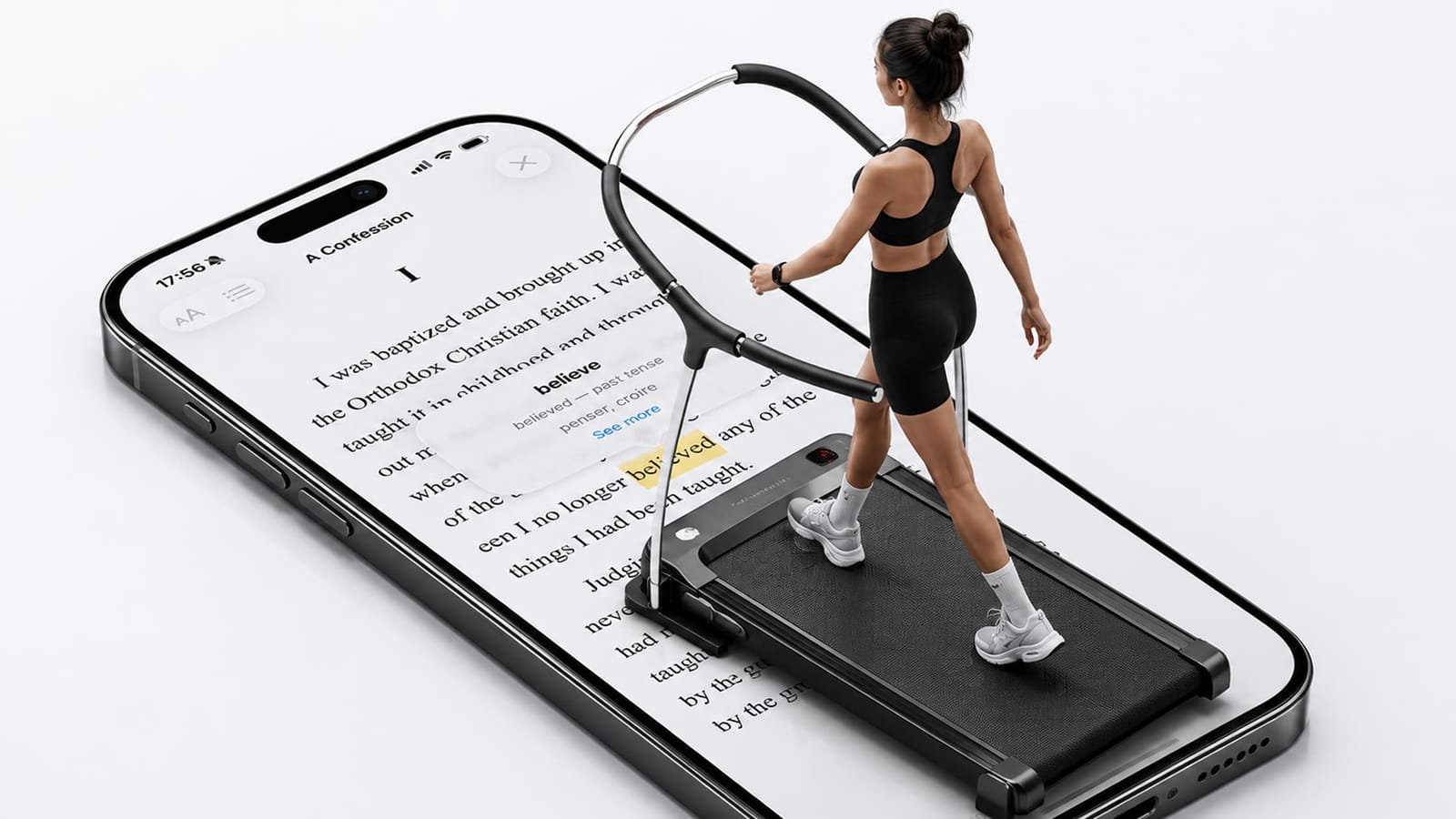
Clue isn’t a course and doesn’t try to be. It’s a free iOS app that solves the vocabulary problem inside the resources you’re already using.
You’re listening to The Daily. The host uses belabor. In a normal flow, you’d either let it go (and lose it) or pause, switch apps, type the word into a dictionary, and try to remember which sentence it was in. With Clue, you tap the word inside the podcast transcript, see the meaning with examples, and the word gets saved with the original sentence attached. Same flow with books, YouTube, and articles.
The point: a self-paced adult learner doesn’t need another course. They need their existing reading and listening to also be the vocabulary system. Clue is built around exactly that. It’s free, B1–C1 oriented, no streaks, no leaderboards, no daily quest.
If you’ve ever started a vocab notebook, used it for two weeks, and quit because the friction was too high, that’s the friction Clue removes.
FAQ
Are free English courses online any good for adults?
The big-name platforms (Cambridge, British Council, USA Learns) are legitimate and well-built. They’re best for filling specific gaps, not as a single backbone. Most adults past B1 will get more from a podcast-plus-tutor setup than from a free general course.
What’s the best free way to learn American English speaking?
Listen to American podcasts daily (The Daily, This American Life, Hard Fork), shadow a two-minute clip every day, and book one or two weekly thirty-minute calls with a U.S.-based tutor on iTalki ($8–$20 per session). Free language exchange on Tandem covers the rest.
Can I get a recognized English certificate for free?
Not from a major issuer. Cambridge, IELTS, and TOEFL all cost. Some Coursera and edX courses offer financial aid that waives the certificate fee. Duolingo English Test is the cheapest accepted-by-some-universities option at $59.
Do I need to take a placement test before I start?
Useful but not required. The British Council and Cambridge both offer free online tests that give you a CEFR level (A1–C2) in about 20 minutes. Knowing whether you’re B1 or B2 helps you pick material — but most people guess correctly anyway based on what they can already watch and read.
How is this different from Duolingo or Babbel?
Duolingo is gamified vocabulary in isolation. Babbel is structured short lessons. Both work best for absolute beginners. If you’re already B1+ and don’t enjoy gamification, neither is the right primary tool. A podcast-plus-tutor-plus-vocab-capture setup is closer to how adults actually progress.
Is one hour a day enough to learn English?
Yes. One hour a day, sustained for a year, takes most B1 learners to comfortable B2 and many to C1. Sustained matters more than the exact amount. Three twenty-minute pieces beat one ninety-minute class you skip half the time.
Should I take a tutor session if I’m using free resources?
If you’ve gone more than two months without speaking practice, yes. Even one thirty-minute tutor call a week prevents the worst plateau — where listening is strong but speaking is frozen. Total cost is usually under $50 a month.
Closing
Free is enough for nearly everything an adult B1–C1 learner needs. The trick isn’t finding more free courses; it’s resisting the urge to keep finding them. Pick a small stack — a podcast, a book, a tutor for one hour a week, and a way to capture vocabulary in context — and stay in it for ninety days. The progress nobody promises you in the free course landing pages comes from doing the boring version of this consistently, on your own clock.
Read in other languages
Related articles
- English Small Talk: Why It Matters and How to Survive It Without Sounding Robotic You step into an elevator with a coworker, you share a six-floor ride in silence, and you can feel the entire interaction going slightly wrong. In…
- English for Beginners: What to Actually Do in Your First Three Months A practical guide for absolute English beginners. What to study, in what order, with what tools. Honest about what works in months one to three.
- English Short Stories for Learners A2–C1: The Best Way to Read Your Way to Fluency Reading short stories in English is one of the most efficient ways to build vocabulary, absorb grammar patterns, and develop a feel for how native speakers
- English for Advanced Learners: From C1 to Native-Level Fluency What the journey from C1 to genuinely native English requires. Idioms, register, cultural references, dense literary fiction. Specific resources.


