


Tomasz Kowalski
Editor, English content · Published May 22, 2026
English for Beginners: What to Actually Do in Your First Three Months
You have decided to learn English from scratch. The good news is that English is one of the easiest major languages to start in — the alphabet is the one you probably already know, the grammar drops most of the complications that make Russian, German, or Hungarian intimidating, and the sheer volume of free learning content in English dwarfs every other language.
The bad news is that the abundance of resources makes it easy to drown. There are 200 apps that all claim to teach you English, 50 YouTube channels promising fluency in six months, and a billion-dollar industry built on selling you the next course before you have finished the last one.
This article is honest about what works in the first 90 days, what to skip, what order to learn things in, and where Clue does and does not fit. Spoiler: Clue is not the right tool for absolute beginners. We’ll explain why and what to use instead.
Where you actually are at A0–A1

The CEFR scale runs from A1 (absolute beginner) to C2 (educated native). A0 is the unofficial label for “literally nothing,” A1 is “can introduce yourself and handle the simplest exchanges,” and A2 is “can describe your daily life in simple sentences and handle short tourist conversations.”
If you are reading this, you are probably between A0 and A2. Be honest about which one — the right tools differ.
- A0: You don’t know the alphabet sounds, you cannot read a simple English sentence, and “Hello, how are you?” is the limit of what you recognize.
- A1: You can read very simple sentences with effort, you know maybe 300–500 words, and you can introduce yourself slowly.
- A2: You can read short paragraphs about familiar topics, you have a working vocabulary of around 1,000 words, and you can have a basic, slow conversation about your daily life.
The first three months should get you comfortably to a strong A2 — sometimes called “lower intermediate.” That is the floor for using a tool like Clue effectively. Below it, you will tap every other word and lose your mind.
Months one to three: the foundation phase
Here is a realistic plan. It assumes 30–60 minutes per day, six days a week. No magic, just consistent practice with the right tools in the right order.
Month 1: alphabet, sounds, first 500 words
Your job in month one is to wire English sounds into your ears and mouth, and to build a survival vocabulary.
Tool: Duolingo. Yes, the green owl. For absolute beginners, Duolingo is genuinely good. The early units cover the alphabet, basic phonics, the most common nouns and verbs, and simple sentence structures. The five-minute lessons fit anywhere. The streak mechanic will get you to come back daily for the first month, which is exactly what you need.
Tool: a pronunciation primer. Search YouTube for “English pronunciation for beginners” by Rachel’s English or BBC Learning English. Spend 10 minutes per day in week one to two on the vowel and consonant sounds. English spelling is notoriously irregular, and learning the sounds early prevents you from internalizing wrong pronunciations of common words.
Realistic outcome by end of month 1: You know roughly 300 words. You can read simple sentences out loud, slowly. You can say “Hello, my name is X. I am from Y. I am a Z.” You are firmly in A1 territory.
Month 2: basic grammar and 1,000 words
Month two is where Duolingo alone starts to wobble. You need a real reference for grammar so you can answer “why does this work?” rather than just “what does Duolingo want me to type?”
Tool: a real grammar book. Essential Grammar in Use by Raymond Murphy (the red Cambridge book) is the global standard for self-study English grammar at A1–B1. Each two-page unit covers one structure with a clear explanation and exercises. Work through it at your own pace — one or two units per session, three or four times a week.
Tool: continue Duolingo. The vocabulary and sentence drills are still useful at this level. Don’t quit yet.
Tool: simple listening practice. Start watching BBC Learning English’s English in a Minute and Easy English on YouTube. They are designed for exactly your level. Don’t worry about understanding everything; the goal is to train your ear to recognize sound patterns and rhythm.
Realistic outcome by end of month 2: You know roughly 800 words. You can write a short paragraph about your day in simple sentences. You can understand learner-focused content at controlled speed. Strong A1, edging toward A2.
Month 3: bridging to real content
Month three is the transition. You are still doing Duolingo and Murphy, but you start carefully adding short, real content.
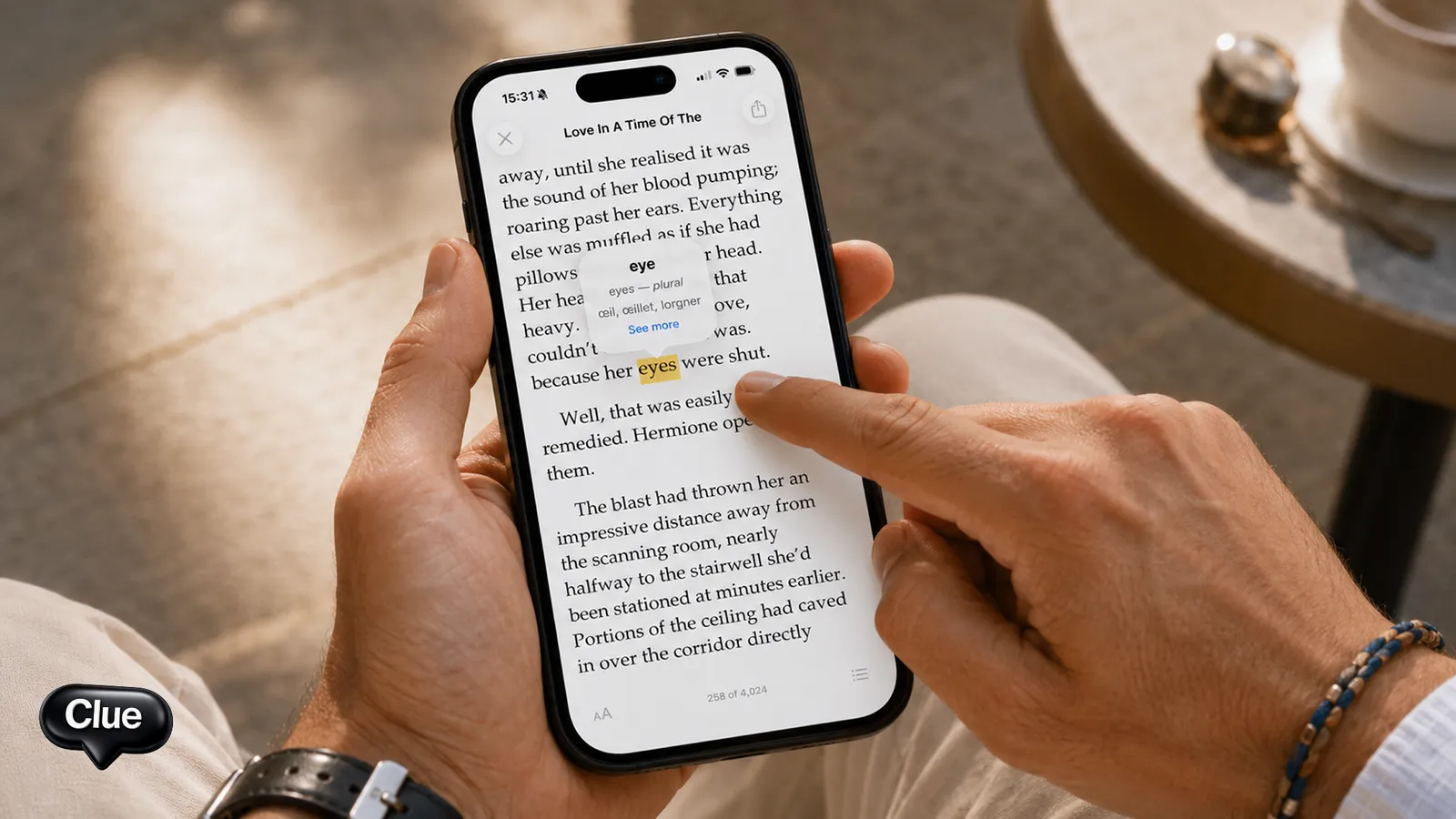
Tool: graded readers. Oxford Bookworms and Penguin Readers publish classic novels rewritten at A1, A2, B1, and B2 levels. Buy one or two A2 graded readers and read them with Clue’s tap-to-translate on every unknown word. Examples: The Adventures of Tom Sawyer (A2/B1), Robinson Crusoe (A2), The Picture of Dorian Gray (A2). These books are designed to feel like real reading without overwhelming you with vocabulary.
Tool: Clue can finally help. This is the point where Clue starts to make sense. The 27,000-word offline dictionary is bundled in the app, translations are in your native language, and you can drop in a graded reader EPUB and read with one-tap translation. Don’t expect to read Hamlet yet — start with the easiest graded readers and work up.
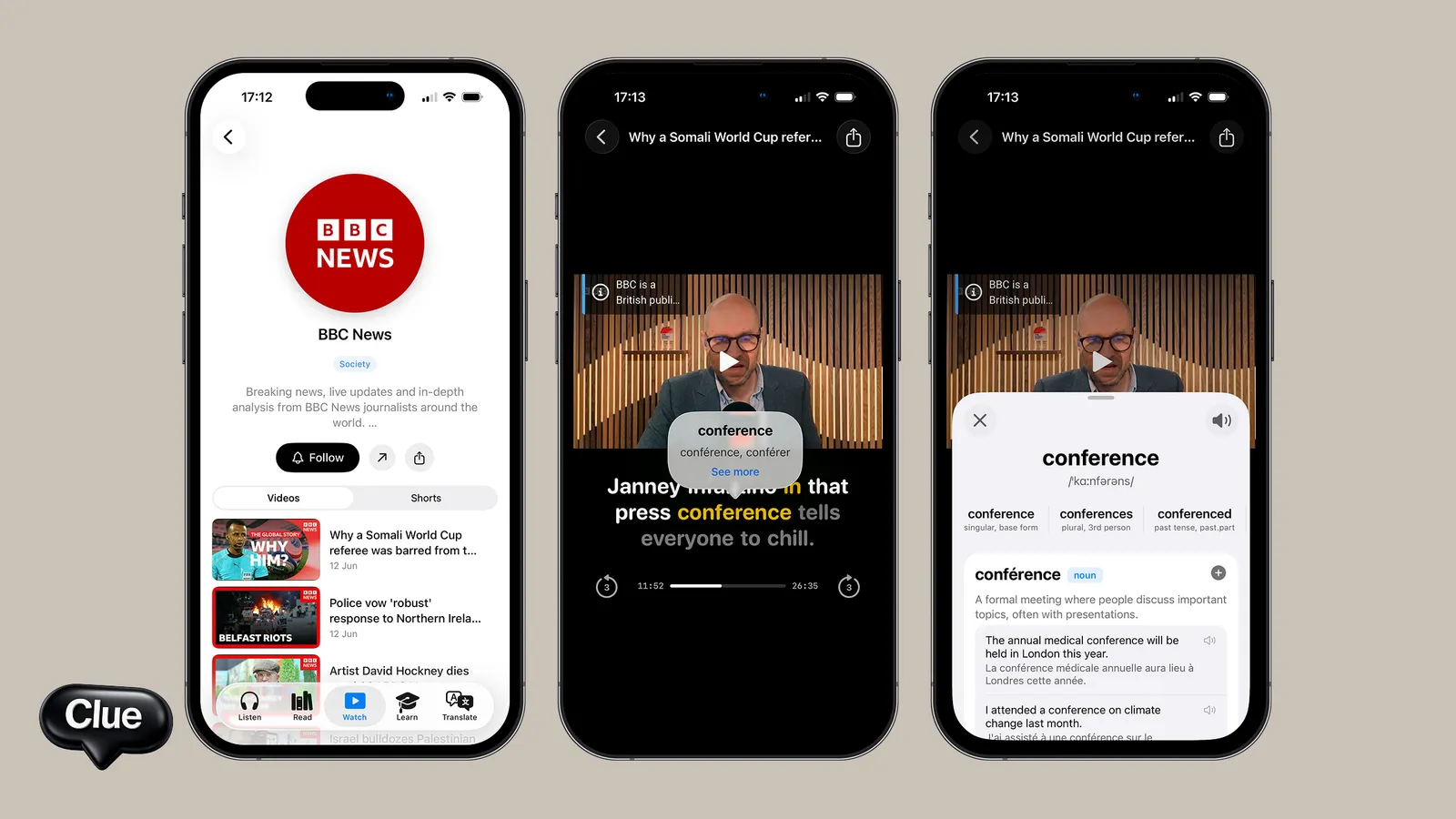
Tool: BBC 6 Minute English. Twice-weekly six-minute episodes on real topics, recorded specifically for learners, with transcripts. Listen to one episode three or four times until you understand most of it. Read the transcript in Clue and tap the words you don’t know.
Realistic outcome by end of month 3: You know roughly 1,200–1,500 words. You can read A2-level graded readers with help. You can follow learner-focused audio. You are at solid A2, possibly nudging into A2+. This is the level where Clue becomes genuinely useful rather than frustrating.
Why Clue is NOT for absolute beginners
We want to be honest about this because too many language tools promise miracles to beginners that they cannot deliver.
Clue is a tap-to-translate tool for real content. That model has a hard requirement: most of the words on the page need to be already known to you. If you understand 90% of a sentence and need help with 10%, tap-to-translate is amazing. If you understand 30% and need help with 70%, you are not reading — you are decoding word by word, and the experience is exhausting and useless.
Specifically:
- A0 with Clue: Every word is a lookup. You make no actual progress. You give up after two days.
- A1 with Clue: Most words are still lookups. You can decode short sentences with effort. Vocabulary growth is slow because each new word competes with too many other new words for attention.
- A2 with Clue on graded readers: This is where the tool starts to work. You know enough words to follow the story, and the new ones land on stable ground.
- B1+ with Clue on real content: This is the sweet spot. Clue earns its place.
The honest path is: spend three months with structured tools designed for beginners, then add Clue when you can actually read a paragraph.
What to use instead in months 1–3
To save you reading marketing pages for every English app on the market, here is the honest shortlist for the foundation phase:
- Duolingo: The best free gamified beginner course. Use daily for month one to three.
- Murphy’s Essential Grammar in Use: The standard self-study grammar reference. Worth the money.
- Anki or Memrise: For spaced-repetition flashcards if you want a more rigorous vocabulary system than Duolingo’s built-in repetition. Optional but useful.
- BBC Learning English on YouTube: Free, professional, designed for your level.
- Italki or Preply for tutoring: Once a week, 30 minutes, with a tutor who specializes in beginners. This is the single highest-leverage thing you can spend money on at this stage if your budget allows. Speaking practice with a patient teacher accelerates everything else.
You do not need a $200 course. You do not need ten apps. The shortlist above plus daily effort gets you to A2 in three months.
Common beginner traps
Five mistakes that quietly slow down most absolute beginners:
Trap 1: Watching films “to learn English” before you have the foundation. Sitting through Friends with subtitles when you only know 200 words is not language learning. It is staring at a screen with mild guilt. Save the films for B1+.
Trap 2: Jumping to “advanced” content because it feels more impressive. A learner who tries to read a New Yorker article at A1 will quit in 90 seconds. Pride is the enemy. Read material at your level.
Trap 3: Memorizing isolated word lists. “Banana, apple, orange, grape.” You will forget them in a week because they have no context. Learn words inside sentences and stories.
Trap 4: Translating word-for-word in your head. English word order is different from most other languages. Translating each word individually produces garbled meaning. Try to grasp whole-phrase meaning even when you don’t understand every component.
Trap 5: Skipping pronunciation early. Bad habits set in within months. If you internalize the wrong pronunciation of “thought,” “though,” “through,” and “tough” at A1, you will fight those habits at B2. Spend real time on phonics early.
The order of things to learn
A defensible learning sequence for absolute beginners:
- Sounds and the alphabet. Two weeks of pronunciation basics.
- Present simple tense. “I am, you are, he is. I have a book.”
- The most common 500 words. Numbers, days, family, food, basic verbs.
- Present continuous. “I am reading. She is working.”
- Past simple. “I went, she did, they had.”
- Simple questions and negatives. “Do you live here? I don’t know.”
- The next 500 words. Body parts, weather, time, basic adjectives.
- Future with ‘going to’ and ‘will’. “I am going to study. I will see you tomorrow.”
- Articles and basic prepositions. A/an/the, in/on/at.
- Modal verbs. Can, must, should, may.
That’s the spine of A1–A2. Murphy’s grammar book covers it. Duolingo touches all of it. After this, real content becomes plausible.
When to bring in Clue
Specifically, Clue makes sense from the moment you can:
- Read an A2 graded reader and understand most of it without a dictionary.
- Follow BBC 6 Minute English with the transcript.
- Hold a slow, simple conversation about your daily life.
At that point, drop the graded reader into Clue and read with tap-to-translate. The 27,000-word offline dictionary covers everything an A2 reader will encounter. Tap the 10–20 unknown words per chapter. Save them. The next morning, run the 5-minute flashcard quiz inside Clue and let the words settle.
That habit alone, sustained over months four through twelve, takes you from solid A2 to comfortable B1 without you having to grind through any more textbook exercises. Real content with active vocabulary work is the highest-leverage habit in language learning, and it becomes possible the moment your foundation is solid enough.
FAQ
How long does it really take to reach A2 from zero?
Three to six months with consistent daily practice. Less if you have a related language background (Spanish, French, Italian, German speakers have a head start on vocabulary). More if you only manage 15 minutes a few times a week.
Is Duolingo enough on its own?
For the first month, almost. By month two you should add a grammar book or you will hit a ceiling on understanding “why” things work. By month three, real content (even graded readers) should enter the mix.
Should I learn American or British English first?
Pick whichever is closer to your goals — where you want to live, what media you consume, what your accent preferences are. The grammar is identical, the vocabulary overlaps 95%, and your ear will adapt to the other variety after a few weeks of exposure.
Is it OK to use a translation app like Google Translate?
For survival emergencies, sure. For learning, no — copy-pasting whole sentences into Google Translate teaches you nothing. The point of looking up a single unknown word in context (which is what Clue does later, once you are ready) is that the surrounding sentence anchors the meaning in your memory.
How do I find a good tutor as a beginner?
Italki and Preply both work. Filter for tutors who explicitly specialize in beginners and who speak your native language. A tutor who only speaks English at you when you don’t yet understand English is going to be frustrating in the first months.
Can I skip the textbook and just use apps?
You can, but you will hit walls. Apps drill what they drill; they cannot answer every grammar question that comes up. A real grammar reference like Murphy is cheap and pays for itself within a month.
From beginner to real English
The first three months are about laying foundations: sounds, the most common words, the basic grammar that lets you build sentences. Use the right tools for this stage — Duolingo, Murphy’s grammar, BBC Learning English, a weekly tutor if you can afford one. Be patient. Build the habit.
When you can read an A2 paragraph without panic, the next phase begins, and tools like Clue start to make sense. Until then, save Clue for later and focus on the foundation. The learners who stick with the right tool at the right time are the ones who reach fluent English a year from now instead of giving up in month two.
Read in other languages
Related articles
- English Slang: A Practical Guide from 90s Throwbacks to Gen Z Internet Speak You hear a coworker call something "mid" and a friend tweet "no cap" and a colleague describe a presentation as "based" and you start to wonder if your…
- English for Advanced Learners: From C1 to Native-Level Fluency What the journey from C1 to genuinely native English requires. Idioms, register, cultural references, dense literary fiction. Specific resources.
- English Pronunciation: What Matters, What Doesn't, and 30 Words People Get Wrong You can speak English with a strong accent and still be perfectly understood. You can also pronounce "comfortable" or "Wednesday" wrong for fifteen years…
- English Audiobooks Guide: Audible, Spotify, and LibriVox by Level Audiobooks are one of the most underused tools in English learning. If you already have the reading level to follow a book but your listening comprehension


