

Ana Ferreira
Language-learning writer · Published May 22, 2026
English Small Talk: Why It Matters and How to Survive It Without Sounding Robotic
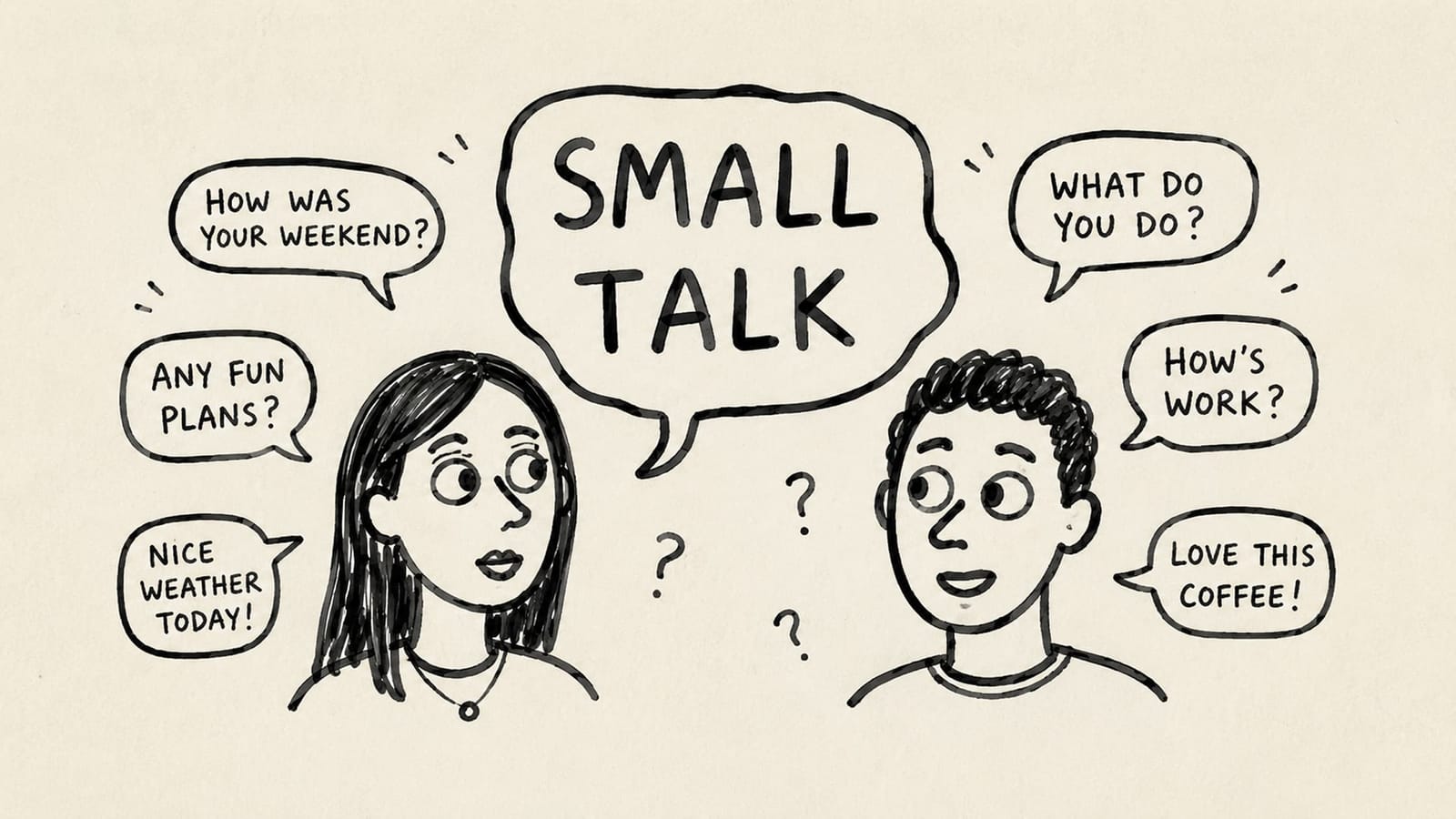
You step into an elevator with a coworker, you share a six-floor ride in silence, and you can feel the entire interaction going slightly wrong. In English-speaking cultures, that silence is louder than any conversation. Small talk is not optional, but it is also not as hard as it feels once you know the script.
Why Small Talk Matters in English-Speaking Cultures
In many European cultures, silence with someone you barely know is fine. In English-speaking cultures, especially the US, UK, and Australia, it reads as cold, unfriendly, or socially clumsy. Small talk is a social glue that signals you are friendly, present, and willing to engage.
Three concrete things small talk does:
- Breaks the ice. It lowers the temperature of any new interaction. Real conversations start after the small talk has warmed up the social space.
- Builds workplace trust. Coworkers who small-talk daily trust each other faster than ones who skip it. This affects hiring, promotion, and project assignment.
- Signals cultural fluency. People who can small-talk in English are perceived as more integrated, regardless of accent or grammar.
The good news for learners: small talk uses a very limited vocabulary and follows predictable patterns. You can master 80% of it in a weekend.
UK Small Talk: The Weather Stereotype Is True
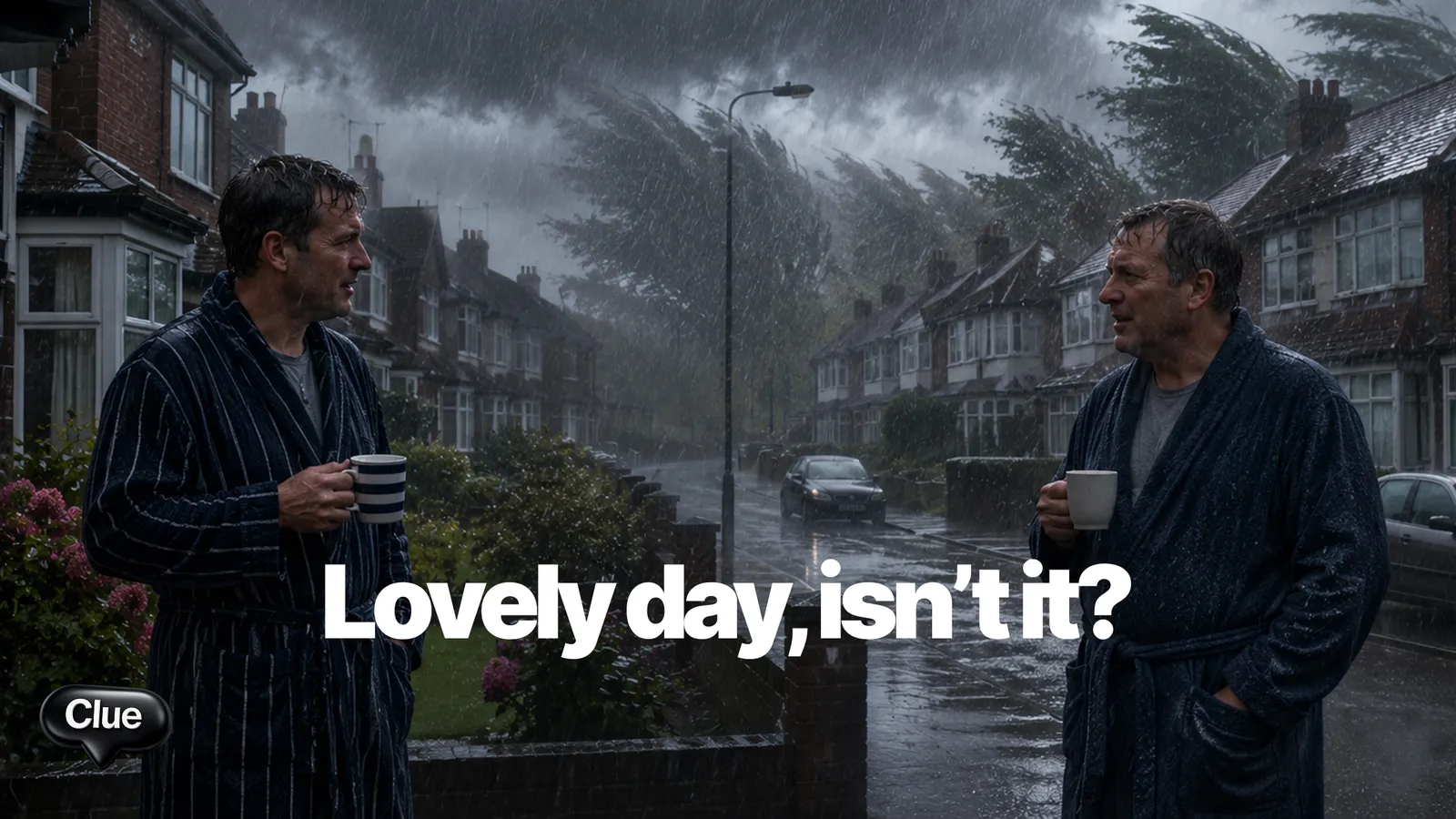
British people really do talk about the weather. It is a cliche because it is accurate. The weather is shared, neutral, and constantly changing, which makes it the perfect topic for low-stakes interaction.
Opening lines about weather
- “Lovely day, isn’t it?”
- “Bit chilly today.”
- “Mad weather we’re having.”
- “Nice to see some sun for once.”
- “Looks like rain.”
Beyond weather
UK small talk also covers traffic, queues (lines), public transport delays, recent sports events (especially football), and minor complaints about anything ordinary. Self-deprecating humor is common.
- “How was your weekend?”
- “Plans for the bank holiday?”
- “Did you see the match?”
- “How’s work?” (asked but not expected to be answered in detail)
British register
British small talk leans toward irony and understatement. “Not bad” might mean “very good.” “Could be worse” might mean “fine.” Direct enthusiasm is uncommon. If you want to sound British, dial back your responses by half.
Things to avoid in UK small talk
- Money. Asking what someone earns is borderline rude.
- Political opinions with people you do not know well.
- Excessive enthusiasm. “Amazing!” “Awesome!” is fine occasionally but reads as performative if overused.
US Small Talk: Warmth First, Substance Second
American small talk tends to be warmer and more enthusiastic than British. The opening lines are friendlier, the smiles are bigger, and the assumption is that two strangers can become familiar quickly.
Common openers
- “How’s it going?”
- “How are you doing today?”
- “Hi, how are you?” (often a greeting, not a real question)
- “Crazy weather, right?”
- “Did you have a good weekend?”
Standard topics
- Sports (especially American football, basketball, baseball)
- Weather
- Travel
- TV shows
- Where you are from (a common opener when meeting Americans abroad too)
- Work, but usually surface level
US register
American small talk is louder and more expressive than British. “I love this song” is normal. “Great seeing you!” with enthusiasm is normal. Negative feedback (“This place is too noisy”) is less common at first contact.
Things to avoid in US small talk
- Politics with people you do not know.
- Detailed health complaints.
- Discussion of how much things cost (though “Where did you get that?” is fine).
- Religion with strangers.
Australian Small Talk: Casual to the Point of Roughness

Australian small talk is famously informal, with frequent swearing among friends and a strong preference for understatement. Coming from Europe, it can feel almost rude in its directness, until you realize that it is also extremely warm.
Common openers
- “How ya going?”
- “G’day, how are ya?”
- “Bit hot today, hey?”
- “Long week?”
- “How was your weekend, mate?”
Australian register
- “Mate” is constant, gender-neutral, and casual.
- Diminutives everywhere: “arvo” (afternoon), “brekkie” (breakfast), “servo” (gas station), “Maccas” (McDonald’s).
- Light teasing is normal between friends and acquaintances. If an Australian friend teases you, it is a sign of warmth, not hostility.
- Avoid being too earnest. “I’m doing great today!” with no irony reads as American to Australian ears.
Things to avoid in Australian small talk
- Talking yourself up. “Tall poppy syndrome” means Australians instinctively cut down anyone who seems too pleased with themselves.
- Excessive complaining. Mild grumbling is fine. Endless complaints are not.
- Political opinions, especially American ones.
Meeting Strangers
The standard script for meeting someone new in any English-speaking country:
- Greeting: “Hi, I’m Anna.”
- Acknowledgment: “Nice to meet you, I’m Jake.”
- Hook: “How do you know [the host/organizer/event]?”
- Backstory: Both people answer briefly.
- Follow-up: “Oh, are you in [related field]?”
- Conversation develops or politely ends.
The trick is having three or four go-to questions in your pocket so you do not freeze.
- “How do you know [host]?”
- “What do you do?”
- “Are you from around here?”
- “How was getting here?”
Work Parties and Office Events
Work parties are small-talk minefields because the relationships are professional but the setting is casual. The safe topics are mostly the same as office small talk, just slightly looser.
Safe topics
- Recent vacations or upcoming travel
- The food and drinks at the event
- The event itself (“Have you been to one of these before?”)
- Recent shared work events (“That town hall was something”)
Topics to handle with care
- Salary
- Office politics
- Other coworkers (especially negative)
- Drinking habits (yours or others)
A useful pattern
If small talk runs dry, ask the other person a question about themselves and follow up with two or three more questions. Most people enjoy talking about their interests when prompted, and you do less heavy lifting.
Networking

Networking events are explicitly about meeting new people. Small talk here has a slight job-search undercurrent, which makes it both easier and harder.
Standard opener
- “Hi, I’m Anna. What do you do?”
This is the only context where “What do you do?” is the very first question and that is normal.
Useful follow-ups
- “How did you get into that?”
- “What’s the biggest project you’re working on?”
- “Are you based here in the city?”
- “Are you here for the whole conference?”
Exiting gracefully
Networking events expect you to move on after 5-10 minutes per person. The graceful exit:
- “It’s been great chatting. Let me give you a quick handshake and let me grab another drink.”
- “I should go say hi to a few people, but let’s connect on LinkedIn.”
- “Don’t let me monopolize your time. Was great meeting you.”
The Hairdresser
A specifically tricky small-talk situation because the same person is in close contact with you for an hour. Some hairdressers love conversation, some prefer silence, and they will usually follow your lead.
Common questions they ask
- “Are you doing anything fun today?”
- “Big plans for the weekend?”
- “Going on any holidays this year?”
Easy responses
- “Just running errands, you?”
- “Nothing big, you know how it is.”
- “Yeah, heading to Spain next month, what about you?”
If you do not want to talk, “I think I’ll just zone out for a bit” is acceptable and not rude. Most hairdressers are grateful for the break.
Uber and Taxi Rides
Driver small talk is short-format and predictable.
Common openers
- “Where you from?”
- “Heading home?”
- “Long day?”
- “Busy weekend?”
Easy responses
- “Yeah, just heading home, you?”
- “Pretty busy, how about you?”
- “Originally from Spain, been here a few years.”
Some drivers want to chat the whole ride. Some prefer quiet. Follow their lead. If they ask one question and then go silent, they are signaling they are done.
How to Keep Conversation Going
The biggest small-talk anxiety for learners is the “what do I say next?” moment after the first exchange. Three techniques solve 90% of this.
Echo and expand
Repeat part of what the other person said and add to it.
- Them: “I just got back from Lisbon.”
- You: “Lisbon, oh nice. I’ve never been. What did you do there?”
Ask follow-up questions
Almost any answer can be followed up with “How long?” “Where exactly?” “What was your favorite part?” “Have you been before?”
Share something parallel
If they share something, share something similar from your own life.
- Them: “We just moved to a new apartment in Brooklyn.”
- You: “Oh nice. We moved last year too. The packing was brutal.”
When to let silence happen
A few seconds of silence is fine. Most learners fear silence and rush to fill it. Native speakers tolerate small pauses. If silence stretches past 5-10 seconds, then yes, find a new topic.
Topics to Avoid
Universal across English-speaking cultures, more or less:
- Salary. Asking what someone earns is rude.
- Religion. Stick to neutral with strangers.
- Detailed politics. Light commentary is fine, partisan opinions are not.
- Weight, body, age. “You’ve lost weight” can be heard well or badly.
- Long medical stories. Brief mentions are fine. Surgery details are not.
- Heated controversial topics. Abortion, gun control, immigration policy. Avoid unless you know the person well.
- Their relationship status, especially after breakups. Wait for them to bring it up.
These are not hard rules. They are guidelines. Different communities have different norms.
Common Mistakes
- Treating “How are you?” as a real question. In most cases, “Good, you?” is the entire answer. A 90-second life update is too much.
- Answering “Where are you from?” with three paragraphs. “I’m originally from Madrid, but I’ve lived here for five years.” Done. Wait for follow-ups.
- Apologizing for your English. Most native speakers do not notice your accent the way you do. Apologizing draws attention to it.
- Avoiding small talk because you find it shallow. It is shallow, and that is the point. It is not meant to be deep. It is meant to be smooth.
- Speaking too quietly. In US small talk especially, low volume reads as nervousness or discomfort. Speak up.
- Translating directly from your culture. German directness (“I don’t like this weather”), French intellectualism (“Have you read Houellebecq’s new book?”), or Italian effusiveness (“Bellissimo!”) do not always land. Calibrate.
- Treating it as a script to memorize. Small talk should feel improvised. If your phrases sound rehearsed, the conversation falls flat.
- Forgetting that small talk is reciprocal. You ask, then they ask. Always be ready to ask back. “And you?” “How about you?” “Same for you?”
Where Clue Fits In
The way to absorb the rhythm of English small talk is to hear it constantly in real-life-style content: podcasts, sitcoms, dramas, interview shows. Listen to a few episodes of any podcast that features two people chatting and you will hear the patterns repeat. Tap unfamiliar phrases as they come up.
The texture of small talk lives in tiny phrases: “yeah, totally,” “for sure,” “right?”, “no kidding,” “you know what I mean?” These are the connective tissue that makes a conversation feel natural. You absorb them from exposure, not from textbooks.
Frequently Asked Questions
Why do English speakers ask “How are you?” if they don’t want a real answer?
It is a greeting, not a question. The format is fixed. Treat it like “Hello” with extra syllables. Answer with “Good, you?” or similar and move on.
Is small talk the same in every English-speaking country?
The patterns are similar, the register varies. American small talk is warmer and more enthusiastic. British is more reserved and ironic. Australian is more casual. Canadian sits between American and British. Irish leans toward more storytelling.
How long does small talk usually last?
In passing (elevator, line at a coffee shop): 30 seconds to 2 minutes. At a networking event: 5-10 minutes before moving on. With coworkers daily: 1-3 minutes morning and again before/after meetings. At a party: variable.
What if I have nothing to say?
Ask the other person a question. People love talking about themselves. “What have you been up to lately?” or “Anything fun planned?” almost always restarts a conversation.
Is small talk just a Western thing?
Not exclusively, but English-speaking cultures rely on it more heavily than many others. Japanese has its own version. Brazilian, Argentinian, and most Latin cultures have warm versions. German, Dutch, and Scandinavian cultures generally have less small talk than English ones.
How do I get better at small talk specifically?
Exposure to dialogue-heavy content (sitcoms, talk shows, podcasts with multiple hosts) plus active practice. Most non-native speakers improve fast once they accept that small talk is a learnable skill, not a personality trait.
What about texting and online chat? Is that small talk?
Similar but compressed. “How’s it going?” texted at 9am is a real opener. “Anything fun this weekend?” Friday afternoon is standard. The volume is lower, but the function is the same.
Closing
Small talk is the part of English that no grammar book prepares you for, and it is also the part that opens the most doors. Pick three openers, three follow-up questions, and three exit phrases. Use them this week. By the end of the month, what felt awkward feels automatic. Real conversations start where small talk ends, and you cannot get to one without going through the other.
Read in other languages
Related articles
- English for Advanced Learners: From C1 to Native-Level Fluency What the journey from C1 to genuinely native English requires. Idioms, register, cultural references, dense literary fiction. Specific resources.
- English Phrasal Verbs: 40 You Actually Need, Grouped by Where You'll Use Them You sit through a meeting and catch every word but not the meaning, because someone said "let's circle back" and "we need to roll this out" and "can you…
- English Audiobooks Guide: Audible, Spotify, and LibriVox by Level Audiobooks are one of the most underused tools in English learning. If you already have the reading level to follow a book but your listening comprehension
- English Level Test: How to Find Your CEFR Level Honestly and What to Do About It You filled out a CV and hovered over "English level." Was it B2? C1? You don't really know, and most online quizzes give you a different answer every…