

Tomasz Kowalski
Editor, English content · Published May 22, 2026
English for Advanced Learners: From C1 to Native-Level Fluency
At C1 you can do almost everything in English. You read books, watch unsubtitled drama, give presentations at work, write coherent essays, debate ideas with native speakers. By any reasonable measure, you speak English.
And yet the gap to “sounds like a well-educated native speaker” still feels like a chasm. Native speakers reach for idioms you don’t recognize. They drop cultural references you’ve never heard of. They use words like “sanguine” and “vicissitude” and “perfunctory” in casual conversation. Their writing has cadence and rhythm yours doesn’t quite have. Sometimes you can hear the difference but can’t reproduce it.
That gap is what separates C1 from C2 — and beyond C2, what separates “very advanced learner” from “native-like.” This article is about what it actually takes to close that gap, why most C1 learners give up at this point, and what specific resources make the journey efficient.
What C1 actually is
The CEFR definition of C1 is: “Can understand a wide range of demanding, longer texts, and recognise implicit meaning. Can express ideas fluently and spontaneously without much obvious searching for expressions. Can use language flexibly and effectively for social, academic and professional purposes.”
In practical terms, a C1 English speaker:
- Reads novels in English without consistent dictionary use (maybe 5–10 lookups per chapter).
- Watches most TV and film without subtitles, with occasional misses.
- Holds professional conversations and arguments without translation in their head.
- Writes with grammatical accuracy and varied vocabulary, though sometimes the prose feels slightly stiff or non-idiomatic.
- Has a productive vocabulary of roughly 8,000 words and a receptive vocabulary closer to 12,000–15,000.
C2 — the highest CEFR level — adds another 5,000 words to that receptive range, plus the cultural fluency to deploy them correctly. C2 is broadly equivalent to a well-educated native speaker on a typical day. Beyond C2 is “native-like,” which is not a CEFR category and which is mostly about cultural saturation rather than vocabulary count.
Why the C1-to-native journey is structurally different
The path from A1 to C1 has a clear shape: structured courses, vocabulary drills, grammar references, gradually more challenging content. The path from C1 to C2 looks nothing like that. Three reasons.
The remaining vocabulary is high-variance. The next 5,000 words you need are not the next 5,000 most-frequent words. They are the words that appear in literary fiction, academic writing, niche journalism, and educated conversation — distributed thinly across an enormous body of text. There is no efficient way to “learn the C2 vocabulary list” because it does not exist as a coherent list.
The skills are increasingly tacit. Knowing when to use “perfunctory” versus “cursory” versus “superficial” is not a rule you can be taught. It is a sense that develops over hundreds of hours of exposure to skilled writers using these words in their proper habitats.
The motivation problem changes. At C1, your English is good enough for most purposes. The marginal benefit of pushing further is small in practical terms. Most C1 learners plateau here permanently and never reach C2 — not because they can’t, but because the return on continued effort is harder to feel.
The learners who do break through are the ones who treat the C1-to-C2 journey as a long, slow accumulation rather than a sprint. The pace is slower, the work is quieter, and the satisfaction is real but subtle.
The diminishing returns of “lessons”

At C1, formal lessons have almost no return per hour. The structured-course world has nothing left to teach you that you couldn’t pick up faster from real content.
What still works at C1+:
- Reading literary fiction and serious nonfiction. Where the C2 vocabulary lives.
- Listening to long-form podcasts and unscripted dialogue. Where the register and rhythm live.
- Watching demanding adult drama. Where the cultural references and subtext live.
- Writing in English regularly. Where you discover the gap between passive and active vocabulary.
- Targeted speaking practice. With a tutor or partner who corrects subtle errors at this level.
What doesn’t work at C1+:
- Generic ESL courses. Not aimed at your level.
- Vocabulary apps with arbitrary word lists. The words you need are content-specific, not curriculum-driven.
- Daily Duolingo. Long since outgrown.
- Re-studying grammar. You already know it; the rare structures that confuse you can be looked up in five minutes.
The whole game at this stage is exposure to high-quality real English, with attention paid to the few words and phrases each week that are new to you.
What native-level fluency actually requires
Four components separate genuine native-level English from C1:
Idiom density. Native speakers use idioms constantly — “throw in the towel,” “the writing on the wall,” “barking up the wrong tree.” Most idioms are opaque if you’ve never met them; once met, they’re easy. There are roughly 25,000 English idioms in common use. You meet them only by reading and listening to a lot of native content over years.
Register flexibility. Native speakers shift register constantly — formal in a job interview, casual with friends, sarcastic with colleagues, neutral in news writing, archaic when quoting Shakespeare. C1 learners often have one default register and stick to it; native speakers fluidly modulate.
Cultural references. Half of Succession’s humor depends on knowing Hamlet. Half of The West Wing’s plot depends on knowing American political history. Newspaper headlines reference Greek myth, Bible stories, 80s sitcoms, and yesterday’s tweets, often in the same paragraph. Cultural fluency is the slowest-developing component of native-likeness.
Subtle word choice. “He was somewhat annoyed.” “He was rather annoyed.” “He was a touch annoyed.” “He was a bit annoyed.” All grammatically correct, all close in meaning, all subtly different in register and connotation. Native speakers know the differences without thinking about them. C1 learners often pick whichever one comes to mind first.
There is no shortcut to any of these. The only path is volume of high-quality input over years, with patient attention to the words and phrases that surprise you.
How advanced learners actually use Clue
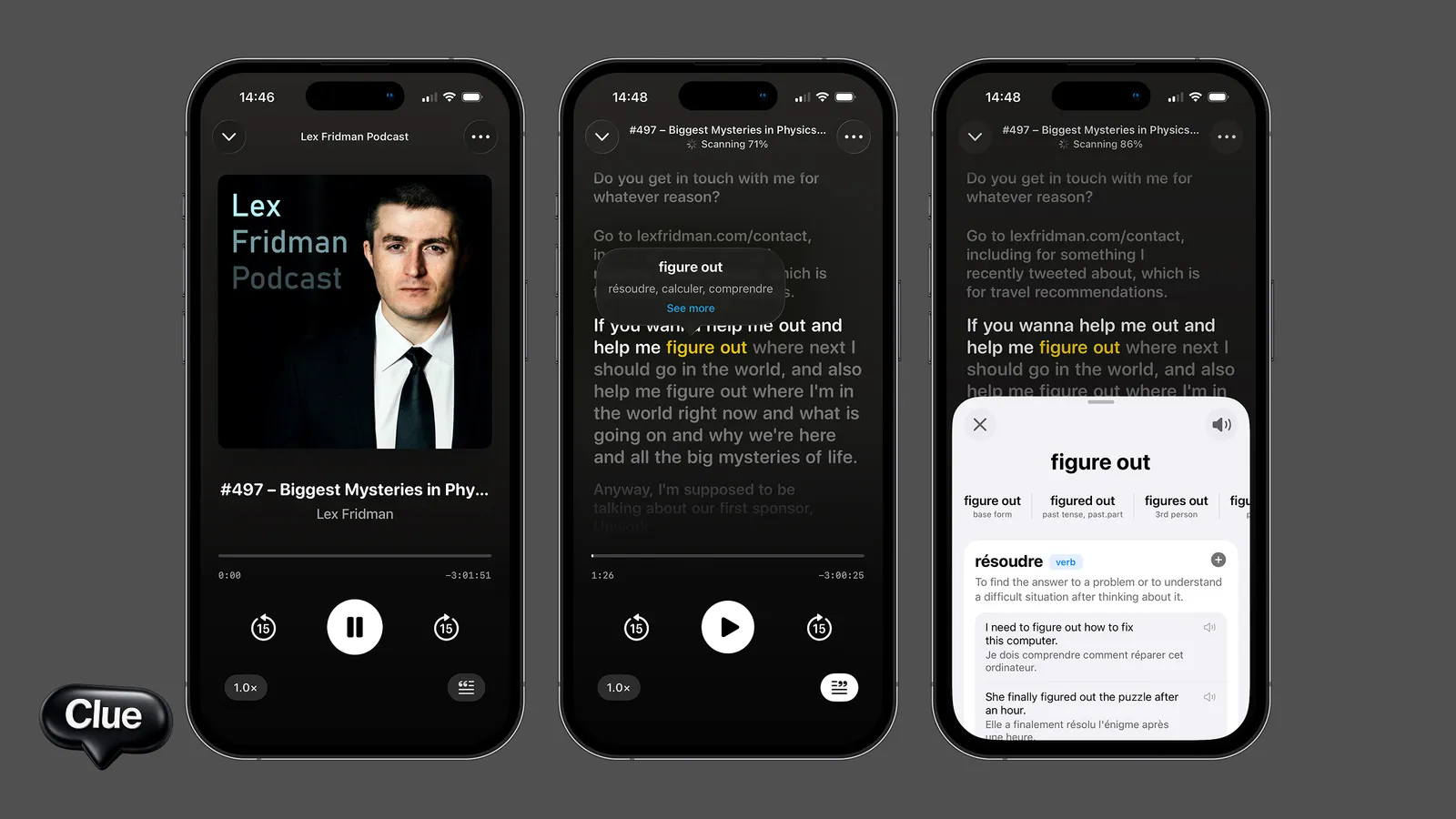
At C1, you tap fewer words than at B1. Maybe 3–5 per chapter of a literary novel instead of 15. But the words you do tap are high-value — a literary verb, a regional idiom, a niche specialist term, a register-marked usage you want to remember.
Clue’s contextual translation matters more at this stage than at any other. A generic dictionary entry for “sanguine” gives you the bland equivalent of “optimistic” — which loses everything interesting about the word. The contextual translation, anchored in the sentence you met it in, preserves the register and the connotation.
The saved-word practice queue stays small and high-quality. Because you’re only saving genuinely high-value words, the deck is manageable and the recall is high. Five words per week, reviewed in context, settle into productive vocabulary within a month.
Three workflows that work particularly well at C1+:
Long-form podcast on the commute. Lex Fridman or The Ezra Klein Show, two hours, with the transcript open in Clue. Tap the words that surprise you. Save three or four worth keeping.
Literary novel before bed. Ishiguro, McCarthy, Tartt. Read a chapter, tap the few words that you don’t fully own yet, save the ones that feel worth knowing.
Magazine essay in a sitting. The New Yorker, The Atlantic, The Guardian Long Read. Twenty minutes of dense prose, three or four lookups. Save the rare adjective or the idiom you didn’t know.
That’s it. The volume is lower than at B1, but the quality of input is higher and the attention is sharper.
Specific resources for C1+
The generic “watch English content” advice is useless at this level. You need pointed recommendations.
Long-form podcasts
Lex Fridman Podcast. Two-to-four-hour interviews with scientists, founders, philosophers, athletes. The vocabulary range is enormous because guests are domain experts speaking in their own technical languages. Unhurried pacing.
Conversations with Tyler. Tyler Cowen interviews economists, writers, and public intellectuals at breakneck speed. Dense, fast, idea-rich. The intro alone is a vocabulary lesson.
The Ezra Klein Show. Long-form policy and culture interviews from the New York Times. Beautiful diction, complex argument, careful word choice. Maybe the best diet of serious American English available on a podcast.
This American Life. Storytelling at the highest level. Ira Glass’s narration is a master class in modern American prose; the guest contributors run from journalists to comedians to ordinary people telling extraordinary stories.
Radiolab. Science and philosophy with a distinctive narrative style. The vocabulary leans technical; the storytelling is gripping.
Hardcore History (Dan Carlin). Multi-hour episodes on historical events. Dramatic, dense, and a fantastic source of historical vocabulary and cultural context.
99% Invisible. Design and the built environment. Roman Mars’s voice and writing are a quiet pleasure.
Books — literary fiction at C1+
Kazuo Ishiguro — The Remains of the Day, Klara and the Sun, Never Let Me Go. Restrained, elegant prose. Ishiguro is one of the most accessible literary novelists writing in English; his vocabulary is rich but never gratuitous.
Cormac McCarthy — The Road, No Country for Old Men, Blood Meridian if you’re brave. Stripped-down modernist prose. Demanding, musical, often haunting.
Donna Tartt — The Goldfinch, The Secret History. Long, dense, literary. Tartt’s vocabulary is genuinely larger than most native speakers’ — you will tap more words per chapter than in any other contemporary novelist.
Hilary Mantel — Wolf Hall and its sequels. Historical fiction set in Tudor England. The prose is dense and the period vocabulary is real but reachable.
Marilynne Robinson — Gilead. Slow, deeply religious, beautifully written. A different register from most contemporary fiction.
Zadie Smith — White Teeth, NW. Multicultural London prose with distinctive voice and inventive vocabulary.
Serious nonfiction
Yuval Noah Harari — Sapiens, Homo Deus. Big-picture history, beautifully written, with a vocabulary that punches above its weight without being archaic.
Tara Westover — Educated. Memoir of growing up in a survivalist Mormon family. Direct prose, vivid scenes.
Ta-Nehisi Coates — Between the World and Me. Essay-length book on race in America. Cadenced, lyrical, demanding.
Rebecca Solnit — A Field Guide to Getting Lost. Essays on memory, place, identity. Slow and beautiful.
Susan Sontag, Joan Didion, James Baldwin. Essay collections. Some of the best modern English prose written in the last 60 years.
TV shows at C1+
Succession. The dialogue is among the densest in contemporary television. Idioms, business jargon, literary references, Shakespearean echoes. Watching it with attention is a master class in adult corporate English.
The Bear. Restaurant kitchen vocabulary, Chicago dialect, fast crossover dialogue. Demanding listening practice.
Mad Men. 1960s American advertising. Restrained, period-correct dialogue. Excellent for register and cultural references.
Breaking Bad and Better Call Saul. Long, well-paced dialogue. The legal scenes in Better Call Saul are particularly rich for vocabulary.
The Crown. Period British English with high register. Slow, careful, and beautifully written.
Sherlock (the BBC series). Fast British English. Subtitles help; rewatching helps more.
Long-form journalism
The New Yorker. The gold standard for long-form English prose. Demanding but worth the climb. Subscribe.
The Atlantic. Excellent essays and reporting. Slightly more accessible than the New Yorker.
The Guardian Long Read. British counterpart. Often political, often beautifully written. Free online.
Aeon and Longreads. Aggregators of high-quality long-form essays. Free.
The London Review of Books and The New York Review of Books. Book reviews and essays at the literary register. The hardest accessible English in regular circulation.
Output, not just input

At C1+, the bottleneck shifts decisively from comprehension to production. You understand far more than you can say or write. Clue and similar tools help with the input half; for output you need entirely different tools.
The honest options:
- A serious tutor. Italki or Preply, but specifically a tutor who can correct subtle C1-level mistakes — register slips, awkward phrasing, almost-right word choices. These tutors are harder to find and more expensive. Worth it.
- Writing. A journal, a blog, a Substack, a regular email correspondent in English. Writing forces you to use the vocabulary you’ve collected. Without regular output, your active vocabulary stays smaller than your passive vocabulary.
- Conversation partners at your level. Native speakers, or other very advanced learners, in topics you genuinely care about. Casual conversation does less than focused intellectual exchange.
- Reading aloud. Read passages from books you love, out loud, slowly. It trains your mouth to produce the rhythms your ear has already absorbed.
The C1-to-native journey requires both halves. Input alone produces a learner who understands beautifully but cannot speak fluently. Output alone produces a learner who speaks fluently but with limited range. The combination, sustained over years, is what produces the slow movement toward native-feeling English.
Idioms, register, and the long tail
The long tail of advanced English is mostly three things:
Idioms. A few targeted lessons help, but most idiom acquisition happens organically — you meet an idiom in context, the meaning is roughly inferable, you tap it for the precise translation, you save it, you meet it again two weeks later in another context, and it sticks. Clue handles this loop well.
Register markers. Words like “rather,” “somewhat,” “indeed,” “albeit,” “wherein” — small particles that shift the register of a sentence. Native speakers use them unconsciously; learners often avoid them and end up sounding either flat or stilted. The fix is paying attention when you read; mark the register markers in well-written prose and notice when they appear.
Cultural references. Read widely outside language-learning content. Read about American political history, British literature, classical mythology, recent pop culture. Cultural fluency is the slowest-developing component, but it’s what eventually makes the difference between sounding fluent and sounding native.
FAQ
I’m already C1 — is Clue still useful?
Yes, if you read literary fiction and listen to long-form podcasts. The friction of looking up the few words per chapter you don’t fully own is bigger than it seems, and Clue removes it. The number of saved words per session goes down at this level, but the quality of those words goes up.
Does the dictionary cover literary and academic vocabulary?
The 27,000-headword dictionary covers almost everything in modern fiction and serious journalism, including most literary vocabulary. Very rare or archaic terms may not be covered, but those are quick to look up online and rarely worth saving as flashcards.
Can I read academic texts in Clue?
Yes. Academic English vocabulary is mostly Greek- and Latin-rooted and very well covered. For specialist field vocabulary (medical, legal, deeply technical), supplement with a domain-specific dictionary or a search engine when you hit terms that aren’t in Clue.
How is this different from Anki for advanced vocabulary?
Anki is pure spaced repetition with cards you create yourself. Clue captures cards automatically as you read, with the original sentence attached. Different workflows; many advanced learners use both — Clue for content-driven vocabulary, Anki for targeted vocabulary lists or specialist domains.
Will my English ever sound truly native?
For most learners who start as adults, the answer is no in a strict technical sense — a trained linguist can usually tell. But functionally native, where your English no longer marks you as a non-native speaker in everyday contexts, is achievable with enough years of high-quality input and output. Most learners who reach this level are surprised by how slowly the last gap closes, and by how much progress is still possible after they think they’ve stopped improving.
How long from C1 to C2?
Honest range: two to five years of consistent input and output. Most learners take longer because most learners coast at C1.
From advanced to native-level
There is no fast path from C1 to native-feeling English. The journey is hundreds of hours of deep input, careful attention to the long tail of vocabulary native speakers use that you don’t, and steady output practice. The good news: at C1 you already speak English well enough to consume any content you want. The work is genuine pleasure, not study.
Clue’s role at this stage is the lookup tool that makes serious reading and listening efficient. The work itself is up to you. Pick up a novel you’ve always wanted to read, queue up a three-hour podcast on a topic you care about, write a paragraph in English every day, and keep going. The path is long, but the destination is real.
Read in other languages
Related articles
- Learn English from Scratch: A0 to B1 on Your Own Starting English from zero as an adult is a different challenge than continuing from an intermediate level. You have no vocabulary to fall back on, no gram
- Clue vs ChatGPT for Learning English: Which Should You Use in 2026? ChatGPT is a brilliant on-demand tutor; Clue turns real podcasts, videos and books into comprehensible input. How they differ and why most learners use both.
- English for Turkish Speakers Learn English from real podcasts, videos, and books with one-tap Turkish translations. Offline dictionary, built for Turkish speakers ready for real content.
- Clue vs Busuu: Which Is Better for Learning English in 2026? Busuu pairs structured courses with feedback from native speakers; Clue turns real podcasts, videos and books into comprehensible input. How they compare.