

Oksana Kovalenko
Language-learning writer · Published May 22, 2026
English Audiobooks Guide: Audible, Spotify, and LibriVox by Level
Audiobooks are one of the most underused tools in English learning. If you already have the reading level to follow a book but your listening comprehension lags behind, audiobooks close that gap faster than most methods people recommend. This guide covers the three main platforms, how to choose the right book for your level, and how to actually learn from audio rather than just pass the time.
Why Audiobooks Belong in Your Learning Stack
The gap between reading comprehension and listening comprehension is one of the most common frustrations at B1–B2. You can read an article without much trouble, but a podcast or native speaker conversation leaves you scrambling. Audiobooks help because they sit in the middle: the vocabulary and sentence structure are literary (more complex than speech), but you’re training your ears, not your eyes.
Audiobooks also provide something podcasts don’t: a text you can follow. Most audiobooks have a corresponding print version. Reading along while listening — called “read-along” or “audiobook shadowing” — trains the connection between how words look and how they sound. For learners whose literacy in English developed before their listening, this reconnection is valuable.
The practical benefit: audiobooks fit into dead time. Commuting, cooking, exercising — any activity that doesn’t need your eyes frees you to listen. That’s 30–60 minutes of English input on days when you can’t sit down and study.
Platform 1: LibriVox — Free, Public Domain, Volunteer-Read
LibriVox records public-domain books using volunteer readers and offers everything for free. The catalog runs to tens of thousands of recordings, primarily classic literature: Dickens, Austen, Poe, Twain, Doyle, Hemingway’s early work.
Who it’s for: B1 learners who want free access to classic fiction, and B2–C1 learners who want extensive listening practice without paying.
The quality issue: LibriVox recordings vary dramatically. Some volunteers are experienced narrators; others are reading into a laptop microphone in an echo-filled room. Before committing to a full book, listen to a sample chapter. The site lets you browse by reader rating.
Best LibriVox picks by level:
- B1: The Adventures of Tom Sawyer (Twain) — American English, clear narration, episodic structure means you don’t lose the plot if you zone out.
- B2: The Great Gatsby (Fitzgerald) — short, poetic, many excellent recordings available. The language is dense but sentences are short.
- C1: The Picture of Dorian Gray (Wilde) — Wilde’s prose is elaborate and the vocabulary is challenging. C1 listeners will find much to study here.
Access: librivox.org — download MP3 or stream. Also available on the LibriVox app for iOS/Android.
Platform 2: Spotify — Curated Audiobooks, Freemium Access
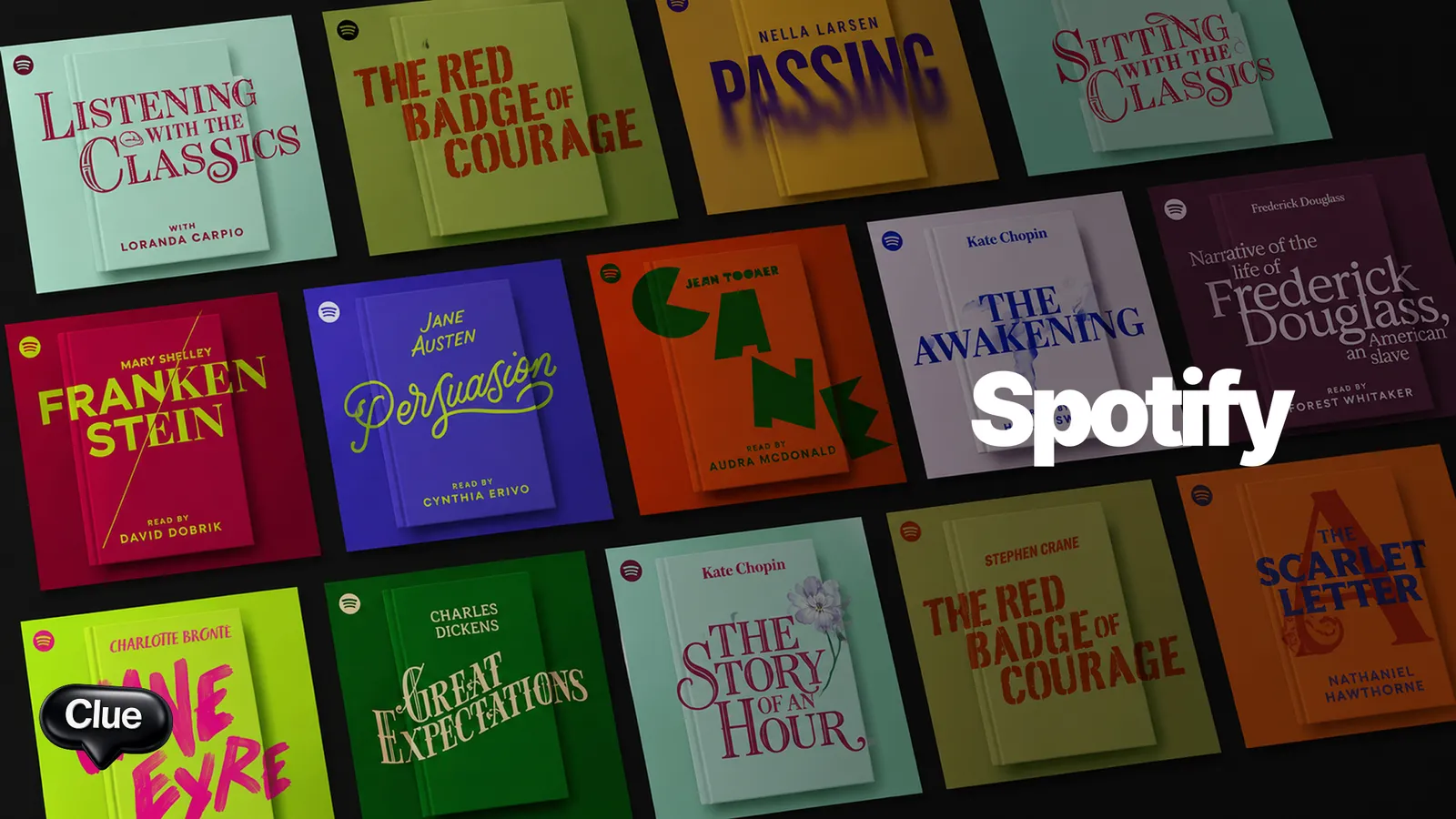
Spotify added audiobooks to its platform in 2023 and now carries a significant catalog. With a Premium subscription (which many users already have for music/podcasts), you get 15 hours of audiobook listening per month. Additional hours cost extra.
Who it’s for: Existing Spotify users who want convenience — everything in one app.
The catalog: Spotify’s audiobook library skews toward popular fiction and contemporary nonfiction. Strong on bestsellers (Colleen Hoover, James Clear, Malcolm Gladwell), less strong on classic literature. For B1–B2 learners, contemporary popular fiction is often better listening practice than classics anyway — the language is current, the narration is professional, and the stories engage.
Best Spotify audiobooks by level:
- B1: The Martian by Andy Weir — first-person narration, clear and casual voice, technical vocabulary but explained in context.
- B2: Educated by Tara Westover — memoir, American English, exceptionally clear narration by Julia Whelan. The vocabulary is literary but the sentence structures are accessible.
- C1: Sapiens by Yuval Noah Harari — originally written in English for a non-native audience, Harari’s prose is unusually clear for a complex intellectual book. The ideas are challenging; the language is less so.
Tip: Spotify lets you adjust playback speed. Start at 0.9x while calibrating your ear to a narrator, then move to 1.0x once familiar. Resist pushing to 1.25x until comprehension is solid.
Platform 3: Audible — The Professional Standard
Audible (owned by Amazon) is the largest audiobook platform in the world. Monthly subscription gives you credits to purchase books; they’re yours to keep. The library is massive, the narration quality is consistently professional, and the Audible app supports features that matter for learners: chapter bookmarks, variable speed, and sleep timer.
Who it’s for: Intermediate to advanced learners willing to pay for quality and selection.
Audible Originals: Audible produces exclusive audio content including some learning-oriented programming. Their original productions often have high production values.
Best Audible picks by level:
- B1–B2: Harry Potter and the Philosopher’s Stone narrated by Stephen Fry — Fry’s narration is warm and clear, British English, and the story’s vocabulary is surprisingly accessible while being rich enough for learners. The entire series works as a progression.
- B2: The Alchemist by Paulo Coelho (translated by Alan R. Clarke) — short, philosophical, simple sentences. The translated English is intentionally clear.
- B2–C1: Becoming by Michelle Obama — narrated by the author. American English, very clear, rich vocabulary, contemporary. Memoir format means you follow a single voice through a coherent story.
- C1: Lincoln in the Bardo by George Saunders — experimental fiction with multiple narrators, dense vocabulary, and literary ambition. Challenging and rewarding.
Audible Whispersync: For learners, this feature is significant. Whispersync links the Kindle ebook to the Audible recording. You can read and listen simultaneously, switch between reading and listening mid-chapter, and tap any word in the Kindle app for a definition. This is close to an ideal learning setup for B1–B2 learners: text + audio + instant vocabulary lookup.
Choosing the Right Level: A Practical Test
Before committing to a book, listen to a 5-minute sample without reading along. Ask yourself:
- Can you follow the story without rewinding?
- Do you understand at least 90% of what’s said?
- Are the unknown words guessable from context?
If yes to all three, the book is at or slightly above your level — a good learning zone. If you’re rewinding constantly or losing the thread, the book is too difficult for listening practice. You might read it first, then return to the audio.
If you understand everything effortlessly, choose something harder. Comfortable listening without challenge doesn’t accelerate learning.
How to Actually Learn from Audiobooks, Not Just Listen
Active listening vs. passive listening. Passive listening — audiobook on while you’re half-focused on something else — builds exposure and familiarizes your ear with English prosody. It’s worth doing. But it doesn’t build vocabulary as effectively as active listening, where you’re fully engaged and noting what you don’t understand.
The shadow method. Listen to a sentence, pause, repeat it aloud. This develops pronunciation and speech rhythm simultaneously. It’s exhausting in short bursts but effective. Use it with a 10-minute excerpt rather than a full chapter.
Read-along for B1–B2. Find the Kindle or PDF version of the book you’re listening to. Read and listen simultaneously for the first chapter. Once you’re familiar with the narrator’s voice and the text’s vocabulary range, listen without reading. Return to the text for any chapter where comprehension slips.
Vocabulary capture. Every 20 minutes, note the words you heard but didn’t fully understand. Don’t pause during listening — note them after. Then look them up in context. This keeps the listening session uninterrupted while still capturing the vocabulary.
Don’t skip genres you find boring. This is surprisingly important. Learners often choose books they wouldn’t read in their own language. Bored attention is poor learning attention. If you love crime thrillers, listen to crime thrillers. If history grips you, listen to history. Language learning is most effective when your attention is fully engaged.
Combining Audiobooks with Vocabulary Review
The audiobook gives you input; vocabulary review converts that input into long-term knowledge. The two together work better than either alone.
If you’re listening and notice a word that keeps appearing but you’re not sure about: jot it down, then later look it up and add it to your review queue. Apps like Clue let you add words from any source — not just content within the app — so you can build a review deck around your audiobook listening, not just your reading.
The goal over time is that the words you noted in week one are recalled automatically by week four. Spaced repetition handles the scheduling; you just need to note the words and trust the system.
Common Mistakes with Audiobooks for Language Learning
Starting with unabridged classics above your level. Dickens and Tolstoy are beautiful, but Dickens’s sentence structures are legitimately complex even for C1 learners. Start with simpler classic texts or contemporary fiction.
Listening only while distracted. Passive listening has value, but if every session is split-attention, progress is slow. Block at least two or three sessions per week for focused listening.
Giving up on a narrator after one chapter. Narrator accents and styles can take adjustment. Give any narrator two chapters before deciding the voice doesn’t work for you. If after two chapters you still can’t focus, switch.
Thinking audiobooks alone are enough. Audiobooks develop listening comprehension and vocabulary through audio context. They don’t replace reading (for written vocabulary), speaking practice (for production), or writing. Use them as one component in a broader practice.
Listening at too high a speed too soon. Speed is useful once comprehension is solid. At 1.5x before you understand 90% at normal speed, you’re just testing your ears’ tolerance for fast sound, not learning.
FAQ
What speed should I listen to English audiobooks at? Start at normal (1.0x) or slightly slower (0.9x) for new narrators. Move to 1.25x when you’re comfortable. Above 1.5x is useful for review, not for first exposure when you’re learning new vocabulary.
Can I learn English just from audiobooks? You’ll develop strong listening comprehension and vocabulary. But speaking, writing, and formal grammar benefit from other practices. Audiobooks are excellent input; you also need production practice.
Are audiobooks better than podcasts for learning English? Different strengths. Podcasts feature natural conversation — interruptions, filler words, unscripted pauses — which better mirrors real-life listening. Audiobooks have literary vocabulary and clearer narration. Both belong in a learning stack; choose based on what you’re working on.
Do I need to understand every word? No. Targeting 90–95% comprehension is healthy. Unknown words that appear once are fine to skip. Unknown words that appear repeatedly are worth noting.
Is British or American English better for audiobooks? Neither is “better” — both are standard. Choose based on which accent is more useful for your context, or alternate to develop ear flexibility. If you deal primarily with American colleagues or media, American English audiobooks make more sense for practical training.
Where can I find audiobooks with text to follow along? Audible Whispersync pairs Audible audio with Kindle ebooks. The Speechify app can sync text and audio. Some public libraries provide OverDrive with simultaneous ebook/audiobook access.
How many hours of listening per week do I need to make real progress? Studies suggest meaningful listening comprehension improvement comes with 3–5 hours per week of focused listening over several months. Casual, consistent listening (20–30 minutes daily) still produces real gains over time.
A Practical Starting Point
Pick one book at your current level, choose a platform you already use, and commit to 20 minutes of listening per day for two weeks. After two weeks, you’ll have a calibrated sense of your listening comprehension ceiling and a starting vocabulary list worth reviewing.
That’s the foundation. Everything else — harder books, faster speeds, deeper genres — follows from showing up consistently at the level that’s right for you now.
Read these free on Clue




Read in other languages
Related articles
- English Grammar Essentials: The Eight Areas That Cover 90% of Real Use You memorized the present perfect three times in school, you got the perfect score on the worksheet, and a week later you still write "I have seen him…
- Clue vs Lingopie: TV Streaming vs Bring-Your-Own Content Clue vs Lingopie compared: a curated TV streaming library for language learners versus a tool that works with any podcast, book, or video you bring.
- English for Ukrainian Speakers Learn English from real podcasts, videos and books with one-tap Ukrainian translations. Offline dictionary, built for Ukrainian-speaking learners.
- Clue vs Babbel: Which Is Better for Learning English in 2026? Babbel is a structured, conversation-focused course; Clue turns real podcasts, videos and books into comprehensible input. How they compare and who each suits.


