


Tomasz Kowalski
Editor, English content · Published May 22, 2026
English for Spanish Speakers
Spanish speakers have a head start in English: the alphabet matches, thousands of cognates carry over (information, situation, possible), and the rhythm of Spanish syllables transfers cleanly into English vowels. The friction shows up later — false friends, phrasal verbs, the gap between English written and English spoken.
Clue is built for the moment your textbook stops being useful. You bring real English content (podcasts, YouTube, books); Clue gives you instant Spanish translations on every word, an offline dictionary of 27,000 English headwords, and a practice mode that turns the words you actually meet into long-term vocabulary.
Why textbook English fails Spanish speakers around B2
Most Spanish-speaking learners stall at the upper-intermediate plateau. The cognates that helped at A2 stop being enough — modern English is built around phrasal verbs (give up, take over, look into) that have no Spanish parallel and rarely appear in textbooks at the right density.
The fix is volume, in real content. Watch enough native-speed English and the phrasal verbs become obvious through context. Tap the unfamiliar ones and the Spanish translation locks them in.
How Clue works for a Spanish-speaking learner
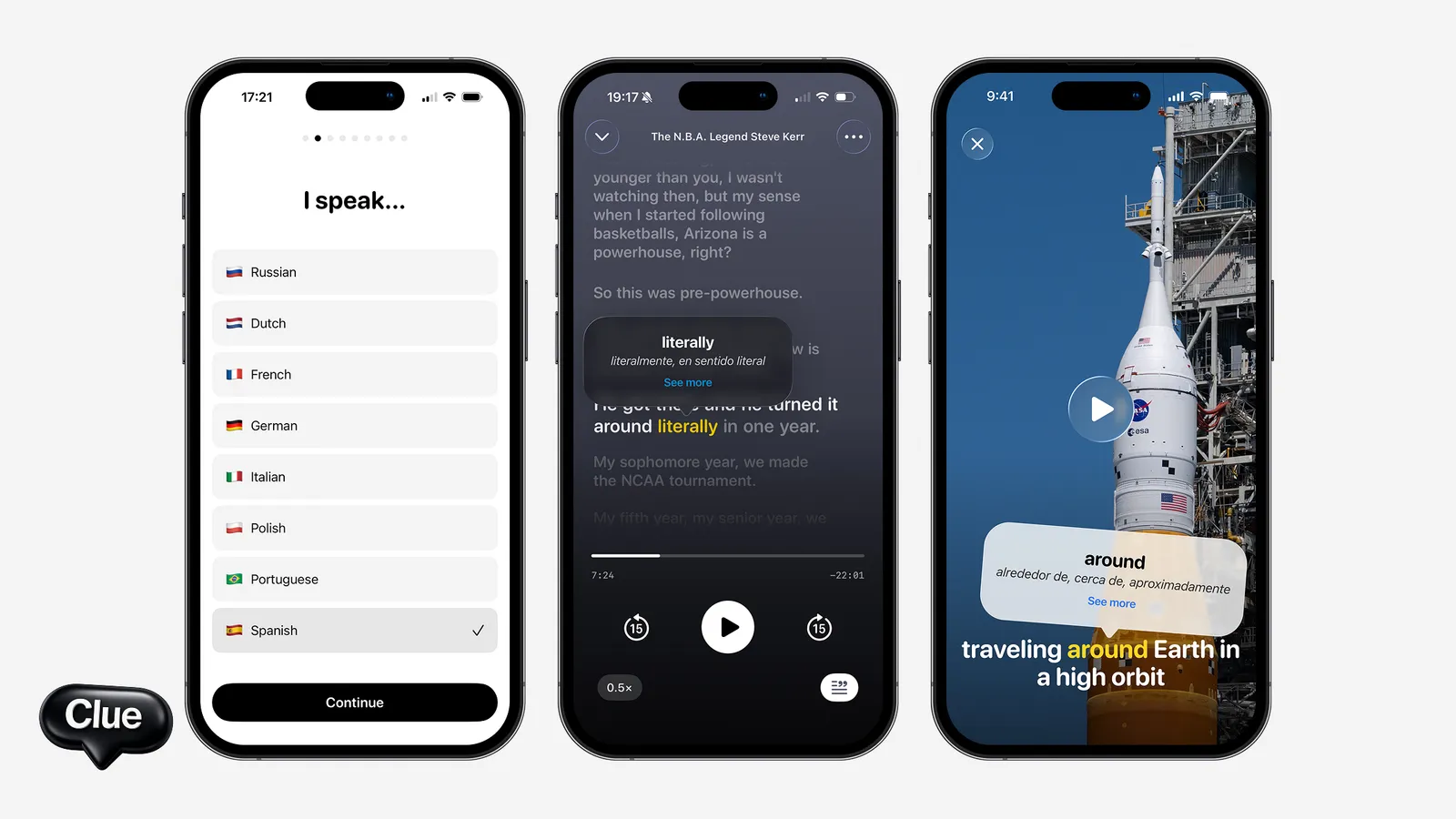
Pick Spanish as your translation language during onboarding. Every dictionary lookup from then on returns Spanish — el significado, la traducción más cercana, la categoría gramatical. The 27,000-word dictionary lives on your phone, so the lookup works offline at native speed.
Open any podcast, YouTube video, book, or movie subtitle. Tap a word, see the Spanish translation that fits the sentence (not a generic dictionary dump). Save the word and it joins your flashcard practice — quizzes built from the actual sentences you heard or read it in.
Best English content to start with
Podcasts: NPR’s ‘Up First’ (clear American English, 10-minute episodes), ‘BBC 6 Minute English’ (designed for learners), ‘The Daily’ (long-form journalism).
YouTube: Vox, Kurzgesagt, TED-Ed, Veritasium — explainer channels with clean diction.
Books: ‘A Man Called Ove’ (translated into English from Swedish, prose is naturally simpler), ‘The Curious Incident of the Dog in the Night-Time’, or any Roald Dahl short story collection.
Common Spanish-speaker mistakes Clue helps with
Confusing ‘actually’ with ‘actualmente’ — Clue’s translation card shows the real meaning in context (it means ‘in fact’, not ‘currently’).
Confusing ‘sensible’ with ‘sensible’ — the English word means ‘prudent’, not ‘sensitive’.
Underusing phrasal verbs — when you tap a phrasal verb in real content, you see the Spanish translation that captures the actual meaning, not the literal sum of the parts.
Built for Spanish speakers across the Spanish-speaking world
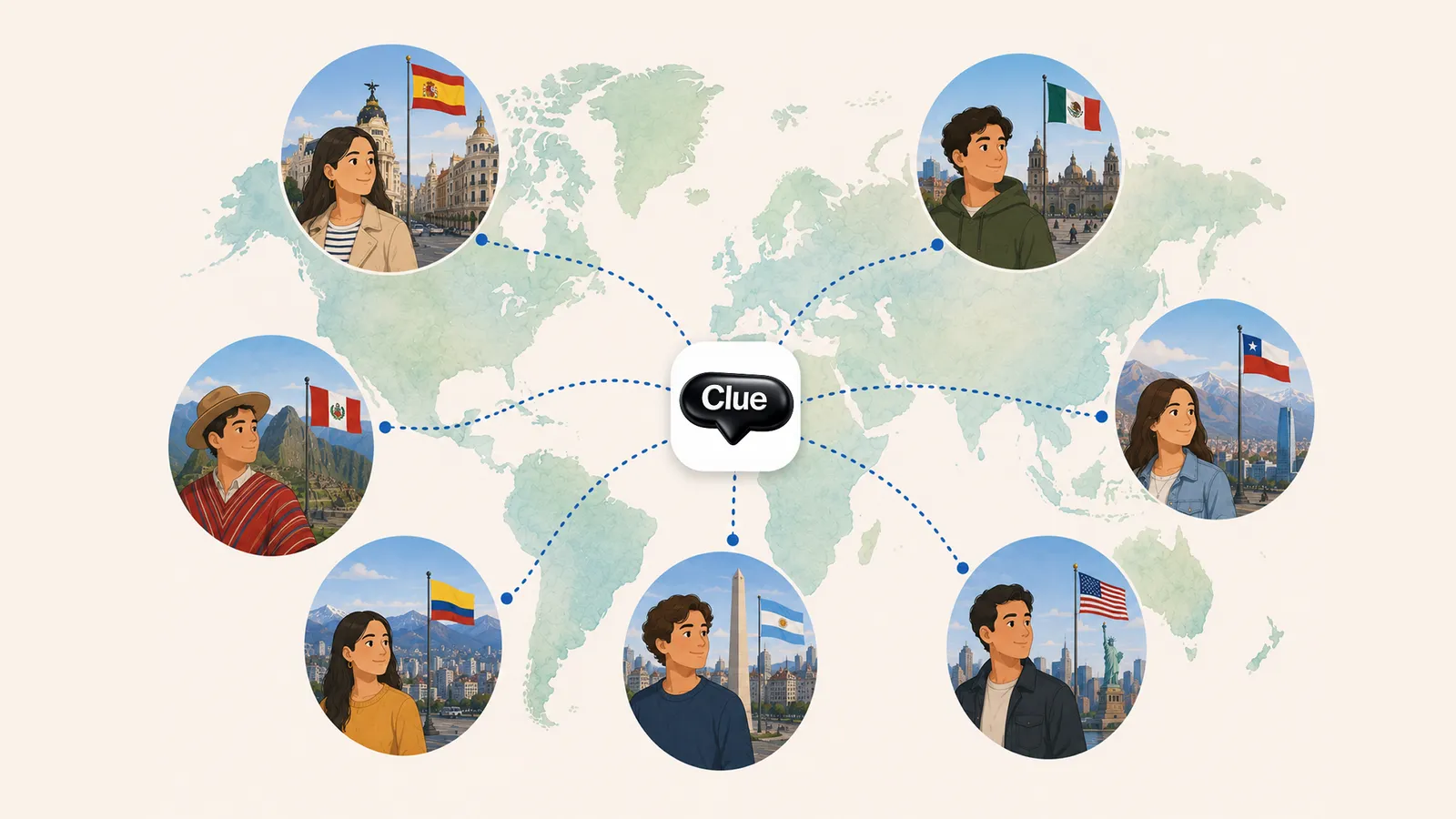
Spain, Mexico, Argentina, Colombia, Chile, Peru, the United States — Spanish is one language with many regional flavors. Clue’s Spanish translations use a neutral register that reads naturally across all of them, with regionalism flagged where it matters.
FAQ
¿Funciona Clue sin internet?
Sí. El diccionario de 27 000 palabras, las palabras guardadas y la práctica funcionan completamente offline. Solo necesitas internet para descargar contenido nuevo.
¿Cuánto cuesta?
Clue es completamente gratis para descargar y usar. Sin suscripción, sin muros de pago, sin límites en búsquedas ni contenido.
Is Clue better than Duolingo for Spanish speakers?
It’s a different tool. Duolingo teaches with built-in exercises; Clue gives you real English content and helps you learn from it. Most users use both — Duolingo for early stages, Clue when they want to start consuming real English.
Does the Spanish translation handle Latin American vs European Spanish?
The dictionary uses a neutral Spanish that’s natural in both. Where a word has a strong regional preference, the card notes it.
What’s the right level to start using Clue?
Comfortable A2 or higher. Below that you’ll be tapping every word; above that, you’re in the sweet spot where the app accelerates real progress.
From textbook English to real English
Spanish speakers who hit the B2 plateau usually need one thing: more hours of real input with a fast lookup tool. Clue is that tool. Pick a podcast tonight, tap your way through the first ten minutes, and notice how much faster the gap closes than another month of grammar drills.
Related articles
- Clue vs LingQ: An Honest Comparison for Learning English in 2026 Clue and LingQ both teach English from real content. Detailed comparison: pricing, libraries, methodology, mobile experience, what each gets wrong.
- English Grammar Essentials: The Eight Areas That Cover 90% of Real Use You memorized the present perfect three times in school, you got the perfect score on the worksheet, and a week later you still write "I have seen him…
- Clue vs Lingopie: TV Streaming vs Bring-Your-Own Content Clue vs Lingopie compared: a curated TV streaming library for language learners versus a tool that works with any podcast, book, or video you bring.
- English for Ukrainian Speakers Learn English from real podcasts, videos and books with one-tap Ukrainian translations. Offline dictionary, built for Ukrainian-speaking learners.


