

Michael Turner
Head of Content at Clue · Published May 22, 2026
Clue vs Lingopie: TV Streaming vs Bring-Your-Own Content
Lingopie is the Netflix of language learning. It licenses TV shows and films in 15+ languages, overlays interactive subtitles, lets you tap any word for a translation, and bundles flashcard practice on top. You sign in, you press play, the show begins. Everything happens inside their player.
Clue takes the opposite bet. There is no licensed library. Instead, you bring any content you already want to consume — a podcast, a YouTube channel, a book in EPUB form, a movie subtitle file — and Clue gives you the lookup layer on top. Same underlying belief (you learn from real content with a fast lookup), very different shape of product.
Short answer: Lingopie if you mostly want to watch TV and you like the idea of a streaming-style subscription. Clue if you consume podcasts, YouTube, and books more than TV, you’re on iPhone, and you’d rather pay zero. They are not really competitors in the strict sense; they target different consumption habits.
Quick comparison table
| Lingopie | Clue | |
|---|---|---|
| Core model | Curated streaming TV library | Bring-your-own content (any podcast, YouTube, book, subtitle) |
| Content type | TV shows, films | Podcasts, YouTube, books, films via subtitle files |
| Library | Licensed by Lingopie, level-tagged | Your imports + small curated set |
| Pricing | Subscription, ~$12/mo or ~$67/year | Free, no subscription |
| Languages | 15+ | English only, from 10 native languages |
| Platforms | Web, iOS, Android, Apple TV, Roku | iOS, Android |
| Subtitles | Interactive, synced, built-in | Synced subtitles for imported content |
| Lookup speed | Server-side, fast on good wifi | On-device, instant offline |
| Podcast support | Not the focus | First-class |
| Book reading | No | Yes (EPUB, PDF, text) |
| YouTube support | Limited | Yes, with caption parsing |
| Offline use | Some downloads on subscription | Full offline mode |
| Best for | TV-focused intermediate learners | Multi-format learners on phones |
What Lingopie does well
Lingopie has done something genuinely hard: license entertainment content from multiple regions and ship it with a learning layer that works.
The integration is seamless. Open the app, browse by level, press play, click any word in the subtitle for a translation, save it. There are no broken links, no missing transcripts, no “this episode isn’t supported.” Everything in the library has been prepared for learning.
The library is real entertainment. Telenovelas in Spanish, K-dramas in Korean, German police procedurals, French sitcoms. Lingopie understood that learners do not want sanitized learner content — they want the stuff actual native speakers watch. That insight matters.
Subtitles are dual-language and interactive. You can show the target language only, the native language only, or both. You can pause on a word, see the translation in context, save it. The subtitle layer is built specifically for learners, not lifted from a standard streaming service.
Multi-platform. Web, iOS, Android, Apple TV, Roku, Chromecast. You can study on your phone during a commute, then continue on the TV in the evening. Lingopie clearly invested in the full living-room experience.
Family-friendly options. Children’s shows are flagged and available, which makes Lingopie one of the few language-learning products that works for kids as well as adults.
Where Lingopie’s trade-offs show
The streaming model has structural limits that Lingopie cannot fully solve.
You are limited to the licensed library. If the show you really want to watch is not on Lingopie, you cannot add it. Licensing is expensive and slow, especially for popular Western shows that already have streaming rights tied up at Netflix, HBO, or Disney. The Lingopie library skews toward content where licensing was cheaper to acquire.
Podcasts and audiobooks are not the focus. Lingopie is TV-first by design. If your commute is an hour each way and you want to fill that hour with English audio, Lingopie is not really built for that use.
No book reading workflow. Lingopie does not support EPUB or PDF reading. For learners who want to read novels with tap-to-translate, the tool simply does not cover that surface.
Subscription required for serious use. The free trial is limited, and meaningful use of the platform needs a paid plan. Pricing has shifted over time but typically lands around $12/month or about $67/year, with lifetime offers that come and go.
Subtitles are only as good as the licensing data. Most shows in the Lingopie library have good subtitles, but a minority have rough auto-generated tracks that show their seams when you start tapping words.
What Clue does well
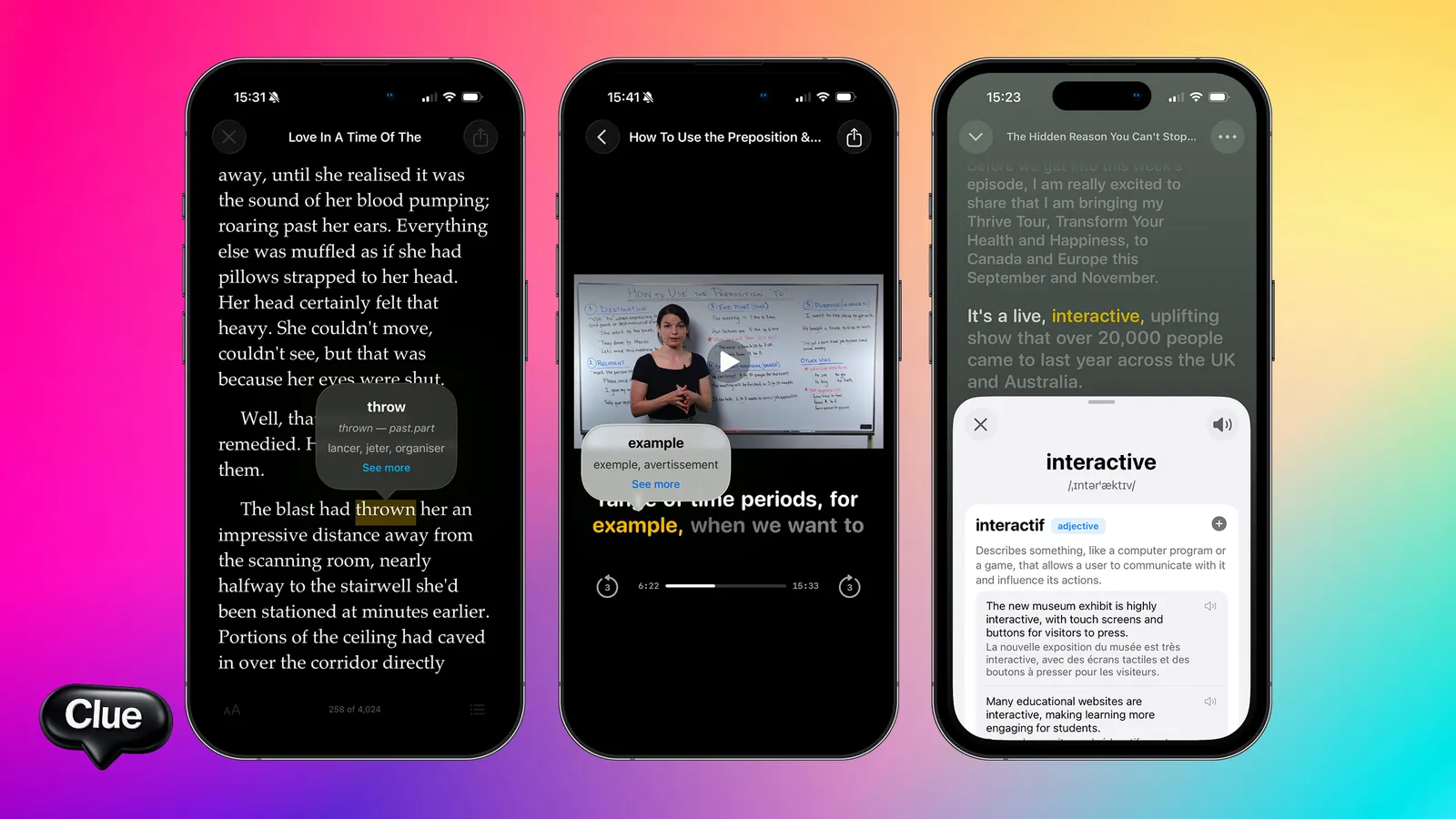
Clue is a tool, not a streaming service. The job is to take whatever you already want to consume and add a lookup layer on top.
Any podcast in your library. Paste an RSS feed and Clue adds the show. New episodes appear automatically. Whether it is BBC 6 Minute English, The Daily, This American Life, or some obscure interview podcast you found through a friend, Clue handles it.
Any book as EPUB, PDF, or plain text. Drop the file in from iCloud Drive or Files. Project Gutenberg gives you 70,000 free public-domain English books out of the gate, plus any DRM-free EPUB you can find from independent publishers.
YouTube videos with their captions. Paste a video URL and Clue pulls the captions for tap-to-translate. Works on the channels you already follow, not just a curated subset.
Movie subtitles work via SRT files. Find an SRT file online for the film you want to watch, load it into Clue, play the movie on your TV or laptop, and follow along on your phone. Less integrated than Lingopie, dramatically more flexible.
Everything is offline. The 27,000-word dictionary is bundled with the app. Lookups are local. Practice mode works on a flight. You only need internet to download new content.
On-device transcription. If a podcast lacks a transcript, Clue runs Whisper locally to generate one. Your audio never leaves your phone, and there are no per-minute server fees.
Free, in a structural sense. No subscription tier. No “free for the first month.” No locked features.
Where Clue is more limited
Clue’s flexibility comes at a real cost.
No streaming TV library. If you want to open an app and have a German telenovela ready to play, Clue cannot do that. The TV workflow in Clue requires you to source a subtitle file, which is friction Lingopie has eliminated.
Mobile only. Clue runs on iOS and Android, but there are no web or TV apps. Lingopie still wins on platform breadth.
English only. All 15+ Lingopie languages are unavailable in Clue. If you are learning anything other than English, this comparison is over before it starts.
Smaller curated library. Clue ships with a small starter set, but most of the value is in what you bring. If you want a deep curated library to browse without thinking, Lingopie has it and Clue does not.
No tap-to-translate inside the Netflix or YouTube apps. Clue’s reader is its own surface. You watch the video elsewhere and follow along in Clue with the captions or subtitle file. That second-screen workflow is fine for some learners and irritating for others.
Pricing in real numbers
Lingopie’s pricing changes periodically, but typical tiers are roughly:
- Monthly: around $12.
- Annual: around $67/year (effective ~$5.60/month).
- Lifetime promos: occasional one-time payment offers in the $100–$200 range during sales.
Over five years at the annual rate, you spend about $335. The lifetime promo, if you catch it, is a much better deal.
Clue costs nothing. The full app, the full dictionary, the full feature set, in all 10 supported native languages. The team is small, the scope is narrow, and the model does not depend on subscriptions.
The pricing comparison is not the whole story — Lingopie’s licensed library has genuine value that costs money to acquire — but for learners watching the spreadsheet, the difference is real.
Methodology: streaming vs flexibility
Both products believe that real content beats invented exercises. They disagree on what “real content” should look like and how it should reach you.
Lingopie’s bet: entertainment is the engine. If learners enjoy what they watch, they watch more, and consistency follows. A curated, integrated library removes excuses about “what to watch tonight.” The subscription fee creates commitment.
Clue’s bet: the content you actually want to consume already exists, scattered across the open web — podcasts in your podcast app, books on Project Gutenberg, YouTube channels you follow. The job of a learning tool is to add a lookup layer on top, not to gatekeep the content itself.
Neither bet is obviously correct. They produce different products for different consumption habits.
When learners use both
A small number of learners use Lingopie and Clue together:
- Lingopie for evening TV time — sit down with a glass of wine, pick a show from the library, do the relaxed half-active learning that streaming makes natural.
- Clue during the day — podcast listening on the commute, book reading at lunch, quick YouTube videos in down time.
This works if you have the budget and the time. Most learners pick one and run with it.
Pick the one that fits your actual consumption

Honest questions to ask yourself:
- How much TV do you watch? A lot of TV → Lingopie has a real advantage. A little TV → Clue covers your other formats better.
- How much podcast and audiobook listening do you do? A lot → Clue. A little → Lingopie’s lack of audio focus is less of a problem.
- Do you want to read English novels? Yes → Clue. No → either works.
- What platform are you on? Phone (iPhone or Android) → either. Web or Apple TV → Lingopie.
- What’s your budget? Free → Clue. $5–12/month is fine → either.
- Are you learning more than English? Yes → Lingopie. English only → Clue is sharper for that one job.
FAQ
Does Clue have its own video library?
No. Clue is a lookup tool, not a streaming service. You play videos in whatever app you normally use, and Clue handles the subtitles or captions in parallel on your phone.
Is Clue cheaper than Lingopie?
Clue is free; Lingopie is a paid subscription. Over a year, the difference is $60–140 depending on which Lingopie plan you take.
Can I use Clue with Netflix?
Not directly. The workflow is: find an SRT subtitle file for the show or film, import it into Clue, play the content on Netflix on a separate device, and follow along on your phone. Less polished than Lingopie’s integrated streaming.
Does Lingopie support podcasts or audiobooks?
Lingopie is TV-first. Some audio content exists in the library but it is not the focus. For audio-heavy learning, Clue is the better fit.
Which has better movies?
Lingopie is more integrated for film viewing — everything plays inside the app with built-in subtitles. Clue is more flexible because you can use any film you can find subtitles for, including films Lingopie has not licensed. Different strengths.
Does Clue work on Android?
Yes — Clue is now available on both iOS and Android.
Can I use Lingopie offline?
Some content can be downloaded on the subscription tier, but the experience is built around streaming with internet. Clue is offline-native — the dictionary, library, and practice all work without any connection.
Different bets on the same idea
Lingopie bets that learners want a streaming-style TV experience, curated and integrated and ready to watch. Clue bets that learners want freedom to use any content they already want to consume, with a tool that works offline on their phone for free.
Both bets are defensible. Which one fits you depends on what you actually watch, listen to, and read in your free time. If your honest answer is “mostly TV in the evening, on the couch, on the big screen,” Lingopie is the right tool. If it’s “podcasts on the commute, books at night, YouTube during lunch, occasional movies,” Clue is the right tool.
Try both if you can — Lingopie usually has a free trial, and Clue is permanently free. A week of real use will tell you which side of the trade you are actually on.
Frequently asked questions
What's the difference between Clue and Lingopie? +
Lingopie is a streaming service: you watch shows from its own curated catalogue with interactive subtitles. Clue is a learning layer for content you choose yourself — podcasts, YouTube videos and books — with instant tap-to-translate. Lingopie gives you the library; Clue lets you bring your own.
Is Lingopie worth it for learning English? +
Lingopie can be effective if you enjoy learning from TV and like a ready-made, learner-friendly catalogue. Its limits are the catalogue itself (you're restricted to what's licensed) and the subscription cost. If you'd rather learn from any content you already love — not just a fixed library — a tool-based approach like Clue fits better.
Is Clue free, and is Lingopie free? +
Clue is free to use. Lingopie is a paid subscription service (often with a short free trial). So beyond the content philosophy, there's a cost difference: Clue lets you learn from real content without a paywall.
Can I learn English from TV shows with Clue like with Lingopie? +
Yes — Clue works with video content, including YouTube, plus podcasts and books, with tap-to-translate subtitles. The difference is you bring the content you want rather than choosing from a fixed catalogue. Lingopie centres on its own licensed TV library; Clue centres on whatever real content you choose.
Read in other languages
Related articles
- English Phrases for Everyday Situations: What to Actually Say in 10 Common Moments You know the grammar, you know the vocabulary, and then a waiter asks "Are you all set?" and you freeze for two seconds because no one ever taught you…
- The Best YouTube Channels to Learn English in 2026 The best YouTube channels for English learners — by level, topic, and accent. Real recommendations, not list-spam, with notes on each.
- Learn English Online: A Free, Course-Free Guide for Adults Most "free English courses for adults" online are either pitched at absolute beginners learning the alphabet, or they're a free trial that ends with a…
- English for Portuguese Speakers Learn English from real podcasts, YouTube, and books with one-tap Portuguese translations. Offline dictionary, designed for Brazilian and European Portuguese speakers.


