
Elif Kaya
Contributing writer · Published May 22, 2026
English Grammar Essentials: The Eight Areas That Cover 90% of Real Use
You memorized the present perfect three times in school, you got the perfect score on the worksheet, and a week later you still write “I have seen him yesterday.” Grammar in classrooms is structured. Grammar in your head needs reps. This is what to focus on if you only have time for the essentials.
Why Grammar Still Matters
There are people on the internet who will tell you grammar is irrelevant and you can just absorb English from listening. They are half right. You can absorb a lot. But the parts that absorption misses are exactly the parts where grammar matters: articles, prepositions, conditionals, the present perfect.
Three honest reasons to study grammar deliberately:
- Errors in these specific areas mark you as a learner faster than vocabulary gaps do. “I have lived in Berlin since five years” tells a native ear immediately that you are not native.
- Some structures rarely appear in your input enough to absorb passively. The third conditional (“If I had known, I would have called”) is real English but uncommon in podcasts.
- You can self-correct in writing if you know the rule. You cannot self-correct what you do not know.
The trick is to study grammar in the right way: short bursts, lots of examples, immediate application, not 200-page reference books read end to end.
Articles: a / an / the

The single most common error among non-native speakers, and the one that takes the longest to fix.
When to use “a” or “an”
- General singular countable nouns when introducing them. “I bought a book.” (Which book? Doesn’t matter yet.)
- Jobs and roles. “She’s a doctor.” “He’s an engineer.”
- “An” before vowel sounds, not vowel letters. “An hour” (silent h), “a university” (sounds like “you”).
When to use “the”
- Specific things already mentioned or known. “I bought a book. The book was great.”
- Things there is only one of. “The sun.” “The earth.” “The president of France.”
- Superlatives. “The best restaurant.”
- Some geographical features. “The Atlantic.” “The Alps.” “The Netherlands.”
When to use nothing (zero article)
- Plural and uncountable general statements. “Cats are clever.” “Coffee is expensive.”
- Most countries, cities, languages. “I live in France.” “I speak Spanish.”
- Meals, sports, school subjects in general. “Dinner is at 7.” “I play tennis.” “She studies physics.”
A useful instinct: if the listener could ask “which one?” and you have a specific answer, use “the.” If you mean any one of many, use “a.” If you mean the category, use nothing.
This is the single grammar point that improves slowest with study. Most fluency happens through exposure to thousands of correctly-used articles.
Prepositions: in, on, at, to, for
Prepositions are pure memorization in any language. Here are the patterns that cover most cases.
Time
- At for specific times. “At 7 pm.” “At noon.” “At Christmas.”
- On for days and dates. “On Monday.” “On December 5th.”
- In for months, years, longer periods. “In March.” “In 2024.” “In the morning.” “In the 90s.”
Place
- At for points and specific locations. “At the bus stop.” “At the door.”
- On for surfaces. “On the table.” “On the floor.” “On the second floor.”
- In for enclosed spaces. “In the room.” “In the car.” “In the box.”
Movement
- To for destinations. “I’m going to Paris.”
- Into for entering. “He walked into the room.”
- From for origins. “She’s from Mexico.”
Common combinations to memorize
- For + duration. “I’ve lived here for five years.”
- Since + starting point. “I’ve lived here since 2020.”
- By + deadline. “Finish by Friday.”
- Until + endpoint. “Until Friday.”
- Good at + skill. “She’s good at math.”
- Interested in + subject. “I’m interested in design.”
- Afraid of + thing. “He’s afraid of dogs.”
- Married to + person. “She’s married to a doctor.”
Prepositions do not translate. Stop trying. Memorize the combinations as units.
Modals: can, could, should, would, must

Modals are tiny verbs that change the meaning of the main verb. They have no -s in the third person (“She can,” not “she cans”) and they take the bare infinitive (“She can swim,” not “She can to swim”).
can / could
- Can = ability. “I can speak French.”
- Can = permission. “Can I go now?”
- Could = past ability or polite present. “I could swim when I was five.” “Could you help me?“
should / shouldn’t
- Advice or expectation. “You should rest.” “She should be here by now.”
would
- Hypothetical. “I would buy a house if I had money.”
- Polite request. “Would you like coffee?”
- Past habit. “When I was a kid, I would walk to school.”
must / mustn’t / have to
- Must = strong necessity or strong belief. “You must wear a helmet.” “She must be tired.”
- Mustn’t = prohibition. “You mustn’t touch this.”
- Have to = external obligation. “I have to work tomorrow.”
Note: “mustn’t” and “don’t have to” are different. “You mustn’t go” means you are forbidden. “You don’t have to go” means it is not required.
might / may
- Possibility. “It might rain.” “She may be late.”
will / won’t
- Future. “I’ll call you tomorrow.”
- Refusal. “He won’t listen.”
Conditionals: Zero, First, Second, Third, Mixed
The conditional system is the most-taught and most-mangled area of English grammar.
Zero conditional: facts
If + present simple, present simple. Used for general truths.
- “If you heat water, it boils.”
- “If I eat dairy, I get sick.”
First conditional: realistic future
If + present simple, will + base verb. Used for likely future situations.
- “If it rains, we’ll stay home.”
- “If you study, you’ll pass.”
Second conditional: unreal present or unlikely future
If + past simple, would + base verb. Used for hypothetical situations.
- “If I had a million dollars, I would buy a house.”
- “If she lived closer, we would meet more often.”
The “was/were” issue: traditionally “if I were” is correct (“If I were rich…”), but “if I was” is now widely accepted in casual speech.
Third conditional: unreal past
If + past perfect, would have + past participle. Used for situations in the past that did not happen.
- “If I had known, I would have called.”
- “If we had left earlier, we wouldn’t have missed the train.”
Mixed conditional: past condition, present result
If + past perfect, would + base verb.
- “If I had studied medicine, I would be a doctor now.”
- “If she hadn’t moved to Berlin, we wouldn’t be married.”
This is one of the more subtle grammar points and rarely mastered without months of exposure.
Present Perfect vs Past Simple

The single grammar point that European learners struggle with most, because most European languages do not make this distinction the same way.
Past simple (preterite): finished time
Used for actions in a completed time period. The time is over or specified.
- “I saw her yesterday.”
- “I worked there last year.”
- “I went to Paris in 2019.”
Present perfect: connection to now
Used for actions in unfinished time, life experience without specific date, or recent events with present relevance.
- “I’ve seen her.” (sometime in my life, no specific time)
- “I’ve worked here for three years.” (and I still do)
- “I’ve just finished.” (recently, present relevance)
Key distinction
- “Did you eat?” = a specific occasion in the past
- “Have you eaten?” = at any point up to now
Common errors
- “I have seen him yesterday.” Wrong. “Yesterday” is finished time. “I saw him yesterday.”
- “I am living here since 2020.” Wrong. Continuous action from past to present is present perfect. “I’ve been living here since 2020.”
- “I live here for five years.” Wrong. “I’ve lived here for five years.”
The trick is to remember that the present perfect almost always has some connection to “now,” even if it is implicit.
Reported Speech
Reporting what someone said usually shifts tenses one step into the past.
Direct vs reported
- Direct: “I’m tired.”
- Reported: “He said he was tired.”
Tense shifts
- Present → past. “I work” → “He said he worked.”
- Past → past perfect. “I worked” → “He said he had worked.”
- Will → would. “I’ll come” → “She said she would come.”
- Can → could. “I can swim” → “She said she could swim.”
Pronoun shifts
- “I love you” → “He said he loved her.”
- “We will help” → “They said they would help.”
Questions
- “What time is it?” → “She asked what time it was.”
- “Do you speak French?” → “She asked if I spoke French.”
Word order in reported questions reverts to statement order. No question mark.
When to skip the shift
If the reported statement is still true, you can leave the present tense.
- “She said she lives in Berlin.” (and she still does)
Gerund vs Infinitive

After certain verbs, you use the -ing form. After others, you use “to + verb.” After some, either works with different meanings.
Verbs followed by -ing
- enjoy, finish, avoid, consider, suggest, recommend, mind, can’t help, look forward to
- “I enjoy reading.”
- “She finished writing the report.”
Verbs followed by infinitive
- want, decide, plan, hope, agree, refuse, learn, manage, promise, choose
- “I want to leave.”
- “She decided to stay.”
Verbs that take both with different meanings
- Remember to do = remember and then do it. “Remember to lock the door.”
- Remember doing = recall a past event. “I remember locking the door.”
- Stop to do = stop in order to do something. “I stopped to eat.”
- Stop doing = quit doing something. “I stopped eating sugar.”
- Try to do = attempt. “I tried to call.”
- Try doing = experiment with. “Try drinking less coffee.”
After prepositions, always -ing: “interested in working,” “good at swimming,” “before leaving.”
This area takes patience. The verb lists are not random, but the patterns are subtle.
Passive Voice
Passive voice flips the focus from who did the action to what was done.
- Active: “The chef cooked the meal.”
- Passive: “The meal was cooked by the chef.”
Why use passive
- When the doer is unknown. “My bike was stolen.”
- When the doer is obvious. “The package was delivered.” (by the courier, of course)
- When you want to emphasize the action or result. “The bridge was built in 1880.”
- For formal or scientific writing. “The experiment was conducted in three phases.”
Forms
- Present simple: is/are + past participle. “It is made in Italy.”
- Past simple: was/were + past participle. “It was painted by Picasso.”
- Present perfect: has/have been + past participle. “It has been finished.”
- Future: will be + past participle. “It will be done.”
- Modals: modal + be + past participle. “It can be repaired.”
When to avoid passive
In casual conversation and most writing, active voice is more natural. Overusing passive sounds bureaucratic.
How to Learn Grammar Naturally
Stop reading 500-page grammar books
Reference grammars are useful for looking things up, not for sequential study. Pick one chapter at a time and apply it.
Use a workbook or app for active reps
You need to produce sentences, not just recognize them. Cambridge English Grammar in Use, Murphy’s English Grammar in Use, or a SaaS like LangCorrect work well.
Tie grammar to reading and listening
When you meet a third conditional in a podcast, notice it. The pattern reinforces itself. Random grammar drills without context fade fast.
Get corrections
Find a way to get your output corrected: a tutor, an exchange partner, a community like italki or LangCorrect. Errors that go uncorrected become habits.
Accept that some grammar comes slowly
Articles (a/an/the) take years to fully internalize for speakers from article-less languages (Russian, Polish, Turkish, Japanese). Do not expect a breakthrough in two weeks.
Common Mistakes
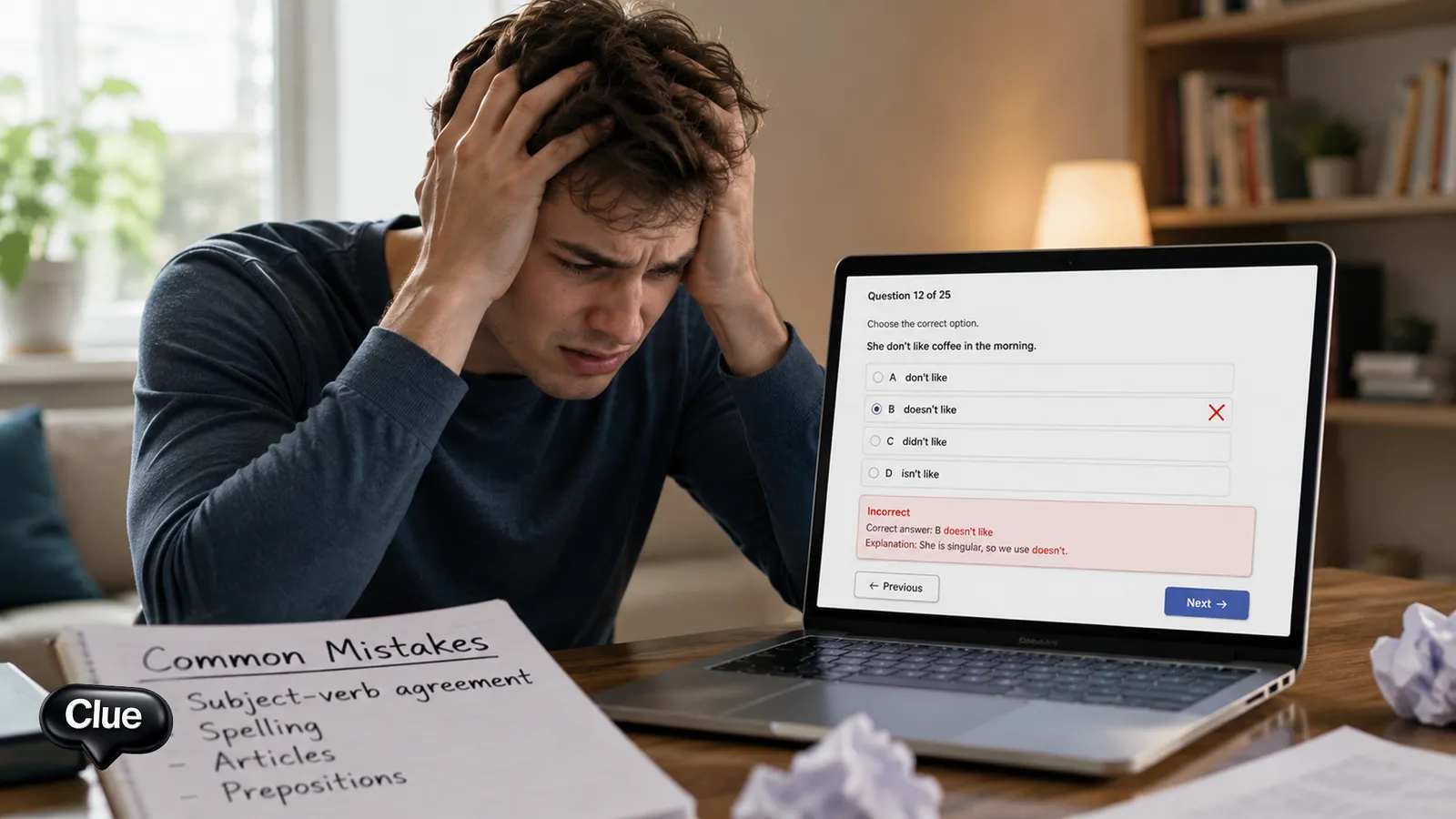
- Using present perfect with finished time markers. “I have seen him yesterday.” Wrong. “I saw him yesterday.”
- Confusing for and since. “I’ve lived here for 2020” should be “since 2020.” “Since five years” should be “for five years.”
- Missing third-person -s. “She work in marketing” should be “She works.” This is a constant slip even at C1.
- Treating modals as full verbs. “She musts go” or “She can to swim” are wrong. Modals are followed by bare infinitive.
- Overusing the passive. “It was decided by the team that the meeting will be rescheduled” is awkward. “The team decided to reschedule the meeting” is cleaner.
- Translating idioms grammatically. “I have hunger” (from “Tengo hambre” or “Ho fame”) should be “I’m hungry.”
- Using a/an with uncountable nouns. “An information” is wrong. “Some information” or “a piece of information” is right.
- Trusting your translation app for grammar. Translators handle vocabulary well and grammar inconsistently. Always sanity-check.
Where Clue Fits In
Clue is not a grammar tool, and that is intentional. We focus on vocabulary and content because grammar without context is forgettable. But when you read or listen inside Clue and meet a present perfect, a third conditional, or a passive structure, you see it in real use, by real speakers, in real conversations. That is the kind of exposure that makes grammar stick.
For deliberate grammar study, use a dedicated book or workbook. For grammar absorption, use real content. The two together is the fastest combination.
Frequently Asked Questions
How important is grammar for fluency?
Important but overrated. Vocabulary and listening practice produce faster fluency gains than grammar drills. That said, ignoring grammar entirely leaves persistent errors that are hard to fix later.
What’s the most important grammar point?
For most learners: articles (a/an/the), the present perfect vs past simple distinction, and prepositions. These three areas cause the most visible errors.
Can I just absorb grammar from listening?
Partially. Common patterns absorb well. Rare patterns (third conditional, mixed conditional, formal passive) need deliberate study because they appear too infrequently to learn passively.
How long does it take to master English grammar?
Most learners reach functional competence in 6-12 months of consistent study. Mastery of subtle areas (articles, conditionals, perfect tenses) takes 3-5 years of exposure plus deliberate practice.
Are British and American grammar different?
Slightly. Americans often use the past simple where British use the present perfect (“Did you eat?” vs “Have you eaten?”). Americans use “gotten” as a past participle, British use “got.” The differences are minor.
Should I learn formal or informal grammar?
Both, but in proportion to your needs. Most learners spend too much time on formal grammar and too little on the casual structures that make up daily speech. “I gotta go” and “I’m gonna” are grammar too.
What’s a “grammar book” worth recommending?
Murphy’s English Grammar in Use is the classic. Cambridge Grammar of English (Carter & McCarthy) is more thorough. Both are reference books, not novels.
Closing
Grammar is not a finish line. It is a baseline. Master the eight areas in this article and you can write and speak intermediate-to-advanced English with confidence. The subtler points (subjunctive, complex conditional structures, formal academic constructions) you can pick up later, as you need them. Most native speakers do not consciously know half of the rules in their own language. They just feel them. You can get there too, given time and reps.
Read in other languages
Related articles
- The Best TV Series to Learn English in 2026, by Level The best TV shows for English learners — beginner to advanced. Real recommendations with notes on accent and difficulty, plus how to actually learn from them.
- How to Learn English by Yourself: A Self-Study System That Actually Works You've tried the apps, watched a few YouTube tutorials, maybe even paid for a course you stopped using by week three. The truth is most adults don't stall…
- English for Intermediate Learners: How to Break the B1–B2 Plateau Stuck at B1 or B2? Why the intermediate plateau happens and how to break through with real content, active vocabulary work, and a different daily routine.
- How to Learn English Grammar Step by Step: A B1-to-C1 Roadmap That Doesn't Drill You to Death Most "step by step" grammar guides hand you the same checklist: present simple, past simple, present continuous, future, conditionals, and so on. You…