


Oksana Kovalenko
Language-learning writer · Published May 22, 2026
English for Russian Speakers
Russian-speaking learners face a steeper start than most: different alphabet, different sentence rhythm, very different verb logic. But once the basics are in, Russian speakers tend to reach upper-intermediate quickly — the abstract vocabulary, especially in academic and technical fields, has more in common with English than the everyday words suggest.
Clue is the tool for the next stage. Real podcasts, real YouTube videos, real books — every word tappable, every translation in Russian, full dictionary on your phone with no internet required.
Where Russian speakers usually plateau
The plateau usually shows up around B2: enough English to read articles and follow simple conversation, not enough to enjoy a film without subtitles or follow a fast podcast. The gap is rarely grammar — it’s a vocabulary gap of about 5,000 words and a listening-speed gap that only volume can close.
Volume of comprehensible input. Hundreds of hours of real English with quick translation when you need it. That’s exactly what Clue is built for.
How Clue works for Russian learners
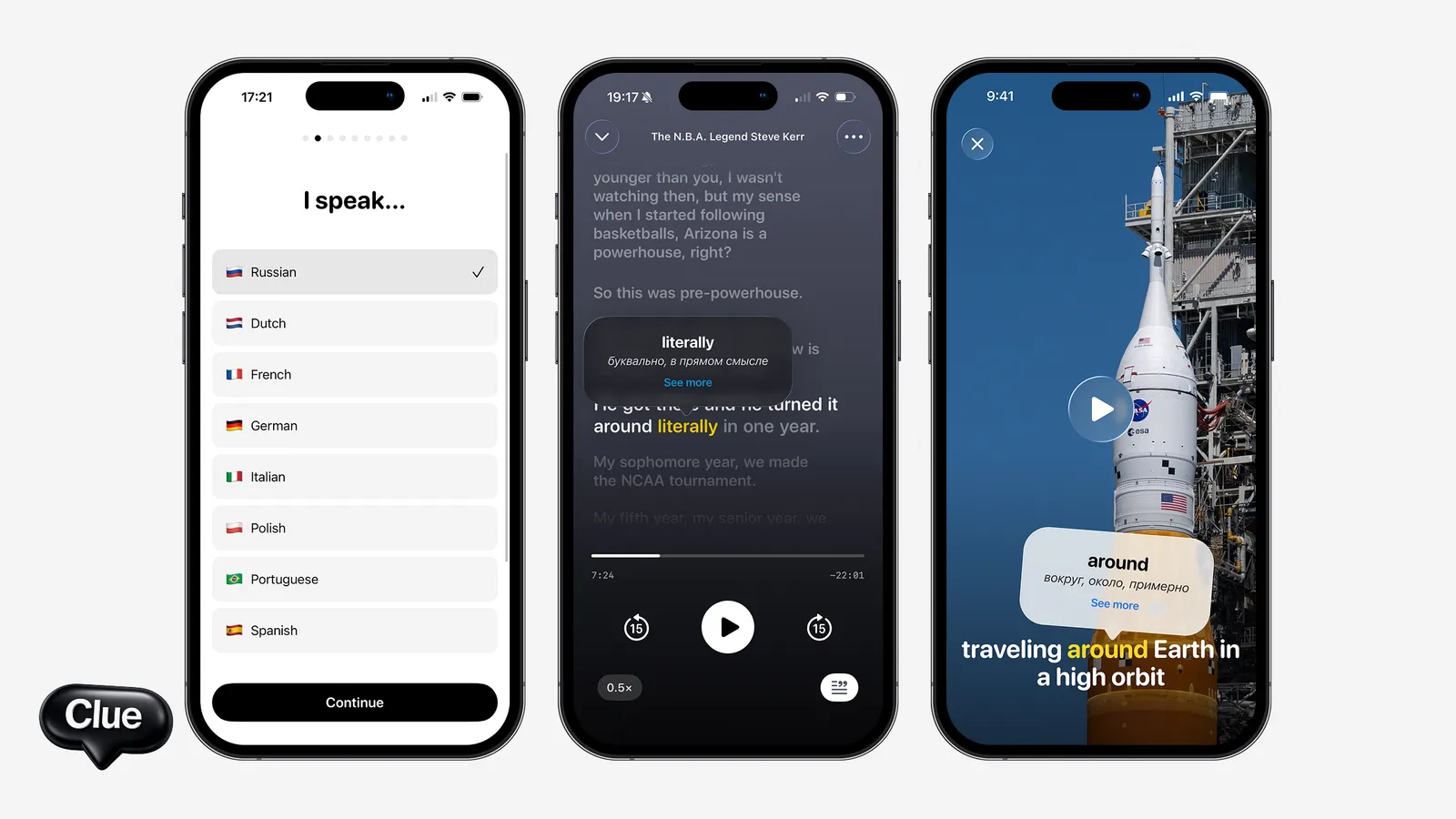
Choose Russian during onboarding. Every word lookup returns the Russian translation that fits the sentence, not a generic dictionary entry. The 27,000-word dictionary is bundled inside the app — лookups work offline, on the metro, on a flight.
Open any podcast, YouTube channel, or book. Tap a word, see the meaning. Save it. Saved words flow into a flashcard deck with the original sentence as context.
Best English content for Russian speakers
Podcasts: ‘Lex Fridman’ (long-form, technical and humanities), ‘The Daily’ (NYT, 25-min news), ‘BBC Global News’ (5-min twice daily).
YouTube: Veritasium, Vsauce, Kurzgesagt — narration is slow enough for intermediates, vocabulary is rich.
Books: ‘Sapiens’ (Yuval Harari), ‘Educated’ (Tara Westover), or anything by Ishiguro — clean prose, modern vocabulary.
False friends Clue catches in real time
Sympathetic doesn’t mean ‘симпатичный’. Magazine doesn’t mean ‘магазин’. Accurate doesn’t mean ‘аккуратный’. Clue’s translation always reflects the meaning in context, so the false friend doesn’t have a chance to stick.
For learners across the Russian-speaking world

Russia, Belarus, Kazakhstan, the Baltics, Ukraine, the global Russian-speaking diaspora — wherever you are, the app works the same. The only thing that changes is your wifi quality, and the dictionary is offline anyway.
FAQ
Работает ли Clue без интернета?
Да. Словарь на 27 000 слов, сохранённые слова и режим практики работают полностью офлайн. Интернет нужен только для скачивания нового контента.
Сколько стоит?
Clue полностью бесплатный — скачивайте и пользуйтесь без ограничений. Никакой подписки, никаких платных стен, никаких лимитов на переводы или контент.
Чем Clue лучше Duolingo?
Это разные инструменты. Duolingo — упражнения и геймификация. Clue даёт реальный английский (подкасты, видео, книги) и помогает учиться из него. Многие используют оба — Duolingo для базы, Clue для перехода к реальному контенту.
С какого уровня имеет смысл начинать?
С уверенного A2 и выше. Ниже — будете тапать каждое слово; выше — попадаете в зону, где приложение реально ускоряет прогресс.
Можно ли загрузить свои подкасты?
Да. Вставьте RSS-ссылку любого подкаста, и Clue добавит его в библиотеку. Если у эпизода нет транскрипта — Clue распознаёт его на устройстве через Whisper, без облака.
Из учебников — в реальный английский
Большинство русскоязычных учеников застревают не из-за грамматики, а из-за нехватки часов реального инпута. Clue убирает главное препятствие — необходимость отвлекаться на словарь. Поставьте подкаст сегодня, тапните несколько слов, и через месяц заметите, как изменилось восприятие беглой речи.
Related articles
- English Pronunciation: What Matters, What Doesn't, and 30 Words People Get Wrong You can speak English with a strong accent and still be perfectly understood. You can also pronounce "comfortable" or "Wednesday" wrong for fifteen years…
- English Audiobooks Guide: Audible, Spotify, and LibriVox by Level Audiobooks are one of the most underused tools in English learning. If you already have the reading level to follow a book but your listening comprehension
- English News for Learners: The Best Sources at Every Level The best English news sources for language learners — from slow learner news to The New Yorker. How to use news for learning without doomscrolling.
- Commonly Confused English Words: 30+ Pairs That Trip Up Even Advanced Learners You write a polished email, hit send, and a minute later you realize you wrote "your" when you meant "you're." Or you said "I borrowed him my charger" out…


