


Ana Ferreira
Language-learning writer · Published May 22, 2026
English News for Learners: The Best Sources at Every Level
News is one of the best daily sources of English input for language learners. The vocabulary is fresh, the topics are real, the register is what educated native speakers actually use, and the genre’s discipline (clear sentences, concrete facts) makes it more accessible than literary prose at every level.
It is also one of the easiest sources to use badly. Doomscrolling The New York Times homepage in English is not language learning — it’s the same anxious behavior in a different language. To get real value from English news, you need the right source at your level and a real practice loop, not just exposure.
This article covers the news sources that work best for learners at each level, with notes on whether each is audio, text, or both, and how to use them without burning out.
Why news is uniquely valuable for learners

Three structural reasons news beats most other content for daily language practice:
It’s daily. Built-in habit reinforcement. You don’t have to “find time” to read news — most people already do, in some language. Switching that habit to English costs nothing in time.
It’s topical. You already care about what’s happening. The motivation to keep reading carries you through difficult vocabulary in a way that fiction sometimes can’t.
It’s repetitive. The same vocabulary appears across days as the same stories develop. Inflation, ceasefire, subpoena, parliament, recession — words that felt foreign in week one become natural in week three because they’ve appeared 30 times.
It’s real. Journalists write for adult native speakers, not for learners. The English is genuine, not simplified.
The combination is unusual. Books are dense but not daily. Podcasts are daily but often topic-narrow. News hits both volume and variety.
Beginner level (A2–B1): slow, simplified, designed for learners
Real news at native speed is too fast for A2–B1 learners. The good news: there are well-made simplified news products specifically for this stage.
BBC Learning English: News Review
The BBC’s learner-focused news show. Two presenters discuss the day’s biggest story in slow, clear British English. Vocabulary is explained as it appears; the transcript is on the BBC site for free.
Episodes are 6–10 minutes. The format is consistent — story summary, vocabulary highlights, sample sentences. Twice a week. Easily the best single news source for A2–B1 English learners.
Voice of America Learning English
The American equivalent. Full website at learningenglish.voanews.com with audio, video, and text versions of news stories at controlled pace. Vocabulary glossaries on most articles. Free, government-funded, ad-free.
VOA’s Special English uses a 1,500-word vocabulary and a slowed speaking pace. Excellent for A2 learners specifically.
News in Slow English
Weekly podcast in American and British editions. News stories at slow speed with full transcripts. The first portion of each episode is free; the deeper learning features (vocabulary lessons, grammar explanations) require subscription.
Worth trying the free version before subscribing.
Newsround (BBC)
The BBC’s news show for British children. Short, well-presented, with vocabulary aimed at 8–13 year-olds. Surprisingly useful for adult A2 learners because the vocabulary is real but accessible.
Intermediate level (B1–B2): daily briefs and short articles
At B1+, you can handle real news, especially in short-brief format.
NPR Up First (audio + transcript)
American daily 10-minute news briefing from NPR. Three hosts rotate through the week, clean delivery, transcripts free on the NPR site. The best short-format daily news for intermediate learners.
The repetition of names, topics, and political vocabulary across days helps things settle in fast. After two weeks of daily NPR Up First, you’ll know who’s who in American politics and the major recurring vocabulary.
BBC Global News Podcast (audio + transcript)
Twice-daily British news, ~25 minutes per episode. BBC reporters from around the world cover international stories. Useful for accent variety — British, Irish, Australian, Indian, African, and many other English varieties appear regularly.
Reuters and AP News (text)
Wire service English — short sentences, neutral register, factual delivery. Reuters.com and apnews.com are free, well-organized, and exemplify the disciplined journalistic English style. Vocabulary is reachable at B1+ and the writing is clean.
The wire-service style is excellent for learners because it minimizes ornate vocabulary and complex sentence structures. The job is to convey information clearly. Use Reuters or AP if you want clarity without literary ambition.
The Daily (NYT) — audio with transcript
Twenty-five-minute daily long-form story from the New York Times. American English at full conversational speed. The transcripts are free on the NYT podcasts site.
Pace-wise, this is a step up from NPR Up First but the format (one story per episode, with narrative structure) makes longer stories easier to follow.
Today in Focus (Guardian) — audio with transcript
The Guardian’s daily British equivalent of The Daily. Long-form story per day, British perspective, free transcripts on the Guardian site.
BBC News (text)

The BBC News website is one of the best free news resources in English. Articles are well-written, clearly structured, and tagged by region and topic. Vocabulary is BBC journalistic — formal but accessible.
The Skimm Daily
A casual American newsletter that summarizes the day’s news in 5 minutes of reading. Email format. Conversational tone with some slang, which makes it useful for absorbing how Americans actually write.
Advanced level (B2–C1): mainstream serious journalism
At B2+, the major English-language newspapers are within reach. The vocabulary is journalistic; the writing is at native level.
The New York Times

Comprehensive American newspaper. The reporting is dense; the opinion section ranges from accessible (Ezra Klein) to dense (Ross Douthat). The Sunday magazine and long-form features are particularly worth reading at B2.
The website is paywalled with a small free quota; full access requires subscription.
The Washington Post
American counterpart to the NYT. Strong politics and national coverage. Similar paywall.
The Guardian
British daily. Free online, no paywall (though donations are requested). Excellent international coverage. The Guardian Long Read on Saturdays is some of the best journalistic writing in English.
The BBC News website
Free, no paywall, comprehensive coverage. The “Long Reads” section publishes substantial features.
The Times of London / The Telegraph
British dailies with a more conservative perspective. Paywalled. Useful if you want to read across the British political spectrum.
The Economist
Weekly British magazine covering global news, business, and culture. The writing style is distinctive — dense, witty, packed with allusions and analogies. Vocabulary is genuinely demanding.
The Economist is excellent at B2–C1 because every article tries to teach you something about an unfamiliar topic in 800 words. Vocabulary diversity per page is extremely high. Paywalled but with student discounts and intermittent free access.
Foreign Affairs
American magazine on international relations. Academic register, demanding vocabulary, slow pacing. Useful at C1+ for absorbing academic English in a journalistic frame.
Advanced (C1–C2): long-form journalism at literary register
At C1+, the long-form essay magazines become both readable and genuinely pleasurable. This is where English journalism crosses into literature.
The Atlantic
American monthly magazine. Long features (5,000–15,000 words) on culture, politics, science, and ideas. The writing is some of the best in English — careful, considered, often beautiful. Reachable at C1.
Notable contributors include Ta-Nehisi Coates, Caitlin Flanagan, Adam Serwer, James Fallows, and many others. The Atlantic’s archive is enormous and most articles are free.
The Guardian Long Read
Free, weekly, often political, frequently beautifully written. The British counterpart to The Atlantic’s long features. Many of the best are international in scope.
The New Yorker
The gold standard for long-form English prose. Demanding but worth the climb. Profiles, reportage, criticism, fiction, poetry, cartoons, the famous Talk of the Town. Vocabulary is genuinely literary — the magazine’s house style assumes a well-educated reader.
For C1–C2 learners, The New Yorker is one of the most rewarding regular reads in English. Paywalled but with generous free access.
The London Review of Books and The New York Review of Books
Bi-weekly literary review magazines. Long essay-length book reviews and original essays. The hardest accessible English in regular circulation. C2 territory.
Both magazines assume readers are themselves well-read in English literature and culture. The vocabulary is the most demanding of any general-circulation publication.
Aeon and Longreads (free)
Aggregators of high-quality long-form essays from around the web. Aeon focuses on ideas, science, philosophy. Longreads aggregates the best magazine-length journalism. Both are free and excellent.
How to use news for daily practice
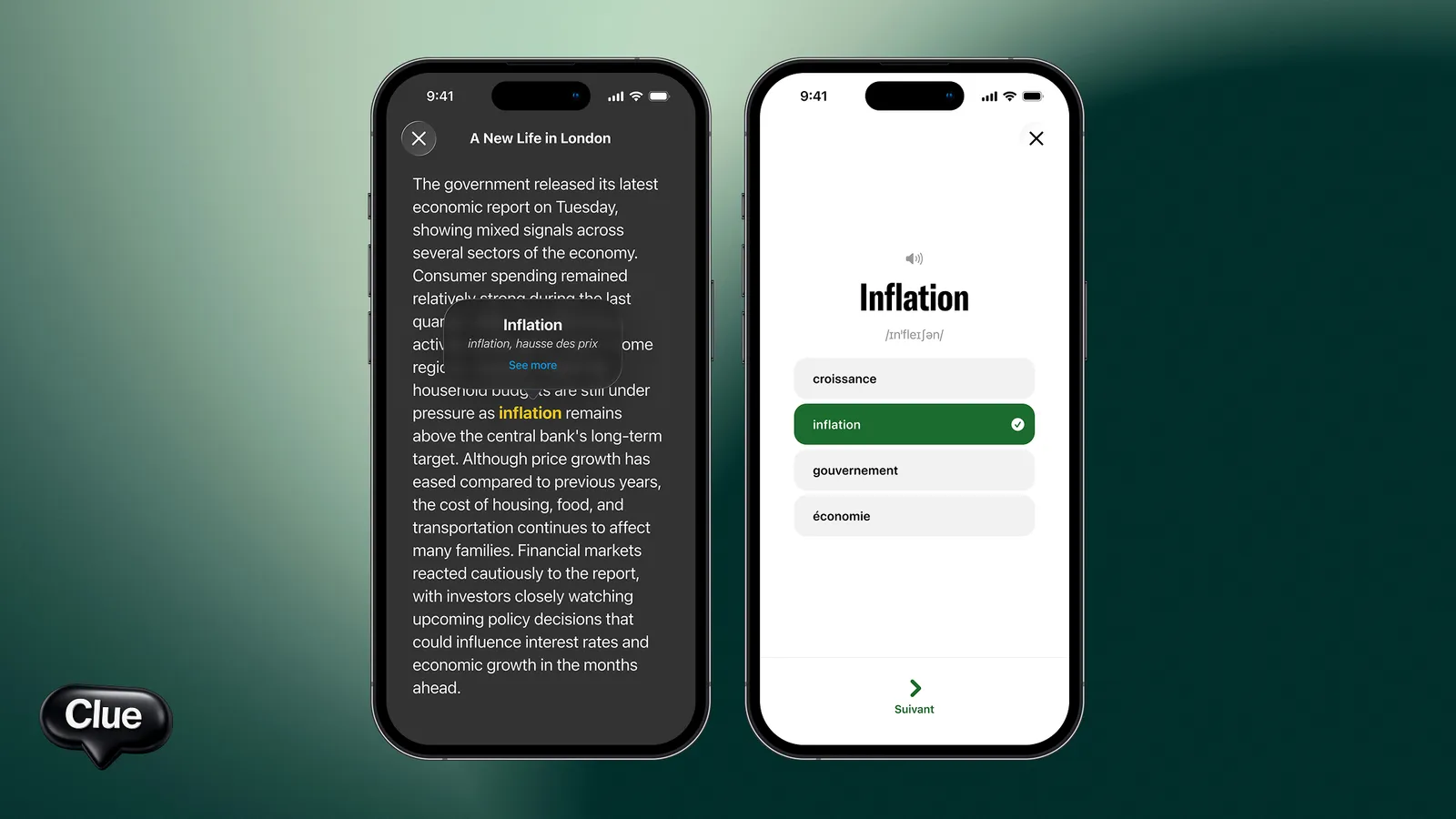
The right loop, repeated:
Pick one source. Not three, not five. One. Stick with it for at least a month.
Read or listen daily. Same time each day if possible. Morning is common; commute is common; pre-bed is fine if the news doesn’t keep you up.
Use Clue’s tap-to-translate. For text, paste articles into a plain-text file and read in Clue. For podcasts with transcripts, follow along with the transcript open. For podcasts without transcripts, Clue’s on-device Whisper transcription works.
Save 5–15 high-value words per day. Not every unknown word — only the ones you think you’ll meet again. News vocabulary is repetitive, so most of what you save will indeed recur within a week or two.
Run flashcard review twice a week. Saved words come back as multiple-choice cards with the original sentence as context.
That’s it. Sustained for three months, the loop produces measurable progress in news comprehension and journalistic vocabulary. The repetition of names and topics across days means vocabulary settles in fast — words like inflation, ceasefire, subpoena, quorum, and injunction stop being foreign within two weeks.
The trap of doomscrolling in English
A genuine warning: news consumption is correlated with anxiety, distraction, and time-on-screen that produces nothing useful. Most adults already over-consume news in their native language; switching to English doesn’t fix the problem and can make it worse because the friction of comprehension delays the natural exit from the doom-loop.
Three guidelines:
Time-box. Twenty minutes of news per day is plenty for both information and language learning. More than that and you’re using “learning” as an excuse for the behavior you’d otherwise be ashamed of.
Pick one source, not ten. Reading the same story across The NYT, The Guardian, BBC, Reuters, and Twitter teaches you nothing new and consumes hours. Pick one source you trust and trust it.
Read full articles, not headlines. Scrolling headlines is the worst form of news consumption. You absorb anxiety without information. Full articles take longer per piece, which naturally limits volume and produces better understanding.
If you find yourself opening news apps more than twice a day, you have a doomscrolling problem, not a language-learning practice.
How to combine news with other content
News is excellent but it shouldn’t be your only English input. A balanced learning diet:
- News (15–25 minutes daily): Vocabulary in current contexts, repetition across days.
- Podcasts (20–30 minutes daily): Longer-form audio, ear training.
- Books (20–30 minutes daily): Density of language, narrative momentum.
- YouTube videos (occasional): Visual context, accent variety.
The combination produces a learner who hears, reads, and speaks across multiple registers. News alone produces a learner who can read journalism well but feels lost in fiction or casual conversation.
A note on AI-generated news summaries

Many newsletters now use AI to summarize the day’s news in three-paragraph briefings. These can be useful for getting the gist quickly, but they’re not great for language learning — the summarizing process flattens vocabulary diversity and produces uniformly clean prose that strips out the texture of real journalism.
For learning, read or listen to the original article. Use AI summaries when you genuinely just want the information.
FAQ
Where can I get transcripts of news podcasts?
Most major shows publish transcripts on their site — NPR, BBC, NYT, Guardian all do. For shows without transcripts, Clue’s on-device Whisper transcription handles any podcast audio in English.
Is it OK to read news in English even if I miss a lot?
Yes, if you use Clue (or a similar lookup tool) to tap unknown words. The repetition of names, places, and topics across days fills in gaps faster than you’d expect. Within two weeks of daily reading, the recurring vocabulary stops being foreign.
How much news per day?
15–30 minutes is the practical limit for active learning. Beyond that, returns diminish and the doomscrolling risk grows.
British or American news first?
Pick the one closer to your goals. Both are equally useful for language learning; the difference is the political and cultural perspective. Many serious learners read both — say, BBC for British/international coverage and NYT or NPR for American.
Can I use Clue with newspaper websites directly?
Copy the article text into a plain text file or paste it into Clue’s reader. Direct integration with paywalled news sites isn’t available, but the manual copy-paste flow is fast.
Should I read business and economics news?
If you have any interest in those topics, yes — the vocabulary is high-density and useful in professional contexts. The Economist is the best single source for business and global politics; Financial Times and Bloomberg are alternatives.
What about local news from English-speaking countries?
Excellent for cultural fluency. A few months of Toronto news teaches you Canadian English and Canadian context; same for Sydney, Auckland, Glasgow, Dublin. Local news sites are usually free.
Pick a paper. Read every morning.
A daily news habit in English is one of the highest-leverage things you can do for your language. Pick one source at your level, read or listen for 20 minutes, tap the words you don’t know in Clue. After a month, the vocabulary that felt foreign starts to feel ordinary.
The wrong approach is bouncing between five sources or treating “English news” as an undifferentiated category. Pick one. Trust it. Build the habit. The depth of repeated exposure to a single source beats the breadth of scattered consumption every time.
Read in other languages
Related articles
- English for Portuguese Speakers Learn English from real podcasts, YouTube, and books with one-tap Portuguese translations. Offline dictionary, designed for Brazilian and European Portuguese speakers.
- The Best Podcasts to Learn English in 2026, by Level The best English podcasts for learners in 2026 — beginner, intermediate, advanced. Real recommendations, not list-spam, with notes on each.
- Learn English Fast: An Honest Method for 45 Minutes a Day Most advice about learning English fast is either useless or dishonest. This article gives you a realistic picture of what's possible, what actually accele
- English for Italian Speakers Learn English from real podcasts, videos and books with instant Italian translations. Offline dictionary, no per-lookup cost, built for Italian-speaking learners.


