


Ana Ferreira
Language-learning writer · Published May 22, 2026
Learn English in Your Sleep? Debunking Passive Learning Myths and What Actually Works
You’ve seen the ads: “Learn English while you sleep,” “Absorb vocabulary passively,” “Just listen and the language comes naturally.” Some of this is outright fiction. Some contains a kernel of truth that gets badly distorted. This article separates the real from the nonsense and replaces myths with concrete listening methods that produce actual results.
The Passive Learning Claim and What Science Says
The most extreme version of passive learning — playing English audio while you sleep and waking up with new vocabulary — is fantasy. The cognitive processes involved in language acquisition (forming new memory traces, encoding semantic relationships, building retrieval pathways) require active attention. There is no credible research supporting sleep-learning as a direct vocabulary acquisition method.
A weaker version of passive learning is more interesting and partially true: background English exposure, even when you’re not consciously attending to it, has some measurable benefit for language familiarity. Hearing English rhythms, common phrases, and natural sentence stress while doing other activities contributes marginally to prosodic awareness (how the language sounds and flows). But “marginal” is the operative word. Passive exposure alone will not teach you vocabulary, grammar, or speaking skills.
A 2014 meta-analysis of language learning research found that active, engaged listening — where learners focus attention on meaning and note unfamiliar elements — produces vocabulary gains 4–6 times larger than the same amount of passive background listening. The gap is enormous.
This doesn’t mean passive listening is useless. It means it’s a supplement to active learning, not a replacement for it.
What Passive Listening Is Actually Good For
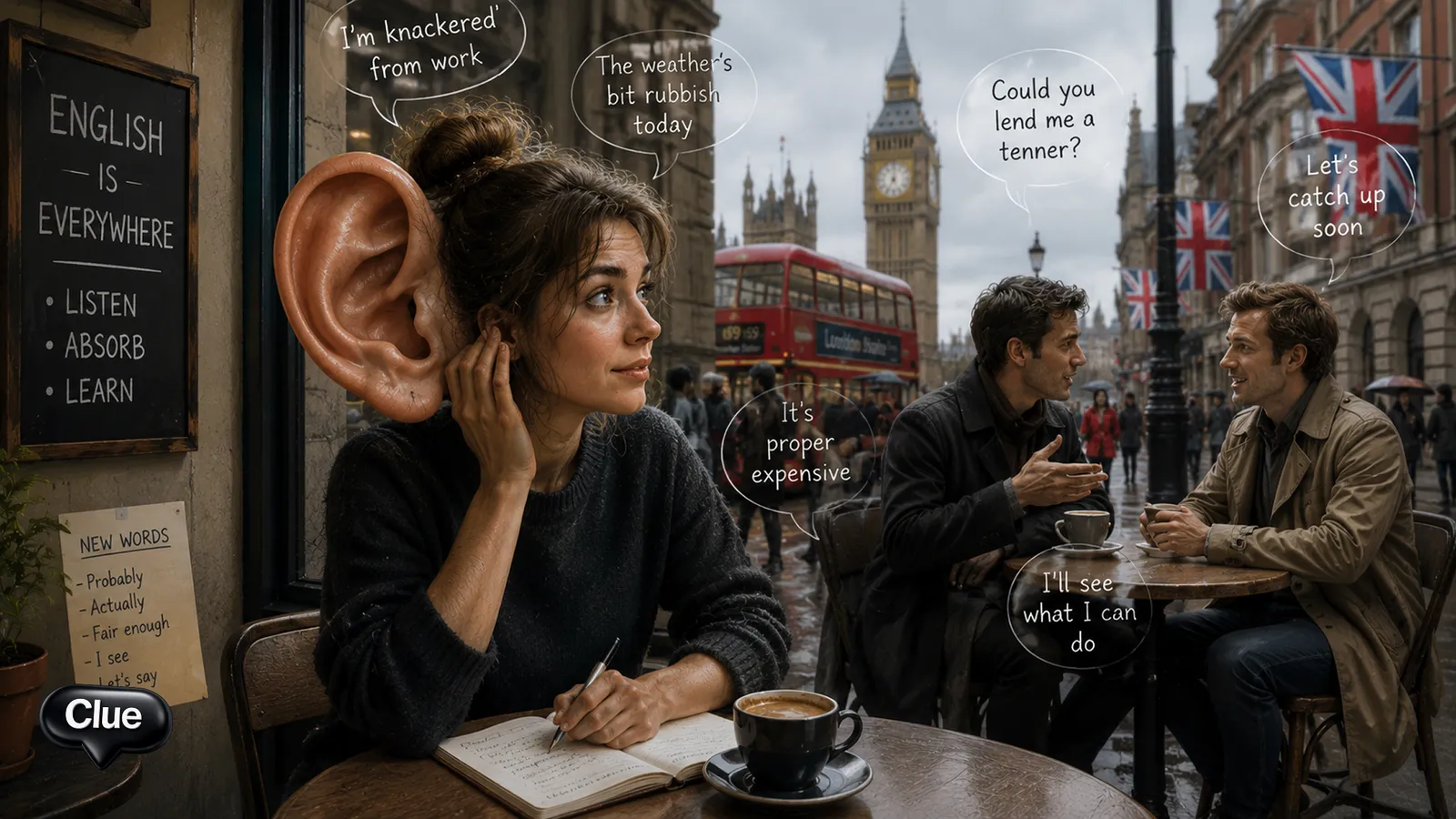
Familiarity with rhythm and prosody. English has a stress-timed rhythm that sounds unnatural to speakers of syllable-timed languages (Spanish, French, Italian, Polish). Passive exposure to natural English helps your ear calibrate to this rhythm over time — a background effect that makes active listening easier.
Maintaining familiarity on busy days. When life prevents a full study session, background listening keeps you in contact with English. It’s worth more than zero. It’s just not worth substituting for focused practice.
Increasing exposure volume at higher levels. At B2–C1, where your comprehension is already strong, passive listening has more value because your brain processes more of the input even without focused attention. An A2 learner watching an English film as background noise is mostly hearing incomprehensible sound. A B2 learner in the same situation is processing recognizable vocabulary and occasional full sentences — a qualitatively different experience.
Reinforcing already-known vocabulary. Passive exposure helps consolidate words you’ve already encountered and learned actively. The word “reluctant” you studied last week gets reinforced when you hear it in background audio. This consolidation effect is real but requires the active learning foundation.
The Real Listening Work: Active Techniques That Build Comprehension
Listening comprehension is a trainable skill — and it responds to specific techniques that passive background exposure cannot provide.
1. Narrow Listening
Narrow listening, developed by language teacher Stephen Krashen, means focusing on a specific topic, speaker, or show rather than sampling widely. If you listen to three episodes of the same podcast back to back, vocabulary and topics repeat. Repetition in context builds comprehension faster than constant variety.
Choose one podcast, YouTube channel, or show you genuinely enjoy. Listen to multiple episodes. The familiarity of the speaker’s voice, cadence, and vocabulary reduces cognitive load and lets you focus on comprehension rather than phonetic decoding.
2. The Intensive Listening Method
Step 1: Listen to a 2–5 minute excerpt without any support (no transcript, no subtitles). Focus entirely on meaning. Note what you understood and what you didn’t.
Step 2: Listen again with a transcript or subtitles (if available). Identify specific words or phrases that blocked comprehension. Look them up.
Step 3: Listen again without transcript. The comprehension improvement from step 2 to step 3 is often dramatic — and that improvement is the skill being built.
Where to find transcripts: Many podcasts offer transcripts (NPR, BBC, This American Life, 99% Invisible). YouTube’s auto-generated captions are imperfect but workable. If no transcript is available, a voice-to-text app can generate one.
3. Shadowing
Shadowing is listening to a native speaker phrase by phrase and immediately repeating, mimicking not just the words but the rhythm, intonation, and speed. This technique, popularized by language teacher Alexander Argüelles, builds listening comprehension and pronunciation simultaneously.
To shadow effectively: use content slightly below your comprehension ceiling (you should understand 90%+ without stopping). Listen to 1–2 sentences. Pause. Repeat aloud, matching the speaker’s delivery as closely as possible. Continue.
This is tiring — 10–15 minutes of focused shadowing is enough. Use it 2–3 times per week with authentic natural-speed English.
4. The Listen-Read Method
For learners who are stronger readers than listeners (common when you learned English mostly through text): read the text first, then listen to the audio. The text familiarizes the vocabulary so your listening session focuses on sound-symbol correspondence rather than vocabulary comprehension. Over time, this trains your ear to recognize in audio what you already know in text.
For audiobooks with corresponding ebooks: read a chapter first, then listen to it. After a few chapters, switch to listen-then-read. Eventually, listening alone becomes the primary mode.
5. One Unknown Word Listening
At B1–B2, a technique for vocabulary acquisition through listening: listen for one specific unknown word per 5-minute segment. Before listening, note one word from your vocabulary list that you’ve seen in reading but never heard. Listen for it. When you hear it, pause and note the context.
This turns passive vocabulary (words you recognize in writing) into active vocabulary (words you can recognize in speech). The focused attention on a single word per segment makes the exposure intentional rather than passive.
Common Misconceptions Beyond Sleep Learning
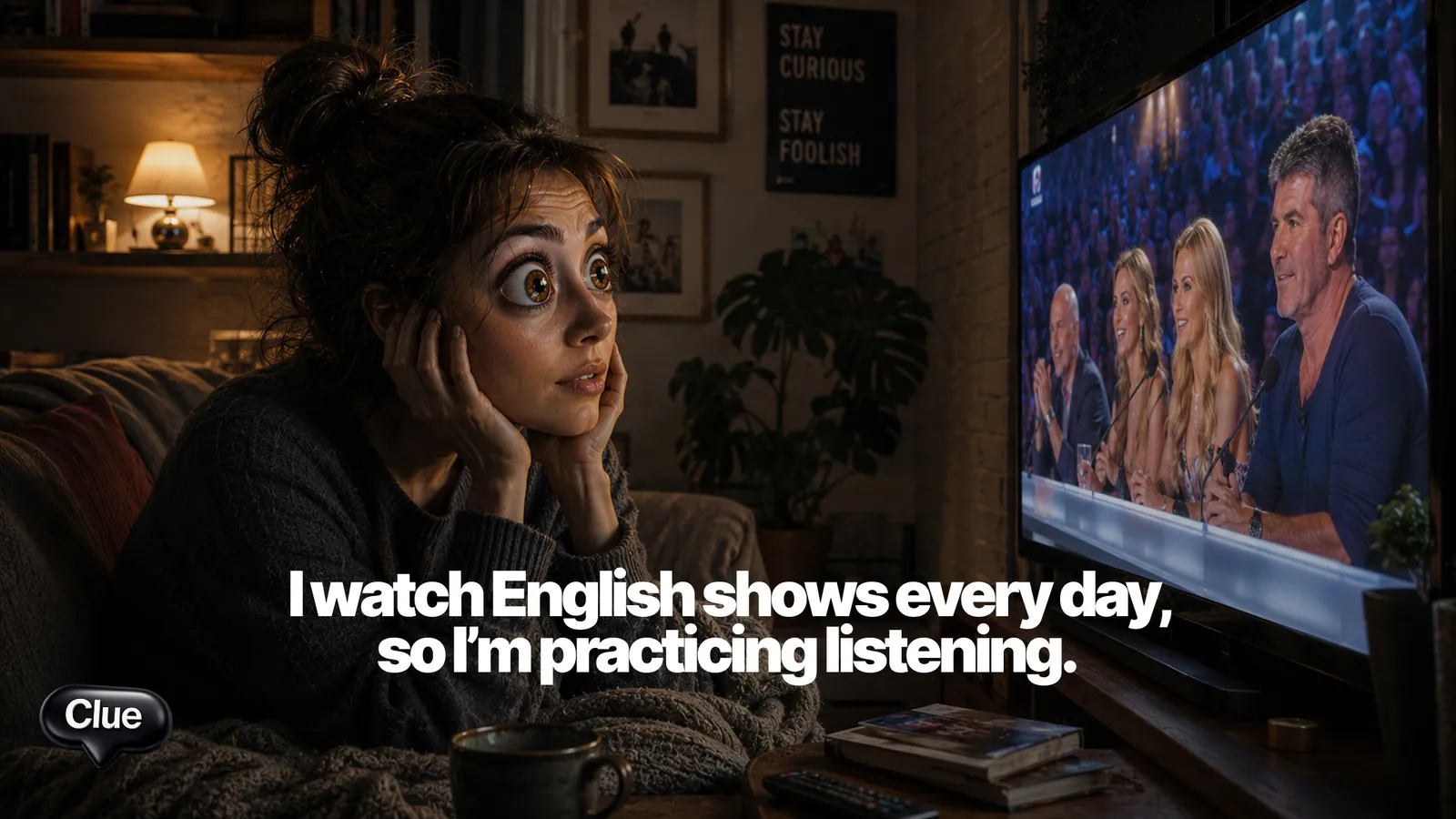
“I watch English shows every day, so I’m practicing listening.” Watching English films with subtitles in your native language is primarily reading practice, not listening practice. Your eyes read the subtitles; your ears get background English. For listening development, use English subtitles or no subtitles, and engage actively with what you don’t understand.
“I lived in an English-speaking country for six months and my English barely improved.” Immersion improves comprehension through sheer input volume, but it doesn’t automatically produce fluency if you spend most of your time with speakers of your own language, use your native language for complex tasks, and passively absorb English without engaging with what you don’t understand. Quantity of exposure matters; quality of engagement matters more.
“I just need to listen more and it’ll come.” At A2, yes — more exposure to comprehensible input at your level is the primary driver. At B1 and above, the bottleneck shifts to vocabulary depth and active comprehension work. “More listening” without attention to vocabulary acquisition plateaus learners because comprehension improves only as fast as vocabulary grows.
“Native-speaker listening material is better because it’s authentic.” Authentic native-speaker content is excellent — and it should be incomprehensible at too high a difficulty level. An A2 learner who “practices” by watching dense political debates is not getting comprehensible input; they’re getting practice at hearing English they don’t understand. Match the content to your level.
Building a Listening Practice That Actually Works
A practical weekly listening structure for B1–C1 learners:
3 days/week — Active intensive listening (20–30 minutes): One podcast episode or YouTube video. Listen once without support. Listen again with transcript (if available). Note specific unknown words/phrases. Look them up after the session.
2 days/week — Shadowing (10–15 minutes): Choose content at or slightly below your level. Short clips of clear, natural speech. Repeat aloud after each phrase.
Daily — Passive background (15–30 minutes, optional): English podcasts or shows while commuting, cooking, exercising. Don’t stress over comprehension; just maintain contact. Counts for less than active sessions but adds up over months.
Weekly — Extended enjoyable listening (30–60 minutes): Watch something in English you’d watch for enjoyment — a film, a documentary, a comedy show. Use English subtitles, not native-language subtitles. Engage with the story. This is the reward that makes the active practice sustainable.
Why Listening Comprehension Lags Behind Reading
Most learners find listening harder than reading, for structural reasons:
Speed: Spoken English moves at 120–180 words per minute. You can’t slow it down (without distortion) the way you can pause on a sentence while reading.
Connected speech: In natural speech, words run together. “Did you eat?” sounds like “Dijeet?” “I don’t know” sounds like “I’unno.” These reductions are predictable but require explicit exposure to recognize.
Accent variation: You might understand British RP and struggle with an Australian accent, or be comfortable with American English and confused by Nigerian English. Each variety requires calibration.
Background noise and audio quality: Real conversations have noise, overlap, and unclear audio. Textbook English is perfect; real speech isn’t.
These challenges are real and only solved by exposure — targeted, active, consistent exposure. No amount of passive listening fixes connected speech recognition; only hearing it, noticing it, and looking it up builds that knowledge.
How Clue Supports Listening Practice
Clue works with audio content as well as reading. When you listen to a podcast or audio within Clue and encounter an unfamiliar word in the transcript or subtitles, tapping adds it to your spaced review queue. The word now has both a reading and listening context. This bridging between your listening experience and your vocabulary review is where passive exposure becomes active learning.
FAQ
Does playing English audio while sleeping help at all? Research does not support sleep-learning of new content. Sleep supports consolidation of content you actively learned before sleeping. Going to sleep after a focused listening session is more useful than the sleep itself being a learning event.
How long does it take to improve listening comprehension noticeably? With 20–30 minutes of active listening 3–5 days per week, most B1 learners notice meaningful improvement within 2–3 months. The improvement feels like “suddenly understanding more” — comprehension gains are often non-linear.
Should I listen to content that’s too hard to force improvement? No. “Input slightly above your level” (i-plus-1 in Krashen’s model) is the research-supported sweet spot. Consistently listening to content far above your level produces frustration, not comprehension gains.
Is it better to listen with or without subtitles? Depends on the goal. Reading English subtitles while listening builds reading-sound connection (useful). No subtitles forces active comprehension from audio alone (best for pure listening skill). Native-language subtitles trains reading in your native language, not listening in English. Cycle through all three depending on your session goal.
What’s the best podcast for English listening practice at B1? This American Life (thisamericanlife.org) is widely recommended: clear American English, a wide range of topics, excellent transcripts available free on their website. For B2: Radiolab, 99% Invisible, Planet Money — all with transcripts.
Start Actively, Not Passively
Passive listening has its place — background, maintenance, enjoyment. But the learners who make consistent, visible progress in listening comprehension are doing active work: intensive sessions, shadowing, vocabulary capture, re-listening with transcripts. That’s the practice. The sleep can stay passive.
Read in other languages
Related articles
- Clue vs LingQ: An Honest Comparison for Learning English in 2026 Clue and LingQ both teach English from real content. Detailed comparison: pricing, libraries, methodology, mobile experience, what each gets wrong.
- Learn English from Scratch: A0 to B1 on Your Own Starting English from zero as an adult is a different challenge than continuing from an intermediate level. You have no vocabulary to fall back on, no gram
- Clue vs Lingopie: TV Streaming vs Bring-Your-Own Content Clue vs Lingopie compared: a curated TV streaming library for language learners versus a tool that works with any podcast, book, or video you bring.
- English for Turkish Speakers Learn English from real podcasts, videos, and books with one-tap Turkish translations. Offline dictionary, built for Turkish speakers ready for real content.


