

Ana Ferreira
Language-learning writer · Published May 22, 2026
How to Learn English by Yourself: A Self-Study System That Actually Works
You’ve tried the apps, watched a few YouTube tutorials, maybe even paid for a course you stopped using by week three. The truth is most adults don’t stall in English because they’re lazy or untalented — they stall because the system they’re following was designed for teenagers in a classroom, not for an adult who already understands most of what they read but can’t find words when speaking.
This guide is for learners between B1 and C1 who want to take charge of their own progress. No course schedule, no homework police, no gamified streaks that punish you for living a life. Just a working method, real tools, and an honest timeline.
Why self-study works better than courses for most adults

Courses are built around a single rhythm. The teacher sets the pace, the textbook sets the topics, and your job is to keep up. That works when you’re sixteen and have nothing else going on. It stops working when you’re thirty-four, have two meetings before lunch, and need to actually use English next Tuesday on a call with a client in Boston.
Self-study flips the controls. You decide what to read, what to listen to, and what to fix first. The cost is that you have to build your own structure. The reward is that every hour you spend is aimed at something you actually care about — your industry’s podcasts, the novel you’ve been meaning to finish, the YouTube channels you’d watch anyway.
Three reasons self-study beats courses for adult learners past A2:
You already understand a lot of English. If you can read this paragraph without a dictionary, you’re past the stage where a beginner course gives you anything new. Most “intermediate” courses recycle the same present-perfect drills you’ve already seen four times. You don’t need more explanations of grammar — you need more contact with the language as it’s actually used.
Your time is non-linear. You don’t have ninety free minutes three evenings a week. You have eight minutes in a coffee line, twenty minutes on the train, forty minutes while cooking. Self-study fits that shape. A course doesn’t.
Your goals are specific. You want to handle a sales call, follow a Netflix show without subtitles, write a clean email, sound less stiff in a job interview. A general course can’t optimize for any of that. You can.
The 5-block system: listen, read, speak, vocab, test

You don’t need a curriculum. You need five inputs in your week, in any order, in any combination. Hit four of the five most weeks and you’ll move. Skip the same one for a month and you’ll plateau there.
Block 1: Listening (4–6 hours per week)
Listening is the foundation because it forces your brain to handle real English at real speed. Reading lets you cheat — you can pause, re-read, look up. Listening doesn’t.
Start with podcasts that have transcripts so you can verify what you actually heard. Good picks for B1–C1 learners:
- The English We Speak (BBC). Six minutes, focused on idioms, two hosts. B1 friendly.
- Luke’s English Podcast. Long episodes, natural pace, hours of free material. B2.
- The Daily (NYT). Twenty-five minutes, journalistic English, current events. B2–C1.
- This American Life. Story-driven, varied accents, real conversation. B2–C1.
- 99% Invisible. Design and culture stories, clean production. B2.
- Hard Fork (NYT). Tech and AI, two hosts who talk like humans. C1.
Mix scripted (news, narrated stories) with unscripted (interviews, two-host shows). Scripted English is cleaner; unscripted English is what people actually speak.
Block 2: Reading (2–4 hours per week)
Reading is where vocabulary gets cemented. You hear a word, you forget it. You read it in three different books over a month and it’s yours.
Read what you’d read in your own language. If you’re a non-fiction person, don’t force yourself through Dickens. If you love thrillers, read Lee Child or Gillian Flynn, not literary fiction someone told you was “good for your level.”
Some safe entry points by level:
- B1: graded readers from Penguin Readers or Oxford Bookworms, then short novels like The Curious Incident of the Dog in the Night-Time by Mark Haddon or Holes by Louis Sachar.
- B2: contemporary literary fiction with clear prose — Normal People by Sally Rooney, Klara and the Sun by Kazuo Ishiguro, anything by Fredrik Backman in English.
- C1: full-fat fiction and serious non-fiction — Educated by Tara Westover, The Goldfinch by Donna Tartt, essays in The Atlantic and The New Yorker.
Don’t look up every word. Look up the word that appears three times in two pages — that’s the one your brain has flagged as important.
Block 3: Speaking (2–3 hours per week)
This is where most self-studiers cheat themselves. You can’t grow a speaking skill by listening more. You have to produce.
Three speaking modes, in order of barrier-to-entry:
- Self-talk. Describe your day out loud while walking. Narrate what you’re cooking. Argue with yourself about whether to take the job. It feels stupid for ninety seconds, then it doesn’t.
- Shadowing. Play a podcast and repeat each sentence one beat behind the speaker, copying intonation. Do it with the same two-minute clip every day for a week. Your mouth learns the music of English.
- Conversation. iTalki and Cambly for paid tutors. Tandem and HelloTalk for free language exchange. Discord servers for hobby-based talk. Aim for two thirty-minute calls per week, more if you can swing it.
If your speaking lags far behind your listening, that’s normal — and the fix is more speaking, not more listening.
Block 4: Vocabulary (15–20 minutes daily)
Vocabulary is where adults waste the most time and get the worst returns. Flashcard decks of 2,000 isolated words don’t stick because your brain treats them as noise. Words stick when they arrive with context: a sentence you heard, a situation you cared about, a feeling attached.
The working method:
- Read or listen to something you find interesting.
- When a word stops you, mark it in context.
- At the end of the session, save the word with the sentence it lived in.
- Review three to five days later. Then a week. Then a month.
This is spaced repetition with one critical detail: the sentence comes with the word. “Notorious — sentence: She’s notorious for being late to her own meetings” is worth fifty times more than “notorious = знаменитый” or “notoire.”
Twenty new words a week stick. Fifty new words a week mostly evaporate.
Block 5: Testing (30–60 minutes weekly)
Not standardized testing. Honest self-checks. Once a week, do one of these:
- Read a paragraph you haven’t seen and notice every word you’d struggle to translate.
- Watch a five-minute video without subtitles, then with subtitles. Where did you lose the thread?
- Write a 200-word email about your week. Check it with Grammarly or paste it to a tutor.
- Record yourself talking for two minutes on a topic. Listen back. Cringe. Note what you said wrong.
Testing isn’t grading yourself — it’s catching where you are now so next week’s practice has a target.
Tools and free resources worth using
You don’t need a paid subscription to anything. Here’s what’s actually free and actually good.
For reading:
- Project Gutenberg for public-domain classics.
- Open Library to borrow modern e-books with a library card.
- The Guardian, BBC News, NPR, The Atlantic (limited free articles) for journalism.
- Medium for opinion essays and tech writing.
For listening:
- Spotify and Apple Podcasts have everything mentioned above.
- BBC Sounds for free British radio and drama.
- NPR One for U.S. public radio.
- YouTube — channels like Real English with Real Teachers, English with Lucy, BBC Learning English, TED-Ed.
For watching:
- YouTube is endless and free. Start with documentary channels (Vox, Veritasium, Wendover) where speech is scripted and clear, then move to vlogs and interviews where speech is messier and faster.
- Netflix with English subtitles. Suggested: The Crown (slow, clear British), Modern Family (fast American family talk), Ted Lasso (mixed accents, lots of idiom).
For grammar reference:
- Cambridge Dictionary’s grammar section.
- British Council’s LearnEnglish site.
- Grammarly’s blog for clean explanations of specific points.
For vocabulary capture:
- A notebook works.
- A Notes app works.
- Anki works if you like making cards.
- Clue works if you’d rather tap inside the podcast or article and have the word saved with the sentence already attached.
For speaking:
- iTalki for tutors from $8–$20 per hour.
- Cambly for on-demand five-minute calls.
- Tandem and HelloTalk for free exchange partners.
- ChatGPT or Claude for low-stakes written practice.
A weekly schedule that actually fits an adult life

Here’s a 7-hour week split into pieces that fit around work.
- Monday morning commute (25 min): podcast, headphones in.
- Monday lunch (15 min): review last week’s saved vocabulary.
- Tuesday evening (30 min): read a chapter of your current novel.
- Wednesday morning commute (25 min): podcast (same one, second listen, for the parts you missed).
- Wednesday evening (30 min): tutor call on iTalki.
- Thursday lunch (20 min): YouTube video on a topic you’d watch anyway.
- Thursday evening (30 min): read another chapter.
- Friday morning commute (25 min): a new podcast.
- Saturday morning (60 min): long-form watching — a Netflix episode, no subtitles first, then with.
- Saturday afternoon (30 min): write a short journal entry in English about your week.
- Sunday morning (30 min): shadowing practice with a favorite clip.
- Sunday evening (45 min): tutor call.
- Spread across the week: 15 minutes daily vocab review.
Total: about seven hours, none of them feeling like homework. Tweak by personality. If you hate journaling, do voice memos. If you hate tutors, double the language-exchange time.
Common mistakes that keep adult learners stuck
Most plateaus aren’t mysterious. They come from one of these patterns:
Studying about English instead of using it. Watching grammar videos for an hour feels productive but produces almost no growth. Reading a novel for an hour produces a lot. If your weekly hours are mostly meta — about the language — you’re stalling.
Choosing content that’s too easy. “Beginner” content is for beginners. If you can follow it without effort, it’s maintenance, not growth. Pick material where you understand 70–85% on first pass. Below that, you drown. Above that, you don’t stretch.
Choosing content that’s too hard. The other side of the same mistake. If a paragraph has fifteen unknown words, you’ll quit before you finish. Stretching is good; suffocating isn’t.
Translating every word. Looking up every unfamiliar word breaks the reading flow and trains your brain to depend on a crutch. Look up words that block meaning or repeat across paragraphs. Let the rest live in fog for now — your brain is better at inferring than you think.
Skipping speaking because it’s uncomfortable. It will always be uncomfortable until you do it a hundred times. The hundredth time is less uncomfortable than the first. There is no shortcut around the first ten.
Tracking the wrong metric. Streaks, XP, “10,000 words known” — these are flattering but unrelated to fluency. The real metrics: can you follow a podcast at 1.25× without losing the plot? Can you hold a ten-minute call without your brain throwing an error? Can you write an email and not need to re-read it three times? Track those.
Switching tools every two weeks. Spending more time choosing apps than using them. Pick a stack you’re 80% happy with and stay in it for at least three months.
Forgetting that vocabulary is the bottleneck. For most B1–C1 learners, what limits you isn’t grammar — it’s the missing 3,000 words. You understand grammar fine when you read; you just don’t have the vocab in active recall when you speak. Solve that and most other problems shrink.
Avoiding the boring parts. Writing is boring. Reviewing old vocab is boring. Recording yourself is boring. They’re also the parts that move the needle when listening alone has stopped.
Realistic timeline from B1 to C1
Here is the honest version of how long this takes, assuming 5–8 hours per week of varied input.
B1 to strong B1 (3–4 months). You stop needing subtitles for slow, clear English. You can follow a podcast meant for native speakers if it’s about a topic you know. You write a short email without panic. Speaking still feels effortful.
Strong B1 to B2 (6–10 months). You watch a Netflix drama with English subtitles and follow most of it. You handle a thirty-minute work call if the topic is in your wheelhouse. You read a contemporary novel and look up maybe ten words per chapter. Vocabulary stops being the obvious blocker; output speed starts to be.
B2 to C1 (12–24 months). Subtitles come off for most content. You can argue a point in English for ten minutes without grinding to a stop. You read for pleasure, not as study. Mistakes are about register and naturalness now — using “kids” vs. “children” right, knowing when “I reckon” sounds British and “I figure” sounds American. The remaining work is shape and color, not foundation.
C1 to functionally native (years, not months). At some point you stop measuring. You handle work in English, read books in English, dream in English a little, still mispronounce one or two words, and that’s fine.
If you’re moving slower than this, the bottleneck is almost always hours of contact, not talent. Doubling your weekly listening time usually unblocks more than switching methods.
Where Clue fits in this picture
Clue isn’t a course and isn’t trying to replace one. It solves one specific problem inside the system above: the vocabulary block.
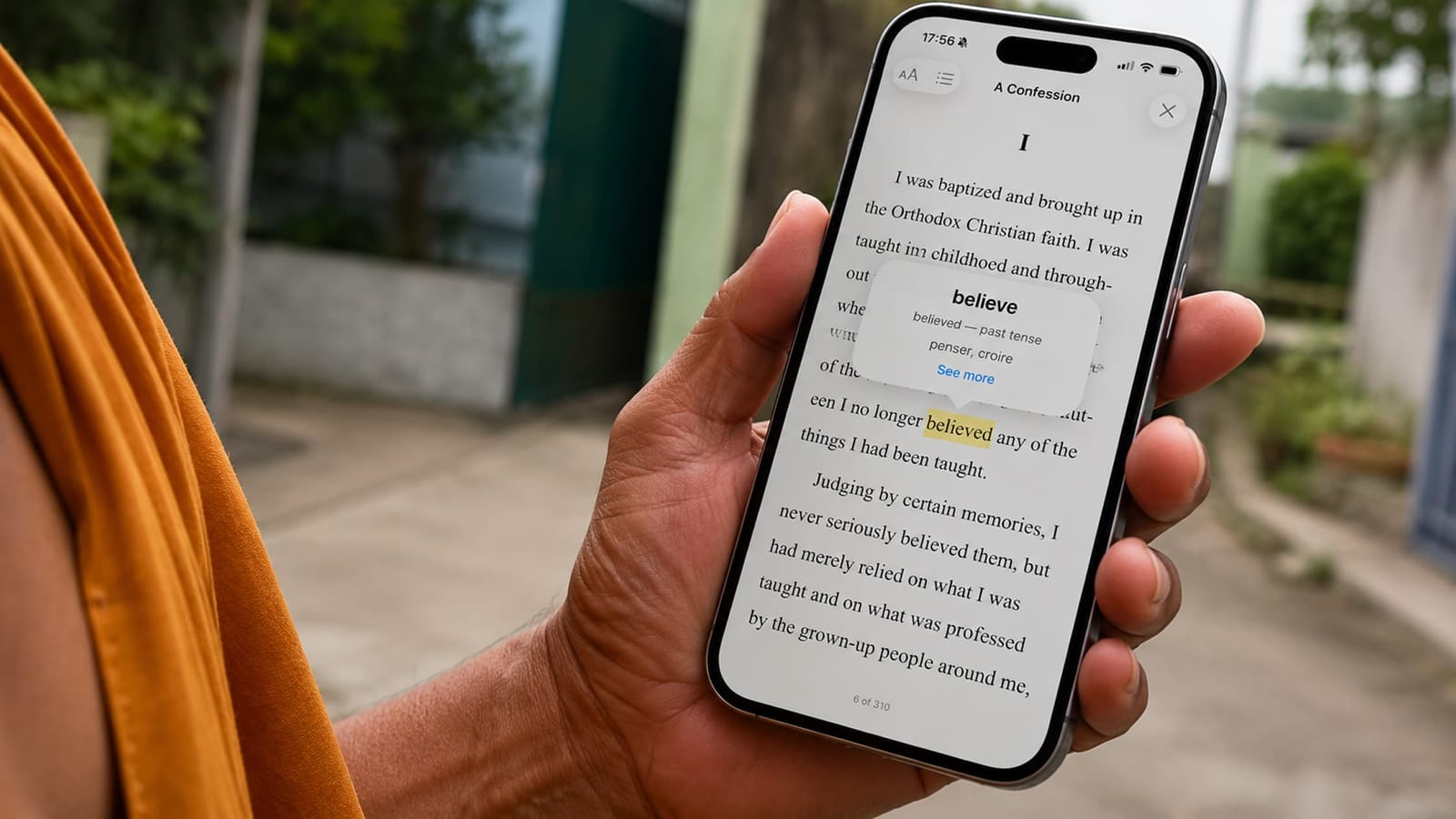
When you’re reading an article or listening to a podcast, a word stops you. You can either look it up in a dictionary tab, lose your place, write it down, and try to come back later — or you can tap it inside Clue, see the meaning, and have the word saved with the original sentence so it shows up for review at the right time later in the week.
It works on podcasts, books, YouTube, and articles — the same media you’re already in. The idea is that vocabulary acquisition should happen inside the content you actually consume, not in a separate app where words sit in isolation.
You don’t need Clue to learn English. You can use a paper notebook and Anki and do fine. Clue removes about ten seconds of friction per saved word and keeps your reading flow intact, which is the part most learners give up on first. If you’ve ever started keeping a vocab notebook and stopped after two weeks, the friction is probably why.
It’s free on iOS, B1–C1 oriented, and there’s no streak shaming.
FAQ
Can I really learn English by myself without a teacher?
To C1, yes — thousands of people have. A teacher can speed things up at specific stages (early speaking, exam prep, pronunciation polish) but isn’t required. What you can’t skip is contact hours with the language. A teacher gives you scheduled hours; self-study makes you provide them yourself. Either works if the hours show up.
How long does it take to learn English from B1 to fluent?
With 5–8 hours of varied input a week, expect 12–24 months from solid B1 to comfortable C1. Less time per week stretches that proportionally. There’s no shortcut, but there’s no ceiling either — the work compounds.
What’s the best free way to learn English at home?
Listen to podcasts you’d want to hear anyway, read books in genres you already like, save vocabulary in context, and do one weekly speaking session with a language-exchange partner or low-cost tutor. Everything you need is free or nearly free.
Should I focus on grammar or vocabulary as an adult learner?
Vocabulary, for most B1–C1 learners. Grammar gaps tend to be repair work — you misuse the present perfect, learn the fix, move on. Vocabulary gaps are the actual ceiling on what you can say and understand. If you’re below B1, that ratio flips.
Do I need to live in an English-speaking country?
No. The internet provides effectively unlimited English input. Living abroad helps if you push yourself into uncomfortable speaking situations daily; if you live in a bubble of expats from your home country, it changes very little. Self-study from your sofa often beats a year abroad spent at the international supermarket.
How do I keep myself motivated without a teacher checking on me?
Tie practice to existing habits — commute equals podcast, lunch equals reading, evening walk equals self-talk. Motivation is unreliable; routine is durable. Also: choose content you’d consume anyway. If you’d watch the YouTube video in your native language, you’ll watch it in English when the alternative is silence.
Are PDFs and grammar workbooks worth downloading?
For B1+ learners, no. PDFs of “1000 essential English words” or “complete grammar guide” feel productive to collect but rarely get used. You’ll learn more from one chapter of a real novel and one podcast episode than from any PDF you’ve downloaded but not opened.
Closing
Learning English by yourself is less about willpower and more about building a setup where contact with the language is the path of least resistance. Pick the podcasts, queue the books, find a tutor for an hour a week, and let your vocabulary system catch the words as they pass. The plan above isn’t optimized for impressive — it’s optimized for not quitting. That’s the only thing that matters at month seven, when your level has shifted in ways you can’t see yet but your friends already can.
Read in other languages
Related articles
- The Best Podcasts to Learn English in 2026, by Level The best English podcasts for learners in 2026 — beginner, intermediate, advanced. Real recommendations, not list-spam, with notes on each.
- Learn English Fast: An Honest Method for 45 Minutes a Day Most advice about learning English fast is either useless or dishonest. This article gives you a realistic picture of what's possible, what actually accele
- English for Italian Speakers Learn English from real podcasts, videos and books with instant Italian translations. Offline dictionary, no per-lookup cost, built for Italian-speaking learners.
- The Best Books to Learn English in 2026, by Level A curated reading list for English learners — from graded readers to literary fiction. Why each book works at each level, with style notes.


