

Elif Kaya
Contributing writer · Published May 22, 2026
The Best Podcasts to Learn English in 2026, by Level
Podcasts are the most efficient way to log hundreds of hours of native-speed English without burning out. They fit into commutes, gym sessions, dog walks, and the half-attention parts of your day that are otherwise lost. A serious daily podcast habit, sustained for six months, will move your listening comprehension further than any other single intervention.
The hard part is picking shows you’ll actually listen to. Most “best podcasts for English learners” lists are populated by half-abandoned ESL shows that you’ll outgrow in two months. This list is different: a small number of real recommendations grouped by level, with notes on why each one works and who it’s for.
A note on methodology: every show below either publishes transcripts on its own site or can be transcribed on-device by Clue using Whisper. The combination of audio plus tappable transcript is what turns a podcast from background entertainment into a real learning tool.
How to actually use a podcast for learning
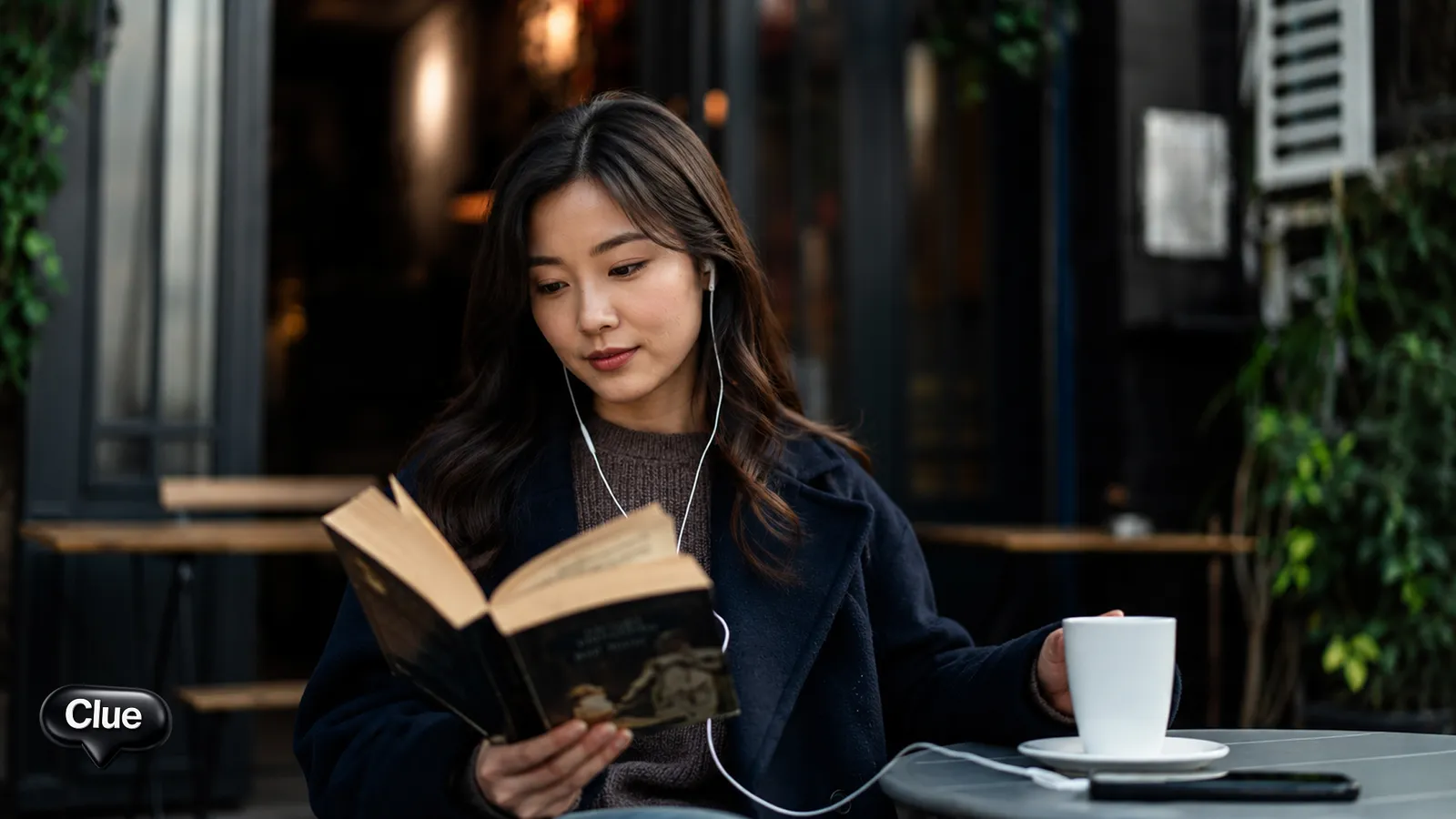
Before the list, a quick word on technique. The point is not to play a podcast in the background and hope for osmosis — though that has some value. The point is active listening with vocabulary capture.
The loop:
- Pick one show. Stick with it for two weeks before considering another.
- Listen with the transcript open. On a phone, that means having the podcast app and Clue both available.
- Tap unknown words as they appear. The translation pops up in your native language in under a second.
- Save the 5–15 highest-value words per episode.
- Run a flashcard review on saved words once a week.
Why two weeks per show: the same hosts use similar vocabulary across episodes. By the fourth or fifth episode you’re comfortable with the show’s register and recurring vocabulary, and new words start landing on stable ground. Bouncing between shows resets that benefit.
Now to the recommendations.
Beginner level (A2–B1): slow, structured, made for learners

The shows in this section are explicitly designed for English learners. The pace is controlled, the vocabulary is curated, and the transcripts are clean.
BBC 6 Minute English
The most learner-friendly podcast in existence. Twice a week, six minutes per episode. Two BBC presenters discuss a topic — climate change, language quirks, social trends — in clear, slow British English. The transcript is on the BBC site for free, with vocabulary callouts and definitions for the trickier words.
If you can only pick one beginner show, this is it. The format is consistent, the topics are interesting, and the British accent is the standard “received pronunciation” that’s easiest for most learners to understand. By episode 20 you’ll know the show’s hosts and their patterns intimately.
Luke’s English Podcast
Long, friendly, often funny episodes by Luke Thompson, a British comedian and English teacher. Episodes range from 30 minutes to two hours. The content is unmistakably for learners but never feels condescending — Luke treats his audience as adults who happen to be learning English.
The catalog is enormous (over 900 episodes as of 2026). Good for binging: pick an episode topic that interests you and dive in.
The English We Speak (BBC)
The BBC’s idiom-focused show. Three-minute episodes, each one explaining a single English idiom or phrase with examples. “Pull someone’s leg,” “throw in the towel,” “barking up the wrong tree.” Idioms are one of the trickiest parts of English for learners, and this show makes them digestible.
Voice of America Learning English
The American counterpart to BBC Learning English. Wide range of formats — news at controlled pace, vocabulary lessons, cultural features. Audio, video, and transcripts are all free. Better for learners who want American English specifically.
EnglishClass101
A podcast network with leveled episodes from absolute beginner up. American English. Free with paid extras. Useful if you want explicit grammar and vocabulary instruction in audio form.
Intermediate level (B1–B2): real podcasts at near-native speed

This is where the list gets interesting. The shows below are not made for learners — they are real podcasts that happen to work for intermediate English learners because of clean production, clear delivery, and accessible vocabulary.
NPR Up First
Ten-minute daily news brief from NPR (National Public Radio). American English, very clean delivery, three hosts who rotate through the week. Transcripts are free on the NPR site.
For a learner who wants a manageable daily news habit, NPR Up First is hard to beat. It’s short enough to listen to every morning, it covers the day’s top stories, and the language is journalistic but reachable. The repetition of names and topics across days helps vocabulary settle in fast.
The Daily (New York Times)

Twenty-five minutes, one news story per day, long-form. Michael Barbaro and Sabrina Tavernise rotate as hosts. American English at full conversational speed.
This is what serious daily news listening sounds like in the United States. The pace is faster than NPR Up First, the stories go deeper, and the producers know how to construct a narrative. By the end of two weeks you’ll know exactly how Michael Barbaro pauses for emphasis, and that familiarity makes the show easier and easier to follow.
BBC Global News Podcast
Twice-daily British news, around 25 minutes per episode. Reporters from around the world, so you hear British, Irish, South African, Indian, and many other accents within a single episode. Vocabulary is BBC journalistic — formal but accessible.
Great for accent variety. If you’re worried your ear is too American or too British, this show fixes it within a month.
TED Talks Daily

Short talks (10–20 minutes) on every topic imaginable. Transcripts are available on the TED site. The narrators vary in skill — some TED talks are beautifully delivered, others are rough — but the diversity of voices and topics is unmatched.
Use TED Talks Daily as a buffet rather than a daily ritual. Browse for topics you actually care about, listen to the talks that grab you, skip the rest.
Stuff You Should Know
Two American hosts (Josh and Chuck) explain one topic per episode — the history of cricket, how vaccines work, who invented the swimming pool. The hosts repeat themselves and rephrase often, which is great for comprehension. Episodes are 45–60 minutes; pace is conversational.
The catalog is huge (over 1,500 episodes) and the hosts are genuinely warm, which makes long-term listening easy.
Hidden Brain

Shankar Vedantam’s NPR show on social science and human behavior. Measured, clear narration; rich vocabulary; consistent storytelling structure. Episodes are 45–55 minutes.
Hidden Brain is one of the best shows for B2 learners because Vedantam speaks slowly and clearly while using genuinely sophisticated vocabulary. You get the range of language without the speed.
99% Invisible
Roman Mars’s documentary podcast about design and the built environment. Why is concrete the color it is? Why do mailboxes look the way they do? Why are there benches in some parks and not others? Storytelling is excellent; vocabulary stays accessible.
Planet Money
NPR’s economics show. Twenty-five-minute episodes that turn one economic concept or news story into a narrative. American English. Vocabulary leans technical but the producers explain everything.
Excellent if you have any interest in business or economics; useful even if you don’t, because the storytelling carries the technical content.
Advanced level (C1+): long-form, demanding, native-speaker pace

The shows in this section are not adjusted for learners in any way. They run two-plus hours, the guests speak at full speed, and the vocabulary is whatever the host and guest naturally use. At C1+, these become genuine pleasures rather than work.
Lex Fridman Podcast

Two-to-four-hour interviews with scientists, founders, philosophers, athletes, mathematicians, neurosurgeons. Lex’s questions are sometimes naive in productive ways — he asks the obvious thing that lets the guest explain from first principles, which is great for learners who don’t know the field.
The vocabulary range is enormous because each guest speaks in their own technical language. One week you’re learning the language of neuroscience; the next week, machine learning; the next week, mixed martial arts.
Conversations with Tyler
Tyler Cowen interviews economists, writers, and public intellectuals at extraordinary speed. The episode notes promise “the conversations Tyler wants to have, not the ones the guest expected,” and that’s exactly what you get. Dense, idea-rich, often surprising.
For C1+ learners interested in ideas, this is one of the best podcasts in the language. Be warned: Tyler talks fast. You’ll need the transcript.
The Ezra Klein Show
Long-form policy and culture interviews from the New York Times. Klein is a careful interviewer with extraordinary diction — every word is chosen, every sentence is structured. The guests are intellectually serious.
This is what literary American English sounds like on a podcast. Useful for vocabulary acquisition; even more useful for absorbing the rhythm of careful, considered prose.
This American Life
Storytelling at the highest level. Ira Glass and his producers turn ordinary life into compelling radio. Each episode usually has a theme and several stories.
The narration is a master class in modern American prose. If you only listen to one episode, try “20 Acts in 60 Minutes” or “The Giant Pool of Money.”
Radiolab
Science and philosophy with a distinctive style — multiple narrators, layered audio, sudden shifts in tone. Episodes are usually 45–60 minutes. The vocabulary leans technical; the storytelling is gripping.
Hardcore History (Dan Carlin)
Multi-hour episodes (sometimes four or five hours) on historical events. Carlin’s voice is theatrical and his vocabulary is rich. Episodes appear infrequently but each one is the equivalent of an audio book.
Excellent for vocabulary, particularly historical and political vocabulary. Excellent for stamina training — if you can follow a four-hour Hardcore History episode, you can follow almost any English podcast.
Modern Wisdom (Chris Williamson)

British host, two-to-three-hour interviews with psychologists, scientists, athletes, philosophers. Williamson is articulate and curious. The British perspective on similar topics to Lex Fridman makes for a useful contrast.
Conan O’Brien Needs a Friend
Conan O’Brien (former American late-night host) interviews comedians, actors, and friends. Casual, funny, often profane. Faster and more idiom-dense than the serious podcasts above, which makes it useful for cultural fluency at the cost of being harder to follow.
If you can comfortably follow Conan, you’ve reached a real milestone in American conversational English.
Hard Fork (New York Times)
Kevin Roose and Casey Newton on tech and AI. Two voices, conversational, current. Excellent for learners interested in technology because the vocabulary is exactly what the tech industry uses.
By accent
Most learners benefit from hearing both major varieties of English. A rough guide:
- British: BBC 6 Minute English, BBC Global News, Luke’s English Podcast, Modern Wisdom.
- American: NPR Up First, The Daily, This American Life, The Ezra Klein Show, Lex Fridman, Stuff You Should Know.
- Mixed / international: BBC Global News (multiple accents within episodes), TED Talks Daily.
- Irish, Australian, Indian, South African: rare on these lists; BBC Global News is the best source of accent variety.
If you’ve never made a conscious effort, mix British and American in roughly equal proportion for the first few months. Your ear adapts.
How long should each session be?
Twenty to thirty minutes is the sweet spot for active listening with tap-to-translate. Longer sessions get diminishing returns — attention fades, you start tapping fewer words, the active learning shades into passive consumption.
Background listening for hours is fine and has its own value (it normalizes the rhythm of English in your head), but it is not the same as the active session. Don’t confuse them.
Why these recommendations and not the usual list
Most “best podcasts for learners” articles are full of slow ESL shows that work for two months and then need to be replaced. The list above includes a few of those for absolute beginners but skews toward real podcasts that adults actually listen to.
The reason: the goal of language learning is to be able to consume real content. Spending years inside the ESL category is staying in the kiddie pool. Real podcasts are the goal. The ESL shows are stepping stones.
The earlier you can move to real content — even with friction, even with frequent dictionary lookups — the faster your English actually improves.
FAQ
Where can I find transcripts for these podcasts?
Most major shows publish transcripts on their own site — NPR, BBC, New York Times all do. For the rest, Clue can transcribe any episode on-device using Whisper. The audio never leaves your phone and there’s no per-minute fee.
How long should each listening session be?
20–30 minutes is the sweet spot for active listening with tap-to-translate. Longer than that and attention fades; shorter than that and you barely settle into the show.
British or American English first?
Pick the one closer to your goals — where you want to live or work, what media you naturally consume. Both are equally useful. Mixing them after a few weeks is good for your ear and prepares you for international contexts where you’ll hear both.
How many new words should I save per episode?
Five to fifteen at intermediate level. At advanced level, often only two or three high-value words. Don’t save every unknown word — only the ones you think you’ll meet again or that feel useful.
Can I add my own podcasts to Clue?
Yes. Paste any RSS feed and Clue adds the show to your library. If the episode has no transcript, Clue runs Whisper on-device to generate one.
Should I listen at 0.75x or 1.5x speed?
For a new show at the edge of your level, 0.75x can help in the first episode or two. Then go back to 1x. Listening above 1x speed is for review or shows you already follow comfortably — it’s not training, it’s compression.
Pick one. Start tonight.
The best podcast to learn English with is the one you actually open every day. Pick a show from the right level above, load it in your podcast app, and have the transcript open in Clue. Tap the words you don’t know. Save five of them. Tomorrow, do it again.
Two weeks of daily listening with active vocabulary work will change your ear faster than a year of passive consumption ever has. The hardest part is choosing the show; the second-hardest is making it through the first three episodes when the host’s voice and vocabulary patterns still feel foreign. After that, the habit takes care of itself.
Listen free on Clue

Frequently asked questions
What is the best podcast to learn English for beginners? +
Beginners should start with slow, clearly-spoken, scripted podcasts that come with transcripts, so you can follow along and look up unfamiliar words. Avoid fast native conversation at first — comprehension matters more than authenticity at the beginner stage.
Can you actually learn English just by listening to podcasts? +
Listening builds comprehension, vocabulary and natural rhythm, but on its own it's passive. You learn faster when you listen actively — with a transcript, pausing to look up words, and revisiting episodes. Pairing podcasts with speaking or writing practice closes the loop.
How many hours of English podcasts should I listen to per day? +
Even 15–30 minutes of focused, active listening per day beats occasional long sessions. Consistency matters more than volume — daily exposure trains your ear and steadily expands the vocabulary you recognise.
Should I use English subtitles or transcripts with podcasts? +
Yes — especially below an advanced level. A transcript lets you map sounds to words, catch what you missed, and look up new vocabulary instantly. In the Clue app you can tap any word in the transcript for an instant translation.
Read in other languages
Related articles
- The Best TV Series to Learn English in 2026, by Level The best TV shows for English learners — beginner to advanced. Real recommendations with notes on accent and difficulty, plus how to actually learn from them.
- How to Learn English by Yourself: A Self-Study System That Actually Works You've tried the apps, watched a few YouTube tutorials, maybe even paid for a course you stopped using by week three. The truth is most adults don't stall…
- English for Italian Speakers Learn English from real podcasts, videos and books with instant Italian translations. Offline dictionary, no per-lookup cost, built for Italian-speaking learners.
- How to Learn English Grammar Step by Step: A B1-to-C1 Roadmap That Doesn't Drill You to Death Most "step by step" grammar guides hand you the same checklist: present simple, past simple, present continuous, future, conditionals, and so on. You…


