
Michael Turner
Head of Content at Clue · Published May 22, 2026
Clue vs Duolingo: Which Is Better for Learning English in 2026?
Duolingo is the most popular language-learning app on Earth — 500 million downloads, a green owl that has become a meme, and a streak mechanic that has hooked millions into daily practice. Clue is a much smaller, much more specific tool built around one idea: real English content, with a one-tap translation for any word you don’t know.
They are not direct competitors. They solve different problems for learners at different stages.
Short answer: Use Duolingo if you are starting from zero or rebuilding shaky basics. Switch to Clue (or add it alongside) the moment you can read an English paragraph without panic. Most serious learners use both — Duolingo for months one to three, Clue from month four onward.
This article goes deep into the differences so you can make the choice yourself.
Quick comparison table
| Duolingo | Clue | |
|---|---|---|
| Best for | A0–A2 beginners, habit-building | B1–C1 intermediates, real-content immersion |
| Methodology | Gamified exercises, structured curriculum | Tap-to-translate any real content |
| Content | Built-in lessons | Your own podcasts, books, YouTube videos |
| Streaks & gamification | Heavy (the streak is the product) | None |
| Free tier | Ad-supported, heart/limit caps | Fully free, no ads, no limits |
| Subscription | Super Duolingo ~$7/mo | No subscription, ever |
| Languages offered | 40+ | English only, from 10 native languages |
| Offline mode | Limited (Super tier) | Yes (27,000-word dictionary on-device) |
| Speaking practice | Built-in voice exercises | Not provided — Clue is input-only |
| Dictionary lookups | Not the primary tool | Core feature, instant, offline |
| iOS / Android | Both | Both |
What Duolingo does well
Duolingo is the best gamified beginner course in any language. Three things they nailed:
The streak mechanic. A red flame that resets if you skip a day has been the single most effective consumer habit-building device of the last decade. Millions of people who would never have stuck with language learning still open Duolingo every day, often for years.
Bite-size lessons. Five-minute units that fit between subway stops. You never have to “find time” for Duolingo — it finds time inside whatever you were already doing.
Systematic vocabulary and grammar coverage at A0–A2. The early lessons cover the high-frequency words and basic structures you genuinely need. By the time you finish the first six units, you can read simple sentences and ask basic questions.
If you are completely new to English and have no foundation at all, start with Duolingo. Three months of daily lessons will give you the base that any other tool — including Clue — will assume you already have.
Where Duolingo runs out of road
Somewhere around the A2–B1 transition, Duolingo’s curve stops matching how real people actually use English. Three problems emerge:
The sentences become surreal. “The bear is drinking tea.” “My duck is on top of the refrigerator.” Memorable, yes — but useless. You learn vocabulary for things you will never need to say, while the words that actually appear in podcasts, books, and TV stay out of reach.
The plateau is hard. Many users hit a wall at A2–B1 and either keep doing daily lessons out of habit (the streak owns them) or quietly stop. Neither outcome moves them toward fluent, idiomatic English.
Speaking practice is shallow. Speaking into a phone and getting “Correct!” or “Almost!” feedback is not the same as forming a sentence with real stakes. It feels like progress, but transfer to real conversation is limited.
Reading and listening at native speed are not trained. Duolingo’s exercises are always at the app’s pace, with the app’s vocabulary, in the app’s voice. The moment you open a real podcast, the sentences feel three times faster than what you practiced.
This is not Duolingo’s fault — gamified courses cannot replicate native-speed input. It is the wrong tool for that job.
What Clue does well
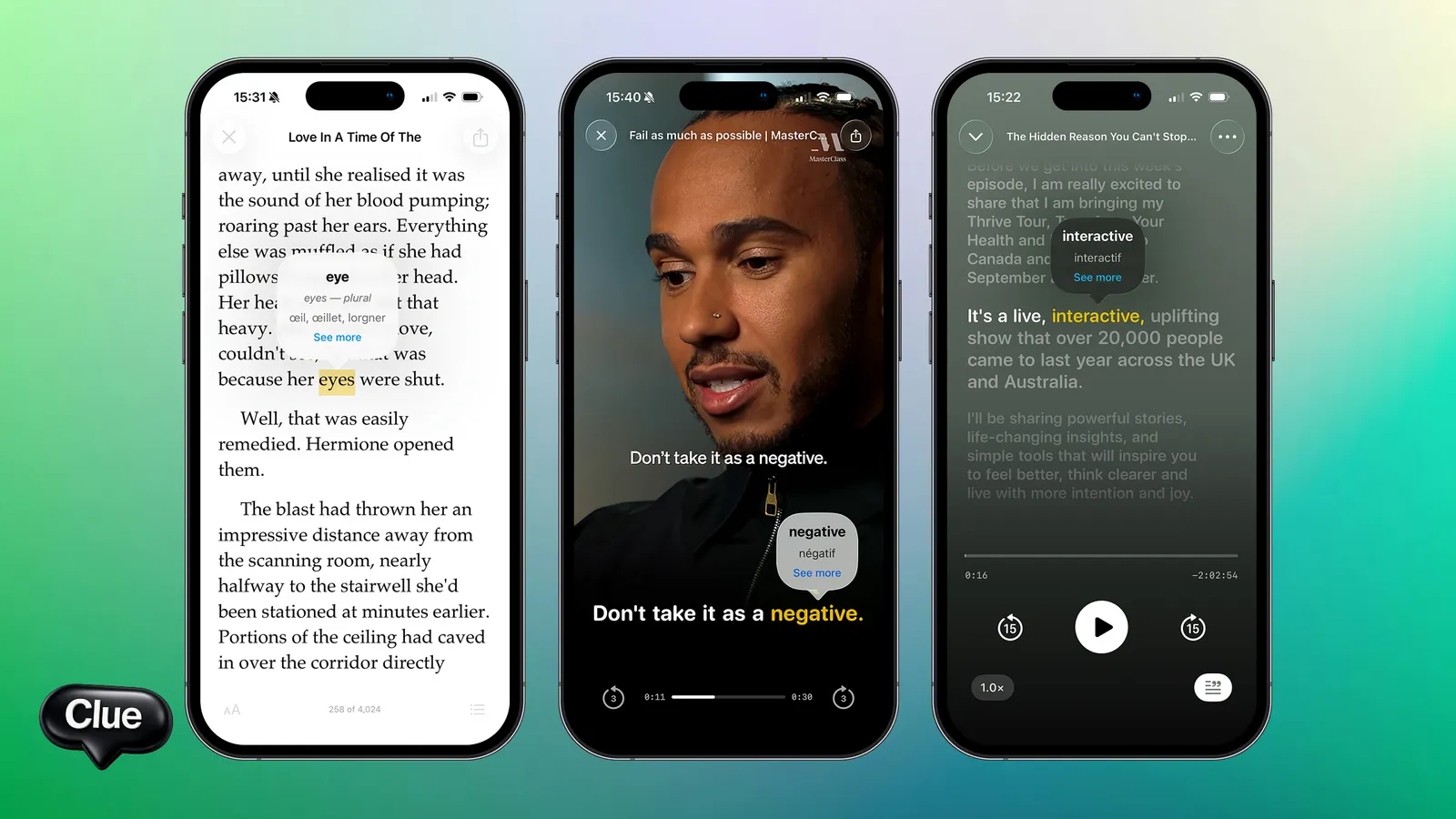
Clue is built for the jump from “I know some English” to “I can use English.”
The premise is simple: you bring real content (a podcast, a YouTube video, an EPUB book, a movie’s subtitle file), and Clue makes every word in it tappable. Tap a word, see an instant translation in your native language. The translation comes from a 27,000-word English dictionary that lives on your phone — no network call, no spinner, no API quota.
Save the word and it joins your personal flashcard practice. Quizzes pull the original sentence as context, so the word lives in the situation where you met it, not in a vacuum.
What this enables:
Hours of native-speed input, every day. A podcast you would listen to anyway becomes a learning tool. A YouTube channel you already follow does double duty. The path between “thing I wanted to consume” and “thing I am learning from” disappears.
Vocabulary that matches what you actually consume. The words you save are the words you encountered in real content, not the words a curriculum decided you should learn. They tend to stick faster because you have a memory of where you met them.
A reading flow that doesn’t break. Reading an English book with a paper dictionary is brutal — you stop, flip pages, lose the thread. Clue’s translation card slides up in under 100ms and lives at the bottom third of the screen. The flow is preserved.
What Clue is not
Clue is not a course. There is no curriculum, no lesson order, no “today’s challenge.” If you are pre-A2 you will struggle — too many unknown words, no structured progression. Start with Duolingo or a textbook, then come back.
Clue is not a streak app. No daily push notifications, no cartoon characters guilt-tripping you back. The product trusts you to return when you have content you want to consume. For motivated learners this is freedom; for users who need external structure it is drift.
Clue does not teach speaking. It is an input tool. For speaking practice you want a tutor (Preply, italki) or a conversation app (Talkpal, Speak).
Clue is on iOS and Android. Both platforms are supported, so it works whether you are iPhone-first or Android-first.
Pricing: side by side
Duolingo’s free tier shows ads between lessons and caps you on “hearts” (mistakes per session). Super Duolingo removes both for about $7/month or $84/year. Family plan is $120/year for six accounts.
Clue has no subscription tier. The full dictionary, all content slots, transcription, practice mode, saved words, and offline mode are free in the base app. There are no ads.
The math: even at Duolingo’s free tier you trade time for the ads. At Super tier you pay roughly $1,000 over a decade. Clue is genuinely zero.
How can Clue afford to be free? Smaller team, narrow scope (English only), no marketing budget. We focus on the product; users find us through search or word of mouth.
How most serious learners actually use both
The realistic timeline for someone who genuinely wants to reach intermediate-plus English:
Months 1–3: Duolingo daily, build the foundation. Maybe a beginner textbook on the side (Murphy’s Essential Grammar in Use is the standard).
Months 3–6: Duolingo lessons start feeling repetitive. Add Clue. Start with one short English podcast or one 5-minute YouTube video per day. Tap the words you don’t know. Save 5–10 of them.
Month 6+: Duolingo becomes optional — you’ve absorbed what it can teach. Clue becomes the primary tool because real content is now within reach. Vocabulary growth comes from the words you actually meet, not from a curriculum.
Month 12+: Add a speaking tool (italki, Preply tutor, Talkpal). Clue keeps providing input; the speaking tool provides output. The two together close the gap from passive understanding to active use.
This is the path that most learners who eventually reach B2+ actually take. The mistake people make is staying inside Duolingo at month six and wondering why their English isn’t getting noticeably better — because the tool was designed for the previous stage.
Which one should you use right now?
Be honest about your current level:
- You cannot read a simple English paragraph yet: Duolingo.
- You can read a simple paragraph but struggle with a paragraph from a news article: Duolingo plus a textbook, no Clue yet.
- You can read a news paragraph slowly but get lost in podcasts: Add Clue. This is the moment it shines.
- You can follow podcasts but reach for the dictionary 20 times per episode: Clue is the right tool. Duolingo will start feeling like a waste of time.
- You can read English books with occasional dictionary lookups: Clue is the only one of the two that still adds value.
FAQ
Is Clue free like Duolingo?
Clue is completely free — no subscription, no paywalls, no ads, no caps. Duolingo’s free tier has ads and limits; the no-ads no-limits experience requires Super Duolingo (~$7/mo).
Does Clue have lessons?
No structured lessons. The “lesson” is whatever real content you choose to consume. Practice mode quizzes you on the words you saved, using the actual sentences where you met them.
Does Duolingo cover the same languages Clue does?
Duolingo covers 40+ languages. Clue is focused specifically on English, from 10 native languages: Russian, Spanish, French, German, Italian, Portuguese, Dutch, Polish, Ukrainian, Turkish.
Can I import Duolingo vocabulary into Clue?
No direct import — the two apps don’t share data. Most learners just start fresh in Clue with content-driven vocabulary; the words you save in Clue are the ones you actually need.
Which has better speaking practice?
Duolingo has built-in voice exercises. Clue does not — it is an input tool, not an output tool. For real speaking practice you want a tutor (italki, Preply) or a conversation-focused app.
Should I cancel Duolingo when I start using Clue?
Not necessarily. Many learners run both for a couple of months — Duolingo for the streak habit, Clue for the real content. Drop Duolingo when the lessons start feeling like a waste of time you could spend with real English instead.
Different tools, different stages
There is no single “best app” for learning English. Duolingo is the best beginner course. Clue is the best bridge from beginner to fluent. They serve different jobs.
The mistake is staying inside Duolingo past month six and wondering why your English isn’t getting better. Once you can read a paragraph, real content is what matters — and Clue is the tool that makes real content tractable for a learner who isn’t quite ready for it unaided.
Try one episode of a podcast in Clue tonight. Tap the words you don’t know. If by the end of the episode you have ten saved words that came from a show you actually wanted to listen to, you’ve already done more for your English than a week of Duolingo lessons at this stage.
Frequently asked questions
Is Clue or Duolingo better for learning English? +
It depends on your stage. Duolingo is great for absolute beginners building basic vocabulary and habit through gamified lessons. Clue is better once you can handle simple sentences and want to understand real English — podcasts, videos and books — with instant tap-to-translate. They complement each other rather than directly compete.
Can Duolingo make you fluent in English? +
Duolingo builds a foundation and good habits, but gamified drills alone rarely produce real-world fluency. Fluency comes from large amounts of comprehensible input and real usage — understanding native content and practising speaking. That's the gap tools like Clue are designed to fill after the Duolingo basics.
Is Clue free like Duolingo? +
Yes — Clue is free to use. Unlike Duolingo's gamified lessons, Clue lets you learn from real podcasts, videos and books with tap-to-translate. Duolingo's free tier is ad-supported with limits; both let you start without paying.
What does Clue do that Duolingo doesn't? +
Clue turns real, native English content — podcasts, YouTube videos, books — into a learning tool: you tap any word or subtitle for an instant translation and learn vocabulary in real context. Duolingo focuses on structured, gamified exercises in its own closed curriculum rather than authentic, open content.
Read in other languages
Related articles
- How to Learn English by Yourself: A Self-Study System That Actually Works You've tried the apps, watched a few YouTube tutorials, maybe even paid for a course you stopped using by week three. The truth is most adults don't stall…
- English for Italian Speakers Learn English from real podcasts, videos and books with instant Italian translations. Offline dictionary, no per-lookup cost, built for Italian-speaking learners.
- How to Learn English Grammar Step by Step: A B1-to-C1 Roadmap That Doesn't Drill You to Death Most "step by step" grammar guides hand you the same checklist: present simple, past simple, present continuous, future, conditionals, and so on. You…
- The Truth About Free English Learning Apps in 2026 Most free English apps aren't actually free. What free means in 2026 — Duolingo, Babbel, Busuu, LingQ, Clue compared. Why Clue stays free.