

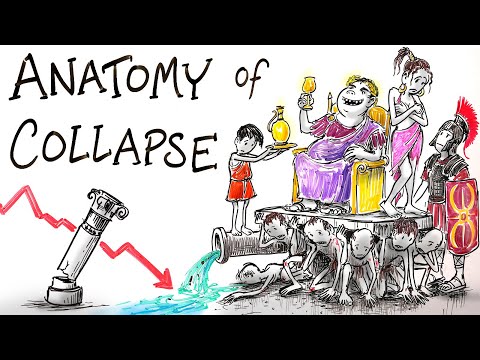
How did History's Greatest Civilization Collapse? The FALL of Rome - Gregory Aldrete
 After Skool
  Open in Clue
About this video
Two of the most famous and widely debated questions in all of history are: “When did the Roman Empire fall?” and “Why did the Roman Empire fall?” Over the centuries, dozens of thinkers have proposed hundreds of different answers to these questions, and even today historians do not agree on the answers to either question. Since the influence of Roman civilization still remains hugely important to the modern world in many fundamental areas such as language, law, architecture, government, and religion, it’s worth taking a look at some of the most popular dates and causes that have been proposed for the fall of the Roman Empire and see what merits each has. According to legend, Rome was founded in 753 BC by Romulus on the banks of the Tiber River. It began as a small monarchy of Latin tribes but became a republic in 509 BC, governed by elected senators. Over the next centuries, the Roman Republic expanded through Italy and the Mediterranean, defeating rivals like Carthage in the Punic Wars. By the 1st century BC, internal conflict and power struggles, including those of Julius Caesar, ended the Republic. In 27 BC, Caesar’s heir Octavian (Augustus) became the first emperor, marking the rise of the Roman Empire. Under emperors like Trajan and Hadrian, Rome reached its greatest extent, stretching from Britain to the Middle East. In the 3rd century AD, the empire weakened from invasions, plagues, and civil wars. Emperor Diocletian divided it into East and West in 285 AD, and by 476 AD, the Western Roman Empire fell when Germanic forces deposed its last emperor. The Eastern Empire, known as the Byzantine Empire, endured for nearly a thousand more years, preserving Roman law, art, and culture, until the fall of Constantinople in 1453 AD, marking the final end of the Roman world. The topic of WHY the great Roman civilization declined is one of contentious debate. In this episode we dispel some of the glorified myths surrounding Rome's collapse and investigate some of the lesser known causes. In the end, perhaps a better and more important question to ask than when or why Rome fell, would be to inquire, "How did it manage to last so very, very long?" Gregory S. Aldrete is Professor Emeritus of History at the University of Wisconsin–Green Bay. He earned his PhD in Ancient History from the University of Michigan. He has been honored with numerous awards for his research and teaching and has received five fellowships from the National Endowment for the Humanities. He is also a prolific scholar whose books include Gestures and Acclamations in Ancient Rome, Daily Life in the Roman City, and The Long Shadow of Antiquity: What Have the Greeks and Romans Done for Us? Gregory's Books: https://amzn.to/3z6NiKC Gregory's Great Courses Plus: https://www.thegreatcoursesplus.com/gregory-s-aldrete Gregory's Audible: https://adbl.co/4e72oP0 Please support After Skool on Patreon https://www.patreon.com/c/AfterSkool Or check our After Skool merch https://shop.afterskool.net/
Watch this video in English to learn English
Watching real YouTube videos in English with subtitles is one of the highest-density ways to absorb the language. How did History's Greatest Civilization Collapse? The FALL of Rome - Gregory Aldrete from After Skool gives you native pace, natural intonation, and vocabulary you'll actually meet in real conversations.
In the Clue app, every subtitle is tap-to-translate. No app-switching, no pausing the video, no dictionary. Just watch.
Videos to Learn English

Wabi Sabi - The Japanese Art of Perfect Imperfection
Genius Solution to Transform Barren Land into Fertile Garden

The Easiest Way to Change Who You Are - Dr Joe Dispenza

Evidence of Plant Intelligence - The Bizarre Polarity of Plants - Rupert Sheldrake

How Ai Slop will Spark the Next Human Renaissance

The Myth That Keeps You Trapped - Alan Watts

Why Inbreeding is Terrible AND Amazing - Bret Weinstein

How Early Separation from Mom Causes Permanent Personality Changes - Erica Komisar

A Brilliant Response to Atheism - John Lennox vs Christopher Hitchens

How to Destroy Your Enemy - Sun Tzu

Are We Waking Up a New God? - Agrippa's Diary

How to Instantly Connect with Anyone - Charles Duhigg