

Could This Thing *Really* Fly?
 MinuteEarth
  Open in Clue
About this video
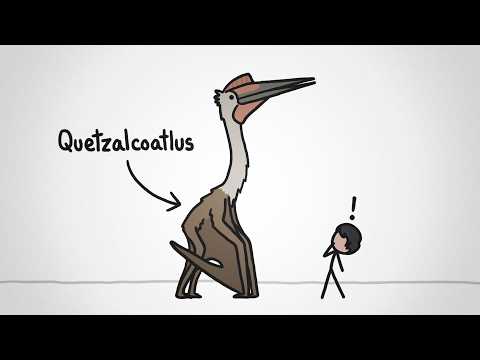
Help stop the worst parts of factory farming: https://www.farmkind.giving/minute-earth?promo=minute_earth The Quetzalcoatlus – one of the largest pterosaurs that ever lived – was able to fly even though it was the size of a giraffe! How on Earth did this giant manage to fly? LEARN MORE ************** To learn more about this topic, start your googling with these keywords: - Pterosaurs: are an extinct clade of flying reptiles in the order Pterosauria and are the earliest vertebrates known to have evolved powered flight. - Quetzalcoatlus: is a genus of azhdarchid pterosaur. Quetzalcoatlus northropi has gained fame as a candidate for the largest flying animal ever discovered. - Deltopectoral crest: is a forward directed bony flange on the upper part of the humerus. It provided insertion surfaces for muscles of the shoulder and chest. - Postcranial pneumaticity: is the presence of air-filled cavities inside bones of the body (everything except the skull) that are connected to the respiratory system. - Quad Launch (also Quadrupedal launch): is a takeoff method where an animal launches into the air using all four limbs—both the hind legs and the forelimbs. If you liked this week’s video, you might also like: Our friends at @Howtown recently made a video about the Quetzalcoatlus and it's great! (They even got to chat with Mark Witton!): https://www.youtube.com/watch?v=5vea06e6x_E Fascinating in-depth video about everything we know about Quetzalcoatlus, by @YourDinosaursAreWrong: https://www.youtube.com/watch?v=gCdOVC7CcXk SUPPORT MINUTEEARTH ************************** If you like what we do, you can help us!: - Become our patron: https://patreon.com/MinuteEarth - Our merch: http://dftba.com/minuteearth - Our book: https://minuteearth.com/books - Sign up to our newsletter: http://news.minuteearth.com - Share this video with your friends and family - Leave us a comment (we read them!) CREDITS ********* Ever Salazar | Script Writer, Narrator, Illustrator, Video Editor, Animator and Director Dr. Krishma Singal (Postdoctoral Researcher - Rice University) | Storyboard Artist Cony Pérez https://www.instagram.com/con0mmm/ | Storyboard Artist Sarah Berman | Illustrator, Video Editor, and Animator Nathaniel Schroeder | Music MinuteEarth is produced by Neptune Studios LLC https://neptunestudios.info OUR STAFF ************ Lizah van der Aart • Sarah Berman • Cameron Duke Arcadi Garcia i Rius • David Goldenberg • Melissa Hayes Henry Reich • Ever Salazar • Leonardo Souza • Kate Yoshida OTHER CREDITS ***************** Rhamphorhynchus Fossil In Berlin Photo by: Uwe Jelting OUR LINKS ************ Youtube | https://youtube.com/MinuteEarth TikTok | https://tiktok.com/@minuteearth Twitter | https://twitter.com/MinuteEarth Instagram | https://instagram.com/minute_earth Facebook | https://facebook.com/Minuteearth Website | https://minuteearth.com Apple Podcasts| https://podcasts.apple.com/us/podcast/minuteearth/id649211176 REFERENCES ************** Hone, David W.E., (2023). The anatomy and diversity of the pterosaurian sternum. Palaeontologia Electronica. https://doi.org/10.26879/1261 Padian, K., et al (2021) Functional morphology of Quetzalcoatlus Lawson 1975, Journal of Vertebrate Paleontology, https://doi.org/10.1080/02724634.2020.1780247 Witton, M. (2018). "Why we think giant pterosaurs could fly". Mark P. Witton's blog. https://markwitton-com.blogspot.com/2018/05/why-we-think-giant-pterosaurs-could-fly.html Sullivan, T., et al (2017). Extreme lightweight structures: Avian feathers and bones. Materials Today. 20. https://doi.org/10.1016/j.mattod.2017.02.004 Martin, E. G., & Palmer, C. (2014) Air Space Proportion in Pterosaur Limb Bones Using Computed Tomography and Its Implications for Previous Estimates of Pneumaticity. https://doi.org/10.1371/journal.pone.0097159 D.T. Ksepka (2014). Flight performance of the largest volant bird, Proc. Natl. Acad. Sci. U.S.A. 111 (29) 10624-10629, https://doi.org/10.1073/pnas.1320297111 Claessens LPAM, O'Connor PM, Unwin DM (2009) Respiratory Evolution Facilitated the Origin of Pterosaur Flight and Aerial Gigantism. PLOS ONE 4(2): e4497. https://doi.org/10.1371/journal.pone.0004497 Witton M, Naish D (2008). A Reappraisal of Azhdarchid Pterosaur Functional Morphology and Paleoecology. PLOS ONE 3(5): e2271. https://doi.org/10.1371/journal.pone.0002271 Witton, M. (2008). A new approach to determining pterosaur body mass and its implications for pterosaur flight. Zitteliana Reihe B: Abhandlungen der Bayerischen Staatssammlung fur Palaontologie und Geologie. B28. 143-158. S. Christopher Bennett, 2003. "Morphological evolution of the pectoral girdle of pterosaurs: myology and function", Evolution and Palaeobiology of Pterosaurs. https://doi.org/10.1144/gsl.sp.2003.217.01.12
Watch this video in English to learn English
Watching real YouTube videos in English with subtitles is one of the highest-density ways to absorb the language. Could This Thing *Really* Fly? from MinuteEarth gives you native pace, natural intonation, and vocabulary you'll actually meet in real conversations.
In the Clue app, every subtitle is tap-to-translate. No app-switching, no pausing the video, no dictionary. Just watch.
Videos to Learn English

How To Kill A Volcano

The Weird Reason Rabies Is So Deadly

Why Don't Blue Whales Eat Fish?

Why Bees Mostly Ignore The Waggle Dance

There’s Really Only One Way To Die

When Does It Make Sense To Kill Your Sibling?

40 Years Without A New Antibiotic. Why?

Why Hives Turn Against Their Queens

Why Eagles are Overdubbed In Movies

Why Haven't We Domesticated Monkeys?

There’s no such thing as a fake feather

Why is it always males that get eaten during sex?