


Lifestyle (sociology)
Deep Look
A science video series exploring big science by going very small.
 Open in Clue
 Videos to Learn English 100
-

Why Did the Mexican Jumping Bean Jump? | Deep Look
Mar 23, 2021
To find its place in the shade! Each hollowed-out seed is home to a head-banging moth larva, just trying to survive the harsh Sonoran Desert sun. SUBSCRIBE to Deep Look! http://goo.gl/8NwXqt Please join our community on Patreon! https://www.patreon.com/deeplook DEEP LOOK is an ultra-HD (4K) short video series created by KQED San Francisco and presented by PBS Digital Studios. See the unseen at the very edge of our visible world. Explore big scientific mysteries by going incredibly small. --- Often sold as novelty items and exported worldwide, Mexican jumping beans are actually the seed capsules of a shrub (Sebastiania pavoniana) that have been taken over by the tiny larvae of an attractive grey moth (Cydia saltitans). The moth lays its eggs on the green immature capsule of female flowers in the spring and summer, and the immature larvae bore into the young seed capsules. The developing seed will be home and food for the larva as it grows. By late summer, the capsules separate into three sections, falling to the ground. The seed capsules with larvae inside them hop around on the ground, to avoid overheating in the harsh sun of the Sonoran Desert. To do this, each larva weaves a silk lining along the seed interior, grabs on with its hind legs, and thrashes its head against the walls. The force topples the seed, as the larva uses its finely-tuned sense of temperature to seek shade. After spending most of its life shimmying around inside the seed capsule, the larva transforms into a pupa, and eventually into an adult moth. The moth only has a few days to quickly find a mate and lay eggs on another Mexican jumping bean bush before it dies. With luck, the young larvae will hop another day in the shade. --- Where do Mexican jumping beans come from? Mexican jumping beans are found primarily in the semi-arid mountainous regions of the Sonoran Desert in northern Mexico. They also occur in the Mexican state of Sinaloa and as far south as Costa Rica. --- Can the Mexican jumping bean moths survive in other places? If the adult moth does not find a Sebastiania pavoniana shrub, then it will die without passing on another generation. The moth has co-evolved with the Mexican jumping bean bush and depends on it for survival. So far, the bush and the moth are not endangered, but the supply is not limitless. --- Are there other kinds of jumping beans in the world? In the same family, the Tamboti tree in Africa also produces jumping beans, sometimes called “African jumping beans.” Also, there are other kinds of jumping galls, some of which are inhabited by gall wasps (see our gall wasp episode below). ---+ Find additional resources and a transcript on KQED Science: https://www.kqed.org/science/1973307/why-did-the-mexican-jumping-bean-jump ---+ More great Deep Look episodes: What Gall! The Crazy Cribs of Parasitic Wasps https://www.youtube.com/watch?v=lOgP5NzcTuA Why Is The Very Hungry Caterpillar So Dang Hungry? https://www.youtube.com/watch?v=el_lPd2oFV4 ---+ Shoutout! 🏆Congratulations🏆 to the following 5 fans on our Deep Look Community Tab for correctly answering how the adult jumping bean moth escapes the seed… the larva cuts a circular exit door with its mandibles *before* becoming a pupa: Mr. Fossil Padmavati Vhanale Agita Fabio Franco Rosy ---+ Thank you to our Top Patreon Supporters ($10+ per month)! Alex Burt Humburg Egg-Roll Shebastian Reyes Wild Turkey Josh Kuroda Chris B Emrick Karen Reynolds dane rosseter David Deshpande Daisuke Goto Nathan Jewsbury Tianxing Wang Allison & Maka Masuda Companion Cube Joshua Murallon Robertson Elizabeth Ann Ditz Kelly Hong Kevin Judge Gerardo Alfaro Robert Amling Laurel Przybylski Leonhardt Wille Sonia Tanlimco El Samuels Mary Truland Shelley Pearson Cranshaw Supernovabetty Carrie Mukaida Sayantan Dasgupta Aurora Roberta K Wright monoirre Rick Wong Kristy Freeman Silvan Caitlin McDonough Misia Clive Carlos Carrasco Nathan Wright Levi Cai Nicolette Ray Blanca Vides Titania Juang Teresa Lavell Scott Faunce Cristen Rasmussen Syniurge SueEllen McCann Noreen Herrington Louis O'Neill Kallie Moore Anastasia Grinkevic Cindy McGill Aurora Mitchell Tearra Guice Adam Kurtz KW Laura Sanborn TierZoo ---+ Follow KQED Science and Deep Look: Instagram: https://www.instagram.com/kqedscience/ Twitter: https://www.twitter.com/kqedscience ---+ About KQED KQED, an NPR and PBS affiliate in San Francisco, California, serves Northern California and beyond with a public-supported alternative to commercial TV, radio and web media. Funding for Deep Look is provided in part by PBS Digital Studios. Deep Look is a project of KQED Science, the largest science and environment reporting unit in California. KQED Science is supported by The National Science Foundation, the Dirk and Charlene Kabcenell Foundation, the Vadasz Family Foundation, the Gordon and Betty Moore Foundation, Campaign 21 and the members of KQED. #mexicanjumpingbeans #jumpingbeans #deeplook
-

Born Pregnant: Aphids Invade With an Onslaught of Clones | Deep Look
Mar 9, 2021
Female aphids are the matriarchs of a successful family operation— taking over your garden. But don’t lose hope; these pests have some serious predators and creepy parasites looking to take them down. SUBSCRIBE to Deep Look! http://goo.gl/8NwXqt Please join our community on Patreon! https://www.patreon.com/deeplook DEEP LOOK is an ultra-HD (4K) short video series created by KQED San Francisco and presented by PBS Digital Studios. See the unseen at the very edge of our visible world. Explore big scientific mysteries by going incredibly small. --- Aphids are one of gardeners’ most hated pests. They’re incredibly prolific, seemingly popping up overnight to take down your favorite veggies. "Aphids are just experts at reproducing," said Ian Grettenberger an entomologist at the University of California, Davis. "Given the right conditions, they can multiply really quickly and get out of control. For most of the year female aphids giving live birth to clones that are themselves already pregnant. That means that most of the time, all of the aphids you see in your garden are pregnant females. When their population gets big enough and the plant they’re on starts to wane, aphids start giving birth to a new type of winged clones called alates. Amazingly, the alates are genetically identical to their wingless mothers. The alates take to the air to find new plants to colonize. --- What do aphids eat? Aphids use their pointy stylet to pierce plant leaves and such out the sugary sap. Usually, plants can handle a light infestation, but aphids reproduce quickly. Heavily infested leaves yellow and wither. Aphids can also carry viruses that they spread between the different plants they feed on. --- How do aphids spread? Aphids give birth to winged clones called alates that fly from plant to plant. Since aphids can clone themselves, it only takes one aphid to infiltrate your garden and start causing trouble. --- How do I get rid of aphids? Some gardeners use oils and pesticide sprays to get rid of aphids but it’s very challenging to get every last one of them. You can purchase predators like lacewing larvae to hunt and eat aphids. You can also purchase parasitoid wasps that lay their eggs in aphids, killing them. ---+ Find additional resources and a transcript on KQED Science: https://www.kqed.org/science/1973052/born-pregnant-aphids-invade-with-an-onslaught-of-clones/ ---+ More great Deep Look episodes: These Mites Rain Down To Save Your Strawberries | Deep Look https://www.youtube.com/watch?v=Q1XFi9r3dIE Sharpshooter Insects’ Sexy Vibrations Spell Trouble in the Vineyard | Deep Look https://www.youtube.com/watch?v=uFA614SEDMQ Samurai Wasps Say 'Smell Ya Later, Stink Bugs' | Deep Look https://www.youtube.com/watch?v=T8y2XmjdXqw&t=75s ---+ Shoutout! 🏆Congratulations🏆 to the following 5 fans on our Deep Look Community Tab for identifying the phenomenon of aphids giving birth to young that are already pregnant - telescoping generations! Duncan AphidKirby Philliam P Paweł Szymanek B.C. ---+ Thank you to our Top Patreon Supporters ($10+ per month)! Alex Burt Humburg Egg-Roll Shebastian Reyes Wild Turkey Josh Kuroda Chris B Emrick Karen Reynolds dane rosseter David Deshpande Daisuke Goto Nathan Jewsbury Tianxing Wang Allison & Maka Masuda Companion Cube Joshua Murallon Robertson Elizabeth Ann Ditz Kelly Hong Kevin Judge Gerardo Alfaro Robert Amling Laurel Przybylski Leonhardt Wille Sonia Tanlimco El Samuels Mary Truland Shelley Pearson Cranshaw Supernovabetty Carrie Mukaida Sayantan Dasgupta Aurora Roberta K Wright monoirre Rick Wong Kristy Freeman Silvan Caitlin McDonough Misia Clive Carlos Carrasco Nathan Wright Levi Cai Nicolette Ray Blanca Vides Titania Juang Teresa Lavell Scott Faunce Cristen Rasmussen Syniurge SueEllen McCann Noreen Herrington Louis O'Neill Kallie Moore Anastasia Grinkevic Cindy McGill Aurora Mitchell Tearra Guice Adam Kurtz KW Laura Sanborn TierZoo ---+ Follow KQED Science and Deep Look: Instagram: https://www.instagram.com/kqedscience/ Twitter: https://www.twitter.com/kqedscience ---+ About KQED KQED, an NPR and PBS affiliate in San Francisco, California, serves Northern California and beyond with a public-supported alternative to commercial TV, radio and web media. Funding for Deep Look is provided in part by PBS Digital Studios. Deep Look is a project of KQED Science, the largest science and environment reporting unit in California. KQED Science is supported by The National Science Foundation, the Dirk and Charlene Kabcenell Foundation, the Vadasz Family Foundation, the Gordon and Betty Moore Foundation, Campaign 21 and the members of KQED. #aphids #deeplook #alates
-

Firebrats and Silverfish Are Rocking Some Old-School Looks | Deep Look
Feb 23, 2021
What *is* that bizarre fishlike thing squirming in your sink at night? Firebrats and silverfish are pretty darn similar to some of the earliest insects on Earth. With three long filaments poking out their back, no wings and mini-me babies, they have something to teach us about survival. SUBSCRIBE to Deep Look! http://goo.gl/8NwXqt Please join our community on Patreon! https://www.patreon.com/deeplook DEEP LOOK is an ultra-HD (4K) short video series created by KQED San Francisco and presented by PBS Digital Studios. See the unseen at the very edge of our visible world. Explore big scientific mysteries by going incredibly small. --- Look closely at the firebrat munching on cereal in your kitchen or getting cozy in a pile of newspapers. You’ll see traits some of the earliest insects had around 400 million years ago. Take its three tail-looking filaments. The two outer ones are called cerci. They work like antennae, detecting chemicals and predators like house centipedes. Other insects, like cockroaches, have a short pair of cerci. But very few insects have the middle filament that firebrats and silverfish possess. Called the median caudal filament, it has tiny hairs that can detect the faintest air currents. --- What do firebrats eat? Cereal, spices and books – both the pages and the glue in the binding. Only a handful of the 500 to 600 species of firebrats and silverfish live with us. In nature, they feed on leaves, stems, needles and bark. “And they will also eat, well, each other,” said entomologist Art Appel from Auburn University. --- Are firebrats dangerous? No, they don’t bite or sting. --- What is the difference between silverfish and firebrats? Silverfish generally prefer cooler parts of the house, while firebrats are drawn to warmer corners, like a water heater – hence their name. --- Does evolution have a goal? When you look at a firebrat, with its ancient traits, you might wonder why it hasn’t changed to be more like other insects. For example, when insects developed wings around 325 million years ago this led to an explosion in insect diversity. So why did firebrats remain wingless, like the earliest insects? “When we see a creature that looks pretty similar to things that were probably living 400 million years ago, we think, ‘Why isn’t that creature doing a better job of being modern?’” said Sandra Schachat, a doctoral student who researches insect evolution at Stanford University. “But the way that evolution works is that it doesn't really have an optimum that things are being driven towards. You don’t need to be the most abundant species in your habitat in order to survive. You only need to be abundant enough that you can maintain some kind of population over time.” ---+ Find additional resources and a transcript on KQED Science: https://www.kqed.org/science/1972757/firebrats-and-silverfish-are-rocking-some-old-school-looks ---+ More Deep Look episodes: Here’s How That Annoying Fly Dodges Your Swatter https://youtu.be/jBPFCvEhv9Y These Termites Turn Your House into a Palace of Poop https://youtu.be/DYPQ1Tjp0ew ---+ Shoutout! 🏆Congratulations🏆 to these 5 fans on our Community Tab who identified what gives the firebrats and silverfish the ability to digest cellulose - special enzymes! Catto The Steel City Storm The GoldenDunsparce Junior Meren Imchen ---+ Thank you to our Top Patreon Supporters ($10+ per month)! Burt Humburg Alex Shebastian Reyes Daniel Weinstein Egg-Roll Karen Reynolds Wild Turkey Josh Kuroda Chris B Emrick dane rosseter David Deshpande Daisuke Goto Allison & Maka Masuda Companion Cube Tianxing Wang Nathan Jewsbury Kelly Hong Kevin Judge Leonhardt Wille Gerardo Alfaro Elizabeth Ann Ditz Laurel Przybylski Mary Truland Sonia Tanlimco Robert Amling Supernovabetty Sayantan Dasgupta Roberta K Wright Joshua Murallon Robertson Cindy McGill Shelley Pearson Cranshaw Carrie Mukaida Aurora monoirre Silvan Rick Wong Levi Cai Syniurge Cristen Rasmussen Carlos Carrasco Misia Clive Kristy Freeman Nicolette Ray Nathan Wright Titania Juang Kallie Moore Caitlin McDonough Scott Faunce SueEllen McCann Noreen Herrington Blanca Vides Teresa Lavell Louis O'Neill Tearra Guice Laura Sanborn Aurora Mitchell Adam Kurtz KW TierZoo ---+ Follow KQED Science and Deep Look: Instagram: https://www.instagram.com/kqedscience/ Twitter: https://www.twitter.com/kqedscience ---+ About KQED KQED, an NPR and PBS affiliate in San Francisco, California, serves Northern California and beyond with a public-supported alternative to commercial TV, radio and web media. Funding for Deep Look is provided in part by PBS Digital Studios. Deep Look is a project of KQED Science, the largest science and environment reporting unit in California. KQED Science is supported by The National Science Foundation, the Dirk and Charlene Kabcenell Foundation, the Vadasz Family Foundation, the Gordon and Betty Moore Foundation, Campaign 21 and the members of KQED. #deeplook #silverfish #firebrat
-
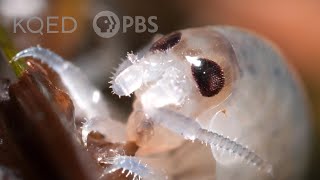
These Acrobatic Beach Hoppers Shred All Night Long | Deep Look
Feb 9, 2021
As the sun sets, hordes of tiny crustaceans called beach hoppers –– also known as sand hoppers –– emerge from underground burrows to frolic and feast. They eat so much decaying seaweed and other beach wrack that by morning all that’s left are ghostly outlines in the sand. Watch and Subscribe to PBS Terra: https://www.youtube.com/pbsterra SUBSCRIBE to Deep Look! http://goo.gl/8NwXqt DEEP LOOK is an ultra-HD (4K) short video series created by KQED San Francisco and presented by PBS Digital Studios. See the unseen at the very edge of our visible world. Explore big scientific mysteries by going incredibly small. --- Night falls, and the beaches come alive with sand hoppers – hungry, jumping shrimp-like creatures that look a lot like giant translucent fleas. No, it’s not a horror movie, and these animals “don’t bite or suck your blood. They’re much more than fleas,” says Jenny Dugan of the Marine Science Institute at UC Santa Barbara. Through her research on sandy beach ecology, Dugan has spent years developing a respect for beach hoppers and their under-appreciated ecological role. The small crustaceans, sometimes as large as two inches, are remarkably in tune with the tides. The mature adult beach hoppers only emerge from their burrows at night when the tide is retreating – which is the best time to find fresh kelp, and less of a risk being seen by predators. Researchers refer to these animals as shredders because they do the necessary work of breaking down and recycling nutrients in beach wrack and kelp, the first step in sending nutrients into the food chain. The presence of sustainable populations of beach hoppers is an indicator of the overall health of a sandy beach ecosystem. --- Where do beach hoppers live? Beach hoppers – also known as sand hoppers – live on sandy beaches in subtropical and temperate zones all over the world. North and South America, Europe, Africa, New Zealand and Australia all have a variety of native species of beach hoppers. On beaches with large amounts of kelp, seagrass and seaweeds washing ashore, you are bound to find sand hoppers too. --- Do beach hoppers bite people? No. Beach hoppers do not bite! They might look like a giant flea, but they aren’t fleas. They are a type of crustacean. Their favorite food is kelp, but they will eat anything that makes up beach wrack – the piles of organic matter that wash ashore on sandy beaches. --- How do beach hoppers know where they are going? Research indicates that some species of beach hoppers use cues from the moon and the sun to orient themselves, and to stay in sync with the ebb and flow cycles of the tides. ---+ Find additional resources and a transcript on KQED Science: https://www.kqed.org/science/1972559/these-acrobatic-beach-hoppers-shred-all-night-long ---+ More great Deep Look episodes: The Snail-Smashing, Fish-Spearing, Eye-Popping Mantis Shrimp https://www.youtube.com/watch?v=Lm1ChtK9QDU California Floater Mussels Take Fish For an Epic Joyride https://www.youtube.com/watch?v=m7p_w4zE3s4 ---+ Shoutout! 🏆Congratulations🏆 to the following 5 fans on our Deep Look Community Tab for identifying the parts of the body the beach hopper use to jump - the uropods - abdominal appendages and parts of their tail. // Δ V S T I N // Sourabh Kamat Jared Blake AngryFox07 sushil singh ---+ Thank you to our Top Patreon Supporters ($10+ per month)! Burt Humburg Alex Shebastian Reyes Daniel Weinstein Egg-Roll Karen Reynolds Wild Turkey Josh Kuroda Chris B Emrick dane rosseter David Deshpande Daisuke Goto Allison & Maka Masuda Companion Cube Tianxing Wang Nathan Jewsbury Kelly Hong Kevin Judge Leonhardt Wille Gerardo Alfaro Elizabeth Ann Ditz Laurel Przybylski Mary Truland Sonia Tanlimco Robert Amling Supernovabetty Sayantan Dasgupta Roberta K Wright Joshua Murallon Robertson Cindy McGill Shelley Pearson Cranshaw Carrie Mukaida Aurora monoirre Silvan Rick Wong Levi Cai Syniurge Cristen Rasmussen Carlos Carrasco Misia Clive Kristy Freeman Nicolette Ray Nathan Wright Titania Juang Kallie Moore Caitlin McDonough Scott Faunce SueEllen McCann Noreen Herrington Blanca Vides Teresa Lavell Louis O'Neill Tearra Guice Laura Sanborn Aurora Mitchell Adam Kurtz KW TierZoo ---+ Follow KQED Science and Deep Look: Instagram: https://www.instagram.com/kqedscience/ Twitter: https://www.twitter.com/kqedscience ---+ About KQED KQED, an NPR and PBS affiliate in San Francisco, California, serves Northern California and beyond with a public-supported alternative to commercial TV, radio and web media. Funding for Deep Look is provided in part by PBS Digital Studios. Deep Look is a project of KQED Science, the largest science and environment reporting unit in California. KQED Science is supported by The National Science Foundation, the Dirk and Charlene Kabcenell Foundation, the Vadasz Family Foundation, the Gordon and Betty Moore Foundation, Campaign 21 and the members of KQED. #beachhopper #sandhopper #deeplook
-

These Mites Rain Down To Save Your Strawberries | Deep Look
Jan 26, 2021
Two tiny mites duke it out on strawberry plants throughout California. One is a spider mite that sucks the juices out of the delicious crop and destroys it. The other, persimilis, is a crafty predator that growers drop by the thousands from high-tech drones to protect their fields. SUBSCRIBE to Deep Look! http://goo.gl/8NwXqt Please join our community on Patreon! https://www.patreon.com/deeplook DEEP LOOK is an ultra-HD (4K) short video series created by KQED San Francisco and presented by PBS Digital Studios. See the unseen at the very edge of our visible world. Explore big scientific mysteries by going incredibly small. Individual spider mites are barely visible, about the size of a grain of salt, but together they cause huge damage to crops around the world. They suck sap from the leaves and stems of crops and houseplants, leaving yellow or dry rusty leaves and tangles of fine silk. Farmers can use pesticides to knock them back, but spider mites quickly develop resistance, making them particularly stubborn pests. So many farmers turn to biological control agents. One of the most popular is another type of mite commonly called persimilis. This predatory mite hunts down spider mites and their eggs. But spreading the tiny hunters over vast agricultural fields is a challenge, so some growers are turning to companies like Parabug to disperse the predators by air using drones. Now, entomologist Christian Nansen and engineer Zhaodan Kong at UC Davis are looking at ways to automate this entire process of crop protection. They’re developing a strategy using drones armed with special cameras to detect changes in the way sunlight bounces off plants' leaves. Software using machine learning algorithms would then read the subtle changes in the leaves' reflectance and come up with a diagnosis about what was causing the stress. If the system suspects a spider mite infestation it could then summon a second drone, packed with predatory mites. The team is working on developing software to accurately drop the predators right on the trouble areas. “The idea is that these natural predators are like tiny paratroopers coming in on the drones,” said Nansen, “with a special eye in the sky that sees exactly where they need to go.” --- What are spider mites? Spider mites are not insects. They're arachnids, more closely related to spiders and ticks. --- How do I get rid of spider mites? One of the best ways to get rid of spider mites on houseplants and garden crops is to spray the plant with water to knock the mites off. There are pesticides that will kill them, but spider mites have a knack for becoming resistant. Oils are also used to smother the mites. Biological control agents like predatory mites can be particularly effective. ---+ Find additional resources and a transcript on KQED Science: https://www.kqed.org/science/1972295/these-mites-rain-down-to-save-your-strawberries ---+ More great Deep Look episodes: Samurai Wasps Say 'Smell Ya Later, Stink Bugs' | Deep Look https://youtu.be/T8y2XmjdXqw How Ticks Dig In With a Mouth Full of Hooks | Deep Look https://youtu.be/_IoOJu2_FKE ---+ Shoutout! 🏆Congratulations🏆 to these 5 fans on our Deep Look Community Tab for identifying the sharp mouthparts of the Persimilis mite - chelicerae! Ivar Golubenko Yann Cohen RandomAlex SARA FATIMA ZeGamingCuber ---+ Thank you to our Top Patreon Supporters ($10+ per month)! Bill Cass Alex Burt Humburg Shebastian Reyes Egg-Roll Daniel Weinstein Josh Kuroda Chris B Emrick Wild Turkey Karen Reynolds dane rosseter David Deshpande Daisuke Goto Companion Cube Tianxing Wang Nathan Jewsbury Kevin Judge Kelly Hong Robert Amling Laurel Przybylski Gerardo Alfaro Elizabeth Ann Ditz Leonhardt Wille Sonia Tanlimco Mary Truland Shelley Pearson Cranshaw Supernovabetty Sayantan Dasgupta Carrie Mukaida monoirre Joshua Murallon Robertson Cindy McGill Silvan Aurora Rick Wong Roberta K Wright Titania Juang Levi Cai Guillaume Morin Nathan Wright Misia Clive Carlos Carrasco Kristy Freeman Caitlin McDonough Noreen Herrington Blanca Vides Teresa Lavell Cristen Rasmussen Nicolette Ray Dogman Kallie Moore Syniurge Scott Faunce SueEllen McCann Tearra Guice Geidi Rodriguez Louis O'Neill Laura Sanborn Aurora Mitchell KW Adam Kurtz TierZoo ---+ Follow KQED Science and Deep Look: Instagram: https://www.instagram.com/kqedscience/ Twitter: https://www.twitter.com/kqedscience ---+ About KQED KQED, an NPR and PBS affiliate in San Francisco, California, serves Northern California and beyond with a public-supported alternative to commercial TV, radio and web media. Funding for Deep Look is provided in part by PBS Digital Studios. Deep Look is a project of KQED Science, the largest science and environment reporting unit in California. KQED Science is supported by The National Science Foundation, the Dirk and Charlene Kabcenell Foundation, the Vadasz Family Foundation, the Gordon and Betty Moore Foundation, Campaign 21 and the members of KQED.
-

These Silk-Swinging Caterpillars Will Ruin Your Picnic | Deep Look
Jan 12, 2021
California oak moth caterpillars eat all the leaves on an oak, leaving a brown skeleton. Then they rappel down on a strand of silk, twirling and swinging. If you were enjoying the shade, good luck getting out of their way. For the oak, the caterpillars are a bigger deal –– will the tree survive? SUBSCRIBE to Deep Look! http://goo.gl/8NwXqt Please join our community on Patreon! https://www.patreon.com/deeplook DEEP LOOK is an ultra-HD (4K) short video series created by KQED San Francisco and presented by PBS Digital Studios. See the unseen at the very edge of our visible world. Explore big scientific mysteries by going incredibly small. --- It’s an event that scientists still can’t explain. Every few years, a light-brown moth native to California seems to appear out of nowhere up and down the state. These California oak moths surround a few trees, usually coast live oaks. Females beat their wings frantically to attract a mate. Once they lay their eggs, the tree is in trouble. Bright-yellow, orange and black caterpillars, known as California oakworms, cover its leaves after a few months. “They will completely devour one tree, while the tree right next to it seems completely untouched,” said Peter Oboyski, executive director of the Essig Museum of Entomology at the University of California, Berkeley. “That suggests that the females are all laying their eggs on the same tree. Is it because they’re attracted to each other? Or is it because this tree is particularly yummy and the tree next to it maybe has too many defensive chemicals? A lot of what’s interesting about this story is all the mystery around it.” --- --- What are those clouds of moths around that oak? In the San Francisco Bay Area, California oak moths emerge in mid-June and in early to mid-October. As the sun sets, you’ll see clouds of them fluttering around an oak, often a coast live oak. Moths lay their white and red eggs on the oak’s leaves or on plants below the tree. The moths that fly in June lay eggs from which caterpillars hatch in early July. The moths that fly in mid-October lay eggs that hatch at the end of the month. These caterpillars develop very slowly over winter and turn into the pupae from which moths will emerge in mid-June. That’s why California oak moths often lay their eggs on coast live oaks so that the evergreen trees can provide foliage for their hungry caterpillars through the winter. --- Should you get rid of California oak moths? Even though it’s harrowing to watch caterpillars defoliate an oak, Oboyski said that healthy trees usually survive the onslaught and grow back their leaves. ---+ Find additional resources and a transcript on KQED Science: https://www.kqed.org/science/1972082/these-silk-swinging-caterpillars-will-ruin-your-picnic ---+ More great Deep Look episodes: Why Is The Very Hungry Caterpillar So Dang Hungry? https://youtu.be/el_lPd2oFV4 It’s a Goopy Mess When Pines and Beetles Duke it Out https://youtu.be/wR5O48zsbnc ---+ Shoutout! 🏆Congratulations🏆 to the following 5 fans on our Deep Look Community Tab for identifying why the female oak moth is fanning her wings - to spread her pheromones to attract males! TorterraGrey8 mr egg Average Viewer Miguel Jose Jared Blake ---+ Thank you to our Top Patreon Supporters ($10+ per month)! Bill Cass Alex Burt Humburg Shebastian Reyes Egg-Roll Daniel Weinstein Josh Kuroda Chris B Emrick Wild Turkey Karen Reynolds dane rosseter David Deshpande Daisuke Goto Companion Cube Tianxing Wang Nathan Jewsbury Kevin Judge Kelly Hong Robert Amling Laurel Przybylski Gerardo Alfaro Elizabeth Ann Ditz Leonhardt Wille Sonia Tanlimco Mary Truland Shelley Pearson Cranshaw Supernovabetty Sayantan Dasgupta Carrie Mukaida monoirre Joshua Murallon Robertson Cindy McGill Silvan Aurora Rick Wong Roberta K Wright Titania Juang Levi Cai Guillaume Morin Nathan Wright Misia Clive Carlos Carrasco Kristy Freeman Caitlin McDonough Noreen Herrington Blanca Vides Teresa Lavell Cristen Rasmussen Nicolette Ray Dogman Kallie Moore Syniurge Scott Faunce SueEllen McCann Tearra Guice Geidi Rodriguez Louis O'Neill Laura Sanborn Aurora Mitchell KW Adam Kurtz TierZoo ---+ Follow KQED Science and Deep Look: Instagram: https://www.instagram.com/kqedscience/ Twitter: https://www.twitter.com/kqedscience ---+ About KQED KQED, an NPR and PBS affiliate in San Francisco, California, serves Northern California and beyond with a public-supported alternative to commercial TV, radio and web media. Funding for Deep Look is provided in part by PBS Digital Studios. Deep Look is a project of KQED Science, the largest science and environment reporting unit in California. KQED Science is supported by The National Science Foundation, the Dirk and Charlene Kabcenell Foundation, the Vadasz Family Foundation, the Gordon and Betty Moore Foundation, Campaign 21 and the members of KQED.
-

Here’s How That Annoying Fly Dodges Your Swatter | Deep Look
Nov 24, 2020
A fly has a pair of tiny, dumbbell-shaped limbs called halteres that were once a second pair of wings. They wield them to make razor-sharp turns and land out of reach on your ceiling. But don't despair – there *is* a trick to smacking these infuriating insects. SUBSCRIBE to Deep Look! http://goo.gl/8NwXqt Please join our community on Patreon! https://www.patreon.com/deeplook DEEP LOOK is a ultra-HD (4K) short video series created by KQED San Francisco and presented by PBS Digital Studios. See the unseen at the very edge of our visible world. Explore big scientific mysteries by going incredibly small. --- Flies are formidable opponents, with an arsenal of tools they carry all over their bodies. For starters, their hair and antennae help a fly sense us as we walk up to them. And a fly’s eyes and tiny brain process information 10 times faster than human eyes and brains. “Compared to flies, humans are slow and sluggish creatures,” said Sanjay Sane, who researches flies at the National Centre for Biological Sciences at the Tata Institute of Fundamental Research in Bangalore, India. Once the fly escapes your swatter and is in the air, it’s in its element and your job is even tougher. Seen up close and slowed down, a fly’s aerobatics are impressive: It makes razor-sharp turns with ease and at great speed. What makes this possible is a pair of modified wings called halteres, a Greek word for dumbbell, which describes their shape. All of the 200,000 species of flies that scientists have described have a pair of halteres and a pair of wings. (That includes mosquitoes, which, wouldn’t you know it, are flies too). Most other insects – bees, butterflies, dragonflies – have four wings and no halteres. --- How do flies’ halteres work? As a fly turns, its halteres sense the rotation. In a split second, neurons at the base of the halteres send information to the fly’s muscles to steer its wings and keep its head steady. “Houseflies flap their wings about 200 times per second, which means they really only have five milliseconds to figure out what the next wingbeat is going to be like. And if you’re using vision that takes too long to do,” said Jessica Fox, who studies flies at Case Western Reserve University, in Ohio. “They really need a mechanical receptor in order to be able to sense their body rotations and correct them on the timescale that they need.” --- How do flies land and stay on the ceiling? Their halteres allow them to rotate quickly to land on the ceiling. Once they’re there, they hang upside down with tiny hooks and sticky pads on their feet. The pads, called pulvilli, have microscopic hairs that excrete a liquid that sticks to the surface. --- How do I swat a fly? “Flies process information about moving objects but they cannot process static objects, Sane explained. “Thus, the best way to approach a fly is in small, quasi-static steps such that they do not see you as a moving object.” ---+ Read the entire article on KQED Science: https://www.kqed.org/science/1971058/heres-how-that-annoying-fly-dodges-your-swatter/ ---+ Shoutout! 🏆Congratulations🏆 to the these 5 fans on our Community Tab for identifying the tiny limbs beneath a fly's wings - halteres: Tom Riddle Unknown Gamer CaeliGlori TorterraGrey8 Juanma G.V. ---+ Thank you to our Top Patreon Supporters ($10+ per month)! Bill Cass Justin Bull Burt Humburg Alex Shebastian Reyes Daniel Weinstein Egg-Roll Karen Reynolds Wild Turkey Chris B Emrick Josh Kuroda Tea Torvinen dane rosseter David Deshpande Daisuke Goto Companion Cube Tianxing Wang Elizabeth Ann Ditz Kevin Judge Leonhardt Wille Laurel Przybylski Dia Kelly Hong Robert Amling Gerardo Alfaro luna Mary Truland Sayantan Dasgupta Supernovabetty Joshua Murallon Robertson Aurora Pamela Parker Carrie Mukaida Shelley Pearson Cranshaw Cindy McGill Laura Sanborn Silvan Wendland monoirre Rick Wong Carlos Carrasco Titania Juang Roberta K Wright Misia Clive Nathan Wright Sonia Tanlimco Levi Cai Nicolette Ray Teresa Lavell Caitlin McDonough Kristy Freeman Blanca Vides Alexandre Valdetaro Guillaume Morin Noreen Herrington Scott Faunce Cristen Rasmussen Dogman Louis O'Neill Kallie Moore Geidi Rodriguez Syniurge SueEllen McCann KW Joao Ascensao Aurora Mitchell Sharon Merritt Adam Kurtz TierZoo ---+ Follow KQED Science and Deep Look: Instagram: https://www.instagram.com/kqedscience/ Twitter: https://www.twitter.com/kqedscience ---+ About KQED KQED, an NPR and PBS affiliate in San Francisco, CA, serves Northern California and beyond with a public-supported alternative to commercial TV, radio and web media. Funding for Deep Look is provided in part by PBS Digital Studios. Deep Look is a project of KQED Science, the largest science and environment reporting unit in California. KQED Science is supported by The National Science Foundation, the Dirk and Charlene Kabcenell Foundation, the Vadasz Family Foundation, the Gordon and Betty Moore Foundation, Campaign 21 and the members of KQED.
-

See Sea Slugs Scour Seagrass by the Seashore | Deep Look
Nov 10, 2020
Eelgrass sea hares may look like lazy, zebra-striped spoonfuls of jello, but these sea slugs are actually environmental heroes. Their voracious appetite for algae helps keep underwater meadow ecosystems in balance–which is great news for sea otters. Deep Look Mollusk Playlist! https://www.youtube.com/watch?v=0wtLrlIKvJE&list=PLdKlciEDdCQBKKj0mY_irUMTg_yS5VEHY SUBSCRIBE to Deep Look! http://goo.gl/8NwXqt DEEP LOOK is an ultra-HD (4K) short video series created by KQED San Francisco and presented by PBS Digital Studios. See the unseen at the very edge of our visible world. Explore big scientific mysteries by going incredibly small. --- Eelgrass sea hares are tiny aquatic slugs named for the bunny-like tentacles on top of their head. They can be found munching on the microscopic algae that grow on the surface of eelgrass, a type of marine seagrass. Also known as the Taylor’s sea hare, these humble, zebra-striped slices of green jello are actually crucial to the health of their ecosystem. They don’t eat the grass itself; instead they help the meadows grow by clearing the way for sunlight to reach the plants, scraping the blades of grass clean with their rows of tiny teeth. The seagrass, in turn, serves as a safe haven to lay their eggs, and protection from predators like crabs and fish. The blades of grass also protect more than just these voracious little cleaners. At Elkhorn Slough, a large winding estuary off of Monterey Bay, the eelgrass beds form a habitat for a diverse community of animals and plant life, which includes sea otters, Dungeness crabs, clams, skeleton shrimp and various fish. For decades, nutrient overload from agricultural runoff has caused excessive algae blooms in Elkhorn Slough, as the thick algal mats block out the sunlight needed for the grass to grow. But with the reintroduction of sea otters to Elkhorn Slough in the 1980’s, ecologists observed a balancing effect on the system. The otters started eating the crabs that eat the sea hares. Because of this trophic cascade, the slug population grew, and their appetite for algae helped keep the eelgrass clean, counterbalancing the effects of the algal blooms. --- Is a sea hare a nudibranch? Nudibranchs and sea hares are both different types of sea slugs. There are various species of nudibranchs and sea hares. All sea slugs are a kind of mollusk. --- What is a trophic cascade? A trophic cascade occurs when the addition or removal of a top predator has a dramatic effect on the food web, drastically changing the structure of an ecosystem, and how nutrients cycle through it. ---+ Read the entire article on KQED Science: https://www.kqed.org/science/1970711/sea-hares-scrub-seagrass-by-the-seashore/ ---+ For more information: Paper on the ecological effects of sea otters, and their relationship to eelgrass and sea hares, by Brent Hughes, Sonoma State University - https://www.pnas.org/content/110/38/15313 Katharyn Boyer’s Lab at San Francisco State’s Estuary and Ocean Science Center, focusing on eelgrass ecology and restoration work in the San Francisco Bay http://online.sfsu.edu/katboyer/Boyer_Lab/Home.html ---+ Thank you to our Top Patreon Supporters ($10+ per month)! Bill Cass Justin Bull Burt Humburg Alex Shebastian Reyes Daniel Weinstein Egg-Roll Karen Reynolds Wild Turkey Chris B Emrick Josh Kuroda Tea Torvinen dane rosseter David Deshpande Daisuke Goto Companion Cube Tianxing Wang Elizabeth Ann Ditz Kevin Judge Leonhardt Wille Laurel Przybylski Dia Kelly Hong Robert Amling Gerardo Alfaro luna Mary Truland Sayantan Dasgupta Supernovabetty Joshua Murallon Robertson Aurora Pamela Parker Carrie Mukaida Shelley Pearson Cranshaw Cindy McGill Laura Sanborn Silvan Wendland monoirre Rick Wong Carlos Carrasco Titania Juang Roberta K Wright Misia Clive Nathan Wright Sonia Tanlimco Levi Cai Nicolette Ray Teresa Lavell Caitlin McDonough Kristy Freeman Blanca Vides Alexandre Valdetaro Guillaume Morin Noreen Herrington Scott Faunce Cristen Rasmussen Dogman Louis O'Neill Kallie Moore Geidi Rodriguez Syniurge SueEllen McCann KW Joao Ascensao Aurora Mitchell Sharon Merritt Adam Kurtz TierZoo ---+ Follow KQED Science and Deep Look: Instagram: https://www.instagram.com/kqedscience/ Twitter: https://www.twitter.com/kqedscience KQED Science on kqed.org: http://www.kqed.org/science ---+ About KQED KQED, an NPR and PBS affiliate in San Francisco, CA, serves Northern California and beyond with a public-supported alternative to commercial TV, Radio and web media. Funding for Deep Look is provided in part by PBS Digital Studios. Deep Look is a project of KQED Science, the largest science and environment reporting unit in California. KQED Science is supported by The National Science Foundation, the Dirk and Charlene Kabcenell Foundation, the Vadasz Family Foundation, the Gordon and Betty Moore Foundation, Campaign 21 and the members of KQED. #seahares #seaslug #seaslugs
-
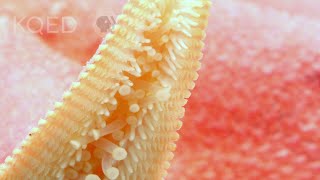
Ever Seen a Starfish Gallop? | Deep Look
Oct 20, 2020
They may look cute and colorful, but starfish are actually voracious predators. To sniff out and capture their prey, they rely on hundreds of water-propelled tube feet, each with a fiercely independent streak. Watch the new PBS Terra science show, OVERVIEW: https://youtu.be/Lt9qYvKFumM SUBSCRIBE to Deep Look! http://goo.gl/8NwXqt DEEP LOOK is a ultra-HD (4K) short video series created by KQED San Francisco and presented by PBS Digital Studios. See the unseen at the very edge of our visible world. Explore big scientific mysteries by going incredibly small. --- On a visit to a friend’s lab in Tokyo, marine biologists Amy Johnson and Olaf Ellers witnessed something they’d never seen before. The starfish in Tatsuo Motokawa’s lab weren’t content slowly gliding across the floor of their tank, they bounced and galloped, zooming around their enclosure. For one of the most familiar animals in the sea, this was a new behavior, never before described in the scientific literature. “It was an absolute epiphany,” said Johnson who studies how sea stars move and teaches marine biology along with Ellers at Bowdoin college in Maine. “ That moment we first saw them bounce completely transformed everything we were planning to do with our research.” Since then, Johnson and Ellers have worked to change the way we understand these animals who have successfully made a home on this planet for at least 450 million years. --- What do starfish eat? Most sea stars are predators. They hunt a variety of marine animals including bivalves like mussels and clams but also sponges, snails, algae. Some sea stars are scavengers that consume detritus. How do starfish breathe? Sea stars mostly transpire through their tube feet which have very thin walls. Oxygenated water travels to other parts of the starfish’s body through its water vascular system. Do all starfish have five arms? Nope! There are many types of sea stars and while most have five arms there are stars with fewer or more. Sea stars have radial symmetry, but may have evolved from a bilateral ancestor (with right and left sides). ---+ Read the entire article on KQED Science: https://www.kqed.org/science/1970271/starfish-gallop-with-hundreds-of-tubular-feet/ ---+ For more information: Article: Sea star inspired crawling and bouncing https://royalsocietypublishing.org/doi/10.1098/rsif.2019.0700 ---+ More Great Deep Look episodes: Sea Urchins Pull Themselves Inside Out to be Reborn | Deep Look https://www.youtube.com/watch?v=ak2xqH5h0YY&t=44s A Sand Dollar's Breakfast is Totally Metal | Deep Look https://www.youtube.com/watch?v=dxZdBPDNiF4 Decorator Crabs Make High Fashion at Low Tide | Deep Look https://www.youtube.com/watch?v=OwQcv7TyX04 For Pacific Mole Crabs It's Dig or Die | Deep Look https://www.youtube.com/watch?v=tfoYD8pAsMw ---+ Shoutout! 🏆Congratulations🏆 to the following fans on our Deep Look Community Tab for being the first five to ID both names for the water inlet structure on a starfish - the sieve plate or madreporite! Elise Wade Pet Owner younis ahmed Mospus the Spider MacKenzie Piacenti ---+ Thank you to our Top Patreon Supporters ($10+ per month)! Bill Cass Justin Bull Burt Humburg Alex Shebastian Reyes Daniel Weinstein Egg-Roll Karen Reynolds Wild Turkey Chris B Emrick Josh Kuroda Tea Torvinen dane rosseter David Deshpande Daisuke Goto Companion Cube Tianxing Wang Elizabeth Ann Ditz Kevin Judge Leonhardt Wille Laurel Przybylski Dia Kelly Hong Robert Amling Gerardo Alfaro luna Mary Truland Sayantan Dasgupta Supernovabetty Joshua Murallon Robertson Aurora Pamela Parker Carrie Mukaida Shelley Pearson Cranshaw Cindy McGill Laura Sanborn Silvan Wendland monoirre Rick Wong Carlos Carrasco Titania Juang Roberta K Wright Misia Clive Nathan Wright Sonia Tanlimco Levi Cai Nicolette Ray Teresa Lavell Caitlin McDonough Kristy Freeman Blanca Vides Alexandre Valdetaro Guillaume Morin Noreen Herrington Scott Faunce Cristen Rasmussen Dogman Louis O'Neill Kallie Moore Geidi Rodriguez Syniurge SueEllen McCann KW Joao Ascensao Aurora Mitchell Sharon Merritt Adam Kurtz TierZoo ---+ Follow KQED Science and Deep Look: Patreon: https://www.patreon.com/deeplook Instagram: https://www.instagram.com/kqedscience/ Twitter: https://www.twitter.com/kqedscience KQED Science on kqed.org: http://www.kqed.org/science Facebook Watch: https://www.facebook.com/DeepLookPBS/ ---+ About KQED KQED, an NPR and PBS affiliate in San Francisco, CA, serves Northern California and beyond with a public-supported alternative to commercial TV, Radio and web media. Funding for Deep Look is provided in part by PBS Digital Studios. Deep Look is a project of KQED Science, which is also supported by the National Science Foundation, the S. D. Bechtel, Jr. Foundation, the Dirk and Charlene Kabcenell Foundation, the Vadasz Family Foundation, the Fuhs Family Foundation, Campaign 21 and the members of KQED. #starfish #seastar #deeplook
-

Watch These Peregrine Falcons Become Fierce Parents | Deep Look
Oct 6, 2020
High up in their 300-foot tower penthouse, falcon stars Annie and Grinnell's romance quickly gets real, as they face the tough demands of raising a family. They furiously guard their eggs from invaders, then stuff their screaming newborn chicks with meat. Will these kids ever leave the nest? Watch Self Evident on PBS Voices! https://www.youtube.com/watch?v=MQkloQHtdo4&list=PL1mtdjDVOoOoOprSD5CrM3bvGeNvgkzGS DEEP LOOK is an ultra-HD (4K) wildlife and nature series created by KQED San Francisco and presented by PBS Digital Studios. See the unseen at the very edge of our visible world. Explore big scientific mysteries by going incredibly small. --- Grinnell, a male peregrine falcon, looked up from his nest and started screaming. It was late March and he was taking a turn warming the four eggs he and his partner, Annie, were caring for in their home atop the bell tower at the University of California, Berkeley. A young female peregrine falcon, quite a bit larger than Grinnell, was lurking on the ledge above him. Young peregrine falcons will often come around the site where a pair is already nesting to check it out and plot a possible takeover. She walked right up to Grinnell in the nest and shrieked almost in his face. Grinnell spread his wings wide and swiftly chased her off the tower. Grinnell had reason to be territorial. He and Annie have been raising chicks on this 300-foot tower since 2017. Peregrine falcons are the fastest animals in the world: When in hot pursuit of a pigeon or other bird to pluck from midair they can reach 240 miles per hour – faster than a single engine plane. But even these raptor superstars need to settle down with a mate and have some babies to whom they can pass on their love for meat. When they do, they often pick a tall building in a city. Peregrine falcons regularly make their homes in cities across the United States, from New York to Chicago to San Francisco. --- --- Why do peregrine falcons nest on tall buildings? Tall buildings – just like the cliffs they live on in the wild – give peregrine falcons protection from predators, a perch from which to hunt pigeons and other birds and ledges where they can lay their eggs. --- Do peregrine falcons make nests? Peregrines don’t build a nest of twigs and leaves. In the wild, they lay their eggs on a ledge in a cliff into which the female has scratched a bowl-shaped depression called a scrape to prevent her eggs from rolling away. --- Why did the peregrine falcon nearly go extinct? The pesticide DDT, used heavily in the 1940s and until 1972 in the United States to control mosquitoes and agricultural pests, accumulated in peregrines’ bodies. It thwarted the development of their embryos. And it reduced the amount of calcium in the eggs, which resulted in eggshells so thin that they broke when parents sat on them. ---+ Read the entire article on KQED Science: https://www.kqed.org/science/1969983/raising-peregrine-falcon-chicks-is-a-real-cliff-hanger/ ---+ For more information: Watch Annie and Grinnell live on three cameras on the Cal Falcons channel: https://www.youtube.com/channel/UCmjo8Rlp6q98TZlG8TDF4GQ/featured ---+ Thank you to our Top Patreon Supporters ($10+ per month)! Bill Cass Justin Bull Burt Humburg Alex Shebastian Reyes Daniel Weinstein Egg-Roll Karen Reynolds Wild Turkey Chris B Emrick Josh Kuroda Tea Torvinen dane rosseter David Deshpande Daisuke Goto Companion Cube Tianxing Wang Elizabeth Ann Ditz Kevin Judge Leonhardt Wille Laurel Przybylski Dia Kelly Hong Robert Amling Gerardo Alfaro luna Mary Truland Sayantan Dasgupta Supernovabetty Joshua Murallon Robertson Aurora Pamela Parker Carrie Mukaida Shelley Pearson Cranshaw Cindy McGill Laura Sanborn Silvan Wendland monoirre Rick Wong Carlos Carrasco Titania Juang Roberta K Wright Misia Clive Nathan Wright Sonia Tanlimco Levi Cai Nicolette Ray Teresa Lavell Caitlin McDonough Kristy Freeman Blanca Vides Alexandre Valdetaro Guillaume Morin Noreen Herrington Scott Faunce Cristen Rasmussen Dogman Louis O'Neill Kallie Moore Geidi Rodriguez Syniurge SueEllen McCann KW Joao Ascensao Aurora Mitchell Sharon Merritt Adam Kurtz TierZoo ---+ Follow KQED Science and Deep Look: Instagram: https://www.instagram.com/kqedscience/ Twitter: https://www.twitter.com/kqedscience KQED Science on kqed.org: http://www.kqed.org/science ---+ About KQED KQED, an NPR and PBS affiliate in San Francisco, CA, serves Northern California and beyond with a public-supported alternative to commercial TV, radio and web media. Funding for Deep Look is provided in part by PBS Digital Studios. Deep Look is a project of KQED Science, the largest science and environment reporting unit in California. KQED Science is supported by The National Science Foundation, the Dirk and Charlene Kabcenell Foundation, the Vadasz Family Foundation, the Gordon and Betty Moore Foundation, Campaign 21 and the members of KQED. #peregrine #falcon #deeplook