
Lifestyle (sociology)
Deep Look
A science video series exploring big science by going very small.
 Open in Clue
 Videos to Learn English 100
-

This Mite-y Beetle Buries the Dead to Start a Family | Deep Look
Sep 24, 2024
Insects called burying beetles haul mouse carcasses down into the dirt and prep them to feed their future offspring. Also known as carrion beetles, they have some stiff competition … and some help from tiny traveling mites. 👉Sign up for our *Nature Unseen* Newsletter here: https://bit.ly/NatureUnseenSignUp SUBSCRIBE to Deep Look! https://www.youtube.com/user/kqeddeeplook?sub_confirmation=1 Please join our community on Patreon! https://www.patreon.com/deeplook DEEP LOOK is an ultra-HD (4K) short video series created by KQED in San Francisco and presented by PBS Digital Studios. See the unseen at the very edge of our visible world. Explore big scientific mysteries by going incredibly small. --- Burying beetles are able to bury a small rodent or bird. They don’t kill these animals – they just benefit from them once their time has run out. Once the carcass is underground, the beetle – working alone or with its romantic partner – rolls it into a ball. This reduces the amount of flesh exposed to bacteria – and decay. To further preserve the flesh, the beetles drag their butts over the rolled carcass and cover it with microbes that slow the rotting. A few days later, the eggs that the female beetle laid next to the carcass hatch into larvae. At first, mom feeds them bits of prechewed mouse. Later, they climb into the carcass to feed on it themselves. Small hitchhiking mites, known as phoretic mites, piggyback on the beetles to the carcass. They feed on minuscule bits of the mouse and reproduce abundantly. But these mites actually help the beetles by doing away with the competition. The mites devour fly eggs that were deposited on the carcass when it was aboveground. Those eggs could have grown into maggots that would have competed with the beetle larvae for the carcass. --- Are burying beetles helpful? Some species can damage crops. But overall, burying beetles are useful. As nature’s undertakers, they break down dead animals, returning nutrients to the soil. --- Are burying beetles endangered? The yellow-bellied burying beetles (Nicrophorus guttula) we filmed at the Bodega Marine Reserve, on California’s Pacific coast, are abundant. So are most of the species of burying beetles around the world. One species, the American burying beetle (Nicrophorus americanus) is threatened, however. This is possibly because it liked to bury passenger pigeon carcasses. Humans overhunted passenger pigeons, leading them to their extinction in 1914. ---+ Find a transcript on KQED Science: https://www.kqed.org/science/1994475/this-mite-y-beetle-buries-the-dead-to-start-a-family ---+ More great Deep Look episodes: Fire Ants Turn Into a Stinging Life Raft to Survive Floods https://youtu.be/cfKr6rnpakE?si=HqQlAD1hDBLseejU Varroa Mites Are a Honeybee’s 8-Legged Nightmare https://youtu.be/69Do8tw_xy0?si=eY9zKgzjxnGUu8wq Born Pregnant: Aphids Invade With an Onslaught of Clones https://youtu.be/vrzalLssomg?si=JZ53ZFbhwfztlouv ---+ Shoutout! 🏆Congratulations🏆 to the following fans on our Deep Look Community Tab for correctly answering our GIF challenge! The correct answer is phoresis. The piggybacking mites are referred to as phoretic mites. @governmentsteez7857 @hendricksonr6406 @TheWhiteScatterbug @Formula_Zero_EX @JavierCanteros ---+ Thank you to our top Patreon supporters ($10+ per month)! Darby Rachel Fenichel Wised1000 Susan Fuhs Hank Poppe Walter Tschinkel Marco Narajos H.M. Andrew Joan Klivans STEPHANIE DOLE Kevin Sholar J Schumacher Lily, Vinny, Izzy Altschuler Drspaceman0 Jamie Edwards BulletproofFrog The Mighty X LAUREL PRZYBYLSKI Kevin William Walker Oliver Wakeling Jessica Hiraoka Laurel Przybylski Jeremiah Sullivan Mehdi Mark Jobes Carrie Mukaida Cristen Rasmussen Wade Tregaskis Burt Humburg Noreen Herrington Roberta K Wright Brigitte Xia Louis O'Neill Jellyman Titania Juang El Samuels Laurel Przybylski Companion Cube Chris B Emrick Kristine Wee Karen Reynolds SueEllen McCann David Deshpande Daisuke Goto Elizabeth Ann Ditz Levi Cai ---+ Follow Deep Look and KQED Science on social: https://www.tiktok.com/@deeplookofficial https://www.patreon.com/deeplook Instagram: https://www.instagram.com/kqedscience/ Twitter: https://www.twitter.com/kqedscience ---+ About KQED KQED, an NPR and PBS member station in San Francisco, serves Northern California and beyond with a public-supported alternative to commercial TV, radio and web media. Funding for Deep Look is provided in part by PBS Digital Studios and the members of KQED. #deeplook #buryingbeetle #phoreticmites
-

Watch Salamanders Skydive! | Deep Look
Aug 27, 2024
When a hungry bird comes near them, wandering salamanders can jump off the tallest trees in the world, California's coast redwoods, skydiving to a safe branch. Researchers decided to put them in a wind tunnel to investigate their daring moves in slow motion. SUBSCRIBE to Deep Look! https://www.youtube.com/user/kqeddeeplook?sub_confirmation=1 Please join our community on Patreon! https://www.patreon.com/deeplook DEEP LOOK is an ultra-HD (4K) short video series created by KQED San Francisco and presented by PBS Digital Studios. See the unseen at the very edge of our visible world. Explore big scientific mysteries by going incredibly small. --- The wandering salamander lives at the tops of coast redwoods in California, which can grow as tall as 30-floor skyscrapers. The salamander can spend the entirety of its 20-year-long life up there, never once touching the forest floor. But the tiny salamanders have a special trick up their sleeves for evading danger. When predators get too close, the wandering salamander goes skydiving up in the trees, controlling their pitch, roll and yaw midair to more safely navigate the skies and prepare for landing. --- How big is the wandering salamander? The wandering salamander is about 4 inches (10 centimeters) long, just a little longer than a credit card. --- Can the wandering salamander really spend its whole life up in a tree? Yep! Researchers tracked salamanders over a 20-year span and found they were often in the same trees year after year. --- How long can these giant California coast redwoods live? The towering evergreen trees can live for 2,000 years or longer! Some of the oldest coast redwoods were thought to be around during the Roman Empire! ---+ Find additional resources and a transcript on KQED Science: https://www.kqed.org/science/1993917/these-salamanders-skydive-from-the-tallest-trees ---+ For more information: Dive into researcher Christian Brown’s oeuvre of research and discoveries here!: http://skydivingsalamander.com/ Researcher and filmmaker Will Goldenberg has met and studied a lot of animals in his career! Check out more of his work here: https://www.willgoldenberg.com/credits.html ---+ More great Deep Look episodes: What Makes This Frog’s Tongue So Fast AND Sticky? https://youtu.be/USxQgEp1GN8?si=TviVBaicRQU14QWh How Can These Flies Live in Oily Black Tar Pits? https://youtu.be/V0CKcK5BqQU This Incredible Little Starfish Has a Secret https://youtu.be/SSTfw1wuP9s ---+ Shoutout! 🏆Congratulations🏆 to the following fans on our Deep Look Community Tab for correctly answering our GIF challenge! The answer is pitch, roll and yaw. @MoltedFeathers @Unknown-bt2yr @matthewnardin7304 @sharpshooter._.b @zooemperor3954 ---+ Thank you to our top Patreon supporters ($10+ per month)! Wised1000 Susan Fuhs Hank Poppe Walter Tschinkel Marco Narajos H.M. Andrew Joan Klivans STEPHANIE DOLE Kevin Sholar J Schumacher Lily, Vinny, Izzy Altschuler Drspaceman0 R B BulletproofFrog The Mighty X LAUREL PRZYBYLSKI Kevin William Walker wormy boi Jessica Hiraoka Laurel Przybylski 吳怡彰 Jeremiah Sullivan Mehdi Mark Jobes Carrie Mukaida Cristen Rasmussen Wade Tregaskis Burt Humburg Noreen Herrington Roberta K Wright xkyoirre Louis O'Neill Jellyman Titania Juang El Samuels Laurel Przybylski Companion Cube Chris B Emrick KW Karen Reynolds SueEllen McCann David Deshpande Daisuke Goto Elizabeth Ann Ditz Levi Cai ---+ Follow Deep Look and KQED Science on social: TikTok: https://www.tiktok.com/@deeplookofficial Patreon: https://www.patreon.com/deeplook Instagram: https://www.instagram.com/kqedscience Twitter: https://www.twitter.com/kqedscience ---+ About KQED KQED, an NPR and PBS member station in San Francisco, serves Northern California and beyond with a public-supported alternative to commercial TV, radio and web media. Funding for Deep Look is provided in part by PBS Digital Studios and the members of KQED. #salamander #redwoods #deeplook
-

How Can These Flies Live in Oily Black Tar Pits? | Deep Look
Jul 30, 2024
In the sticky oil seeps known as the La Brea Tar Pits, the tiny petroleum fly and their larvae thrive in the natural asphalt that oozes up to the surface. The larvae hunt among the fossilized bones of dire wolves, mammoths and saber-toothed cats. SUBSCRIBE to Deep Look! https://www.youtube.com/user/kqeddeep... Please join our community on Patreon! https://www.patreon.com/deeplook DEEP LOOK is an ultra-HD (4K) short video series created by KQED in San Francisco and presented by PBS Digital Studios. See the unseen at the very edge of our visible world. Explore big scientific mysteries by going incredibly small. — Thousands of years ago, ice age creatures like dire wolves, mammoths and saber-toothed cats met their end in the sticky oil seeps now known as the La Brea Tar Pits (@LaBreaTarPitsAndMuseum) . These tar pits, a window into the distant past, are located in the heart of Los Angeles, not far from West Hollywood and Beverly Hills. But among these fossils, the tiny petroleum fly and their larvae not only survive but thrive in the natural asphalt that still oozes to the surface today. While scientists aren’t entirely sure how, adult petroleum flies can walk and mate on the tar pits without getting their feet stuck. But if any other part of their body touches the asphalt, they’re doomed. Their larvae, on the other hand, truly love this environment. They can fully submerge in the dark, viscous asphalt and feast on small insects that get trapped in it. As they eat, petroleum fly larvae end up ingesting a lot of asphalt, which you can see through their guts. Humans, however, could get cancer if we ingested that much asphalt. The larvae need the asphalt to survive. While other insects rely on a waxy layer to protect them from the elements, the petroleum fly larvae’s exterior is so thin that it would dry out without the asphalt. Living among the fossils, the petroleum fly, with unique adaptations and resilience, continues to be a mystery to scientists. --- Are scientists still excavating the La Brea Tar Pits? Yes. Scientists are working on two active excavation sites where they are still finding fossils of different plants and animals that have lived in the LA Basin between 50,000 years ago and today. --- Are there dinosaurs in the La Brea Tar Pits? A common misconception about the La Brea Tar pits is that they contain dinosaur bones. Dinosaurs went extinct about 65 million years before the tar pits began to form. The tar pits are an ice age fossil site that formed between 50,000 and 40,000 years ago. --- Have they ever found human remains in the La Brea Tar Pits? Yes. The partial skeleton of a human woman was discovered in 1914. ---+ Find an article and additional resources on KQED Science: https://www.kqed.org/science/1993662/tar-pits-are-a-death-trap-except-for-this-fly ---+ More Great Deep Look episodes: This Daring Fly Swims in a Shimmering Bubble Shield https://www.youtube.com/watch?v=T88hBWlxuMQ Yes, That Fly Did Come Up Your Drain https://www.youtube.com/watch?v=i16o8iXaDac Fly Metamorphosis Is a Beautiful Nightmare https://www.youtube.com/watch?v=uDkw0txlWgg A Tsetse Fly Births One Enormous Milk-Fed Baby https://www.youtube.com/watch?v=odCtCote9U0 ---+ Shoutout! 🏆Congratulations🏆 to these fans on our Deep Look Community Tab who correctly answered our GIF challenge! AryaPDipa Royalfelineandtracygrant brettnielsen3103 https://www.youtube.com/post/Ugkx3qQAIJ8jkgjAiTIndAIxNtrHK9pMA7uu ---+ Thank you to our Top Patreon Supporters ($10+ per month)! Kevin Sholar Burt Humburg Karen Reynolds Daisuke Goto Chris B Emrick Companion Cube Cristen Rasmussen Laurel Przybylski David Deshpande Wade Tregaskis Laurel Przybylski Adam Cleaver Kevin William Walker hoxtom Mark Jobes El Samuels Carrie Mukaida Dot Jessica Hiraoka Noreen Herrington H.M. Andrew Louis O'Neill J Schumacher Drspaceman0 The Mighty X Walter Tschinkel Joan Klivans R B LAUREL PRZYBYLSKI BulletproofFrog Mehdi Lily, Vinny, Izzy Altschuler Jellyman Levi Cai Titania Juang Roberta K Wright Elizabeth Ann Ditz SueEllen McCann MrBeeMovie STEPHANIE DOLE Smoulder the Dragon Hank Poppe xkyoirre KW Jeremiah Sullivan 吳怡彰 wormy boi Marco Narajos ---+ Follow Deep Look and KQED Science on social: https://www.tiktok.com/@deeplookofficial https://www.patreon.com/deeplook Instagram: https://www.instagram.com/kqedscience/ Twitter: https://www.twitter.com/kqedscience ---+ About KQED KQED, an NPR and PBS member station in San Francisco, serves Northern California and beyond with a public-supported alternative to commercial TV, radio and web media. Funding for Deep Look is provided in part by PBS Digital Studios and the members of KQED. #petroleumfly #oilfly #TarPits
-

Watch This Starfish Protect Her Babies From Danger | Deep Look
Jul 9, 2024
Unlike most sea stars, six-rayed sea star moms are VERY involved in their kids' lives, caressing and protecting their babies for months. When they're big enough, the youngsters venture out on their own to ruthlessly hunt down their tiny prey. SUBSCRIBE to Deep Look! https://www.youtube.com/user/kqeddeeplook?sub_confirmation=1 Please join our community on Patreon! https://www.patreon.com/deeplook DEEP LOOK is an ultra-HD (4K) short video series created by KQED in San Francisco and presented by PBS Digital Studios. See the unseen at the very edge of our visible world. Explore big scientific mysteries by going incredibly small. --- The California shoreline is home to the tiny six-rayed sea star. About the size of a bottle cap, these diminutive starfish have an unusually attentive style of raising their young. “Most sea stars use a broadcast spawning method,” says Berenice Baca-Ceballos, a graduate student at San Francisco State University. Broadcast spawners release huge numbers of eggs and sperm directly into the water. The lucky ones meet and develop into larvae that grow up all on their own. Most never reach adulthood. But mama six-rayed stars of the genus Leptasterias are different. “The mother sea star will sit on her eggs for about two to three months until her eggs develop, hatch, and grow into little juvenile sea stars,” says Baca-Ceballos. “She’s like a mother chicken. The female sea star sits on her eggs until the little baby sea stars, that look like delicate living snowflakes, are ready to adventure out.“ This style of holding on to their young as they develop is called brooding. While six-rayed sea stars have many fewer offspring than most sea stars, they spend more time taking care of their young. “By protecting her young, the six-rayed star increases the chances that her babies will survive,” Baca- Ceballos says. --- How do starfish move? Starfish move using hydraulic pressure. They have a system of canals, called the water vascular system, which run through their bodies. The canals connect to a large number of tiny flexible tube feet that end in adhesive pads. A starfish contracts muscles to adjust the hydraulic pressure in the tube feet, allowing it to crawl along surfaces. --- How do starfish eat? Starfish are mostly carnivores. Many types of starfish eat shellfish like mussels, clams and snails. A starfish will use its numerous tube feet to slowly pry open its prey’s shell. Once it has opened the shell enough, the starfish will extend its stomach out through its mouth to digest its prey alive. Some types of starfish also eat small fish, plankton and detritus. --- Do starfish have eyes? Starfish usually have a simple eyespot at the tip of each arm. Also called ocelli, these eyespots can only sense light and dark. ---+ For more information: The Cohen Lab at San Francisco State University studies six-rayed sea stars of the genus Leptasterias. https://sarahcoh0.wixsite.com/cohenlab ---+ More great Deep Look episodes: Ever Seen a Starfish Gallop? | Deep Look https://youtu.be/9rxf_2EgwfE?si=Sh8s_FGGcxa8QWuD Sea Urchins Pull Themselves Inside Out to Be Reborn | Deep Look https://youtu.be/ak2xqHCo5h0YY?si=j1PkWkJ6Z5SyocZV A Sand Dollar’s Breakfast Is Totally Metal | Deep Look https://youtu.be/dxZdBPDNiF4?si=bX7cnnx1CS5aO6PP ---+ Shoutout! 🏆Congratulations🏆 to the following fans on our Deep Look Community Tab for correctly answering our GIF challenge! The answer is "brachiolar arms" that are reabsorbed when they sea star's permanent arms emerge. @mohammedyaser1357 @dumbbirdwayne @nuzwo2723 @callystarizka-tata7892 @magicdolphin3090 ---+ Thank you to our top Patreon supporters ($10+ per month)! Kevin Sholar Burt Humburg Karen Reynolds Daisuke Goto Chris B Emrick Companion Cube Cristen Rasmussen Laurel Przybylski David Deshpande Wade Tregaskis Adam Cleaver Kevin William Walker hoxtom Mark Jobes El Samuels Carrie Mukaida Dot Jessica Hiraoka Noreen Herrington H.M. Andrew Louis O'Neill J Schumacher Drspaceman0 The Mighty X Walter Tschinkel Joan Klivans R B BulletproofFrog Mehdi Lily, Vinny, Izzy Altschuler Jellyman Levi Cai Titania Juang Roberta K Wright Elizabeth Ann Ditz SueEllen McCann MrBeeMovie STEPHANIE DOLE Smoulder the Dragon Hank Poppe xkyoirre KW Jeremiah Sullivan 吳怡彰 wormy boi Marco Narajos ---+ Follow Deep Look and KQED Science on social: https://www.tiktok.com/@deeplookofficial https://www.patreon.com/deeplook Instagram: https://www.instagram.com/kqedscience/ Twitter: https://www.twitter.com/kqedscience ---+ About KQED KQED, an NPR and PBS member station in San Francisco, serves Northern California and beyond with a public-supported alternative to commercial TV, radio and web media. Funding for Deep Look is provided in part by PBS Digital Studios and the members of KQED. #starfish #seastar #deeplook
-

Fly Metamorphosis Is a Beautiful Nightmare | Deep Look
Jun 18, 2024
Download Opera for free: https://opr.as/dju-deep-look Like the beloved butterfly, a house fly goes through an incredible metamorphosis. To make its grand entry into the world, it deploys a specialized, fluid-filled balloon on its head called the ptilinum (till-EYE-num) to break open its pupal casing, freeing itself to buzz around your kitchen. SUBSCRIBE to Deep Look! https://www.youtube.com/user/kqeddeeplook?sub_confirmation=1 Please join our community on Patreon! https://www.patreon.com/deeplook DEEP LOOK is an ultra-HD (4K) short video series created by KQED San Francisco and presented by PBS Digital Studios. See the unseen at the very edge of our visible world. Explore big scientific mysteries by going incredibly small. House flies start out their lives as eggs. Maggots hatch from those eggs and eat (and eat and eat) until they’re ready to pupate and turn into flies. Emerging from their pupal home takes a lot of effort. In fact, they evolved a whole organ just to break free from that hard case. They use that organ, called a ptilinum, a pulsing sac filled with hemolymph – or bug blood – just once in their lives, to get out of their pupae. ---+ Insecticide-resistant Mosquitoes? Geoffrey Attardo, professor of entomology at the University of California, Davis (@UCDavis), who helped us with this episode (including filming some of it!), specializes in the biology of vector-borne diseases. He’s been investigating the physiological responses to insecticide exposure in Aedes aegypti mosquitoes. Aedes aegypti are carriers of diseases like Zika and dengue fever. Learn more about how these invasive insects survive the chemical onslaught of insecticides here: https://www.nature.com/articles/s41598-023-43676-9 ---+ How can fly larvae help investigators solve crimes? We were lucky enough to work on this episode with Martin Hall at the Natural History Museum in London (@NaturalHistoryMuseum), who shared his images of developing blowfly pupae for the video. Why did he and his colleagues make these images? Well, knowing what age a pupa is can help investigators determine when it may have been laid as an egg on a dead body. Read more about how they recorded the images we used: https://royalsocietypublishing.org/doi/10.1098/rsos.160699. And to learn about the forensic application, read here: https://link.springer.com/article/10.1007/s00414-017-1598-2. Still hungry for more info? You can read more about Hall’s work on metamorphosis here: https://royalsocietypublishing.org/doi/10.1098/rstb.2019.0071 ---+ House flies flourish in filth! Dana Nayduch, Research Leader at the U.S. Department of Agriculture’s Arthropod-Borne Animal Diseases Research Unit at the USDA's Agricultural Research Service (@USDAARS), knows a lot about house flies! She was the one who tipped us off to their incredible metamorphosis and inspired this episode! House flies flourish in microbe-rich environments, making them powerful vectors for diseases that can harm animals and humans. Knowing which microbes they’re eating, how long they carry those organisms, and whether they eventually transmit harmful microbes is important in assessing the house fly's risk to human and livestock health. Learn more in this paper: https://academic.oup.com/aesa/article/110/1/6/2893406 ---+ More great Deep Look episodes: Meet the Bug You Didn't Know You Were Eating https://www.youtube.com/watch?v=JuGfWVBjOxU This Weevil Has Puppet Vibes But Drills Like a Power Tool https://www.youtube.com/watch?v=rVYlWiFKXEg GIF CHALLENGE WINNERS: 🏆Congratulations🏆 to the following fans on our Deep Look Community Tab for correctly answering our GIF challenge! @russellhawkins859 @huddyhall6686 @zondon490 @carlossalassierra938 @callystarizka-tata7892 ---+ Thank you to our top Patreon supporters ($10+ per month)! Kevin Sholar Max Paladino Burt Humburg Daisuke Goto Karen Reynolds Companion Cube Wade Tregaskis David Deshpande Cristen Rasmussen Chris B Emrick Laurel Przybylski Kevin William Walker hoxtom Adam Cleaver Mark Jobes Walter Tschinkel Afaq Khan HMA El Samuels Dot Cho Minsung Levi Cai Drspaceman0 Roberta K Wright R B Titania Juang Mehdi Jessica Hiraoka Joan Klivans Elizabeth Ann Ditz Lily, Vinny, Izzy Altschuler Noreen Herrington Louis O'Neill Jeremiah Sullivan J Schumacher SueEllen McCann KW MrBeeMovie xkyoirre Jellyman Smoulder the Dragon 吳怡彰 Hank Poppe BulletproofFrog Carrie Mukaida STEPHANIE DOLE The Mighty X wormy boi Marco Narajos ---+ Follow Deep Look and KQED Science on social: https://www.tiktok.com/@deeplookofficial https://www.patreon.com/deeplook Instagram: https://www.instagram.com/kqedscience Twitter: https://www.twitter.com/kqedscience ---+ About KQED KQED, an NPR and PBS member station in San Francisco, serves Northern California and beyond with a public-supported alternative to commercial TV, radio and web media. Funding for Deep Look is provided in part by PBS Digital Studios and the members of KQED. #deeplook
-
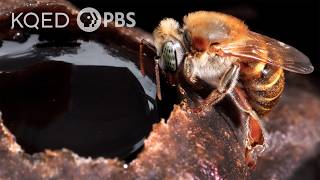
Stingless Bees Guard Tasty Honey With Barricades, Bouncers and Bites | Deep Look
May 28, 2024
More than 600 bee species across Mexico, Central and South America and tropical regions worldwide make honey, but don’t have stingers to protect it. So, how do they keep thieves away? And what does their honey taste like? WATCH: Meet the Bug You Didn’t Know You Were Eating: https://youtu.be/JuGfWVBjOxU?si=s-2bxJP0NzZgWPwY JOIN our community on Patreon! https://www.patreon.com/deeplook DEEP LOOK is an ultra-HD (4K) short video series created by KQED in San Francisco and presented by PBS Digital Studios. See the unseen at the very edge of our visible world. Explore big scientific mysteries by going incredibly small. --- Stingless bees build their nests mainly in the hollows of living trees, anywhere from rainforests to cities. Deep Look filmed four species kept by stingless beekeeper Emilio Pérez in the state of Oaxaca, in southwestern Mexico. He keeps Melipona beecheii, Scaptotrigona pectoralis, Scaptotrigona mexicana and Nannotrigona perilampoides to sell their honey. Stingless bees have evolved different ways to protect their honey and larvae from mammals and insects that want to eat them. Every night, tiny black bees with green eyes called Nannotrigona perilampoides cover the entrance to their nest with a barrier built out of cerumen, a material that stingless bees make by mixing wax with resins they collect from trees and other plants. The smell and stickiness of the resins keep ants away. Stingless bees also post guard bees at their nest entrance. And when defensive strategies don’t work, they tangle in their enemies’ hair, bite them with their mandibles and sometimes even coat them with resin. --- What is the difference between a honeybee and a stingless bee? Honeybee is the common name for a dozen or so species in the genus Apis. Apis mellifera, the Western or European honeybee, and Apis cerana, the Eastern or Asian honeybee, are kept worldwide because they’re very productive. Their workers, all female, use stingers to protect their hives. Stingless bees, also known as meliponines, produce smaller amounts of honey than honeybees, though some species are very productive. Both honeybees and stingless bees live in colonies with worker bees and queens. --- Does the honey of stingless bees have beneficial health properties? In Latin America and Asia, stingless bee honey is sold as a health product to treat ailments like sore throats. Honeys from both stingless bees and honeybees have hydrogen peroxide, which is antimicrobial. Since stingless bees collect resins, pollen and nectar from a host of plants – many in the rainforest – scientists are studying their honey for chemicals that might have medicinal properties. “There are really interesting chemicals in there. Some of them have known properties and it’s usually antifungal, antibacterial, even antiviral and anti-inflammatory, said entomologist David Roubik, who studied these bees at the Smithsonian Tropical Research Institute in Panama. “If all those things apply to every kind of stingless bee, I seriously doubt it. It does depend on what kind of flowers they’ve been visiting and what kind of resin they collect.” ---+ More great Deep Look episodes: Varroa Mites Are a Honeybee’s 8-Legged Nightmare https://youtu.be/69Do8tw_xy0?si=c4D-kc55iGihV2Oe Honeybees Make Honey ... and Bread? https://youtu.be/sAKkjD3nEv0?si=kOml9j36VtmtXViJ ---+ Shoutout! 🏆Congratulations🏆 to the following fans on our Deep Look Community Tab for correctly answering our GIF challenge! @MissGenesisSaga @murc.q @Stardrop-luck @TheBestInsects @othnielheristiyono3505 ---+ Thank you to our top Patreon supporters ($10+ per month)! Kevin Sholar Burt Humburg Max Paladino Daisuke Goto Karen Reynolds Chris B Emrick Companion Cube David Deshpande Wade Tregaskis Laurel Przybylski Cristen Rasmussen Adam Cleaver Kevin William Walker hoxtom Mark Jobes Carrie Mukaida El Samuels Walter Tschinkel Dot Joan Klivans Cho Minsung Jessica Hiraoka Bethany Noreen Herrington Louis O'Neill Elizabeth Ann Ditz HMA Levi Cai J Schumacher Drspaceman0 R B Roberta K Wright BulletproofFrog Titania Juang Jennifer Altschuler Jellyman Mehdi SueEllen McCann KW STEPHANIE DOLE MrBeeMovie xkyoirre Smoulder the Dragon Jeremiah Sullivan The Mighty X wormy boi Marco Narajos ---+ Follow Deep Look and KQED Science on social: https://www.tiktok.com/@deeplookofficial https://www.patreon.com/deeplook Instagram: https://www.instagram.com/kqedscience/ Twitter: https://www.twitter.com/kqedscience ---+ About KQED KQED, an NPR and PBS member station in San Francisco, serves Northern California and beyond with a public-supported alternative to commercial TV, radio and web media. Funding for Deep Look is provided in part by PBS Digital Studios and the members of KQED.
-

Meet the Bug You Didn't Know You Were Eating | Deep Look
May 7, 2024
The cochineal is a tiny insect deeply rooted in the history of Oaxaca, Mexico. Female cochineals spend most of their lives with their heads buried in juicy cactus pads, eating and growing. After cochineals die, their legacy lives on in the brilliant red hue produced by their hemolymph. Dyes made from cochineal have been used in textiles, paintings, and even in your food! https://www.youtube.com/user/kqeddeeplook?sub_confirmation=1 Please join our community on PATREON! https://www.patreon.com/deeplook DEEP LOOK is an ultra-HD (4K) short video series created by KQED in San Francisco and presented by PBS Digital Studios. See the unseen at the very edge of our visible world. Explore big scientific mysteries by going incredibly small. — The cochineal, a tiny insect deeply rooted in the history of Oaxaca, Mexico, is known for the vibrant crimson color it produces. This color comes from carminic acid in its hemolymph, a fluid equivalent to blood in other organisms. As nymphs, cochineals search for a spot on cactus pads to feed and settle in. They quickly develop a protective white wax coating to shield themselves from the hot sun. Once a female cochineal finds a perfect spot, she attaches permanently, living there for the rest of her life. Indigenous people in Mexico have been harvesting cochineals by brushing them off cacti and sun-drying them long before the Spanish arrived in the 1500s. By the 1700s, their pigment was as valuable as silver, establishing cochineals as a prized global commodity. In Oaxaca, weavers continue to use cochineal dye. They grind dried cochineal on a metate, dissolve the powder in boiling water to dye wool, and then weave the dyed wool into stunning designs on a loom. Dyes made from cochineal have been used in textiles, paintings, and even in your food as a natural alternative to artificial dyes. --- Which types of food contain cochineal? Cochineal can be found in some brands of candies, ice cream, beverages, yogurt, fish and meat. Allergies to cochineal are possible but rare. --- Where is cochineal found? Today, Peru is the largest commercial producer of the cochineal, followed by Mexico. This insect is also found in other parts of South America, the Canary Islands, and the southwestern United States. Additionally, the cochineal was introduced to countries like Ethiopia and South Africa, where it became a pest. --- Besides red, what other colors are made from cochineal? Cochineals are a natural way of obtaining brilliant reds, pinks, oranges and purples. ---+ Find additional resources and a transcript on KQED Science: https://www.kqed.org/science/1992430/meet-the-bug-you-didnt-know-you-were-eating ---+ More Great Deep Look episodes: Silkworms Spin Cocoons That Spell Their Own Doom https://www.youtube.com/watch?v=cgavTIBQ_Z0 Watch Ladybugs Go From Goth to Glam https://www.youtube.com/watch?v=FCFUk4f3zXw The Ladybug Love-In: A Valentine's Special https://www.youtube.com/watch?v=c-Z6xRexbIU Why Did the Mexican Jumping Bean Jump? https://www.youtube.com/watch?v=3lkdidU79TY&t=25s You'd Never Guess What an Acorn Woodpecker Eats https://www.youtube.com/watch?v=XvPaiDX_3JM ---+ Shoutout! 🏆Congratulations🏆 to @Chris06660 on our Deep Look Community Tab for correctly answering our GIF challenge! https://www.youtube.com/post/UgkxeDI-wAisgVg4iuY7rAiZDQKyTuSALk74 ---+ Thank you to our Top Patreon Supporters ($10+ per month)! Kevin Sholar Burt Humburg Max Paladino Daisuke Goto Karen Reynolds Chris B Emrick Companion Cube David Deshpande Wade Tregaskis Laurel Przybylski Cristen Rasmussen Adam Cleaver Kevin William Walker hoxtom Mark Jobes Carrie Mukaida El Samuels Walter Tschinkel Dot Joan Klivans Cho Minsung Jessica Hiraoka Bethany Noreen Herrington Louis O'Neill Elizabeth Ann Ditz HMA Levi Cai J Schumacher Drspaceman0 R B Roberta K Wright BulletproofFrog Titania Juang Jennifer Altschuler Jellyman Mehdi SueEllen McCann KW STEPHANIE DOLE MrBeeMovie xkyoirre Smoulder the Dragon Jeremiah Sullivan The Mighty X wormy boi Marco Narajos ---+ Follow Deep Look and KQED Science on social: https://www.tiktok.com/@deeplookofficial https://www.patreon.com/deeplook Instagram: https://www.instagram.com/kqedscience/ Twitter: https://www.twitter.com/kqedscience ---+ About KQED KQED, an NPR and PBS member station in San Francisco, serves Northern California and beyond with a public-supported alternative to commercial TV, radio and web media. Funding for Deep Look is provided in part by PBS Digital Studios and the members of KQED. #cochineal #carmine #oaxaca
-
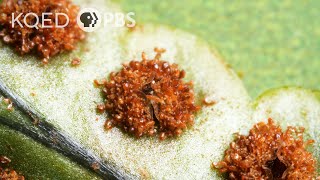
Watch Ferns Get Freaky | Deep Look
Apr 16, 2024
Look at the underside of a fern leaf. Those rows of orange clusters aren’t tiny insects; they’re spores waiting to be catapulted away. Once a spore lands, it grows into a tiny plant, from which fern sperm swim away, searching for an egg to fertilize. Think of *that* next time you’re hiking in the forest. Is There a Quick Fix for Ocean Acidification? : https://www.youtube.com/watch?v=PqFwRMgvMVY&list=PLnNZYWyBGJ1F8ofFm4H9UTrHxqU8zngK4&index=5 PBS EARTH MONTH PLAYLIST: https://www.youtube.com/playlist?list=PLnNZYWyBGJ1F8ofFm4H9UTrHxqU8zngK4 DEEP LOOK is an ultra-HD (4K) short video series created by KQED in San Francisco and presented by PBS Digital Studios. See the unseen at the very edge of our visible world. Explore big scientific mysteries by going incredibly small. --- Each of the clusters on the fern leaf is called a sorus. Within each sorus are wormlike structures called sporangia, which are filled with spores. If you look at a sporangium under a microscope, you see it has an outer ring filled with water. When the spores mature and it’s warm outside, that water starts to evaporate. The ring shrinks and bends back, making the sporangium crack open. Then the ring jerks forward, hurling out the spores. A single fern launches millions of spores. Each one grows into a tiny plant about as big as a pea, known as a gametophyte. But gametophytes aren’t baby ferns. Instead, their job is to make eggs and sperm in specialized organs. When it rains or the environment is moist, that’s when ferns mate: Fern sperm swim away on a film of water to find eggs to fertilize. The fertilized eggs then grow into ferns. ---So, do ferns have seeds? No, ferns don’t make seeds or flowers. ---+ Find a transcript on KQED Science: https://www.kqed.org/science/1992380/watch-ferns-get-freaky ---+ More great Deep Look episodes: The Secret Lives of Plants playlist: https://youtube.com/playlist?list=PLdKlciEDdCQDqukAqdb99nhvMiJulSYxL&si=r6adLEy03FdHH7JK Busy Bees and Other Pollinators playlist: https://youtube.com/playlist?list=PLdKlciEDdCQCfoI8E24mbuk259unmiwG9&si=RD3TIO2qtNXvUoog ---+ Shoutout! 🏆Congratulations🏆 to these ___ fans on our Deep Look Community Tab for correctly answering our GIF challenge! https://www.youtube.com/post/Ugkxk4ee1xCg-VW4zIarOoprTVaAaVYx-akS @hunterbrock3349 @lionparcelpalagan7515 @Ischemiaa @leprifacioncustard4921 @markembeck7099 ---+ Thank you to our top Patreon supporters ($10+ per month)! Burt Humburg Max Paladino Karen Reynolds Daisuke Goto Chris B Emrick Wade Tregaskis David Deshpande Laurel Przybylski Cristen Rasmussen Mark Jobes El Samuels Carrie Mukaida Cho Minsung Jessica Hiraoka Louis O'Neill Elizabeth Ann Ditz Noreen Herrington Jeremiah Sullivan Levi Cai Drspaceman0 Titania Juang Roberta K Wright The Mighty X R B BulletproofFrog Jellyman Mehdi 吳怡彰 SueEllen McCann KW xkyoirre wormy boi ---+ Follow Deep Look and KQED Science on social: https://www.tiktok.com/@deeplookofficial https://www.patreon.com/deeplook Instagram: https://www.instagram.com/kqedscience/ Twitter: https://www.twitter.com/kqedscience ---+ About KQED KQED, an NPR and PBS member station in San Francisco, serves Northern California and beyond with a public-supported alternative to commercial TV, radio and web media. Funding for Deep Look is provided in part by PBS Digital Studios and the members of KQED. #ferns
-

These Solar-Powered Carnivorous Flatworms Divide and Conquer | Deep Look
Mar 26, 2024
Tiny marine flatworms called acoels hunt for prey in coral reefs. They're referred to as “plant-animals'' because they've got a partnership with photosynthetic algae that live inside of them. But this acoel's real superpower is its ability to regenerate any part of its body! PATREON SPECIAL OFFER: https://www.patreon.com/deeplook DEEP LOOK is an ultra-HD (4K) short video series created by KQED in San Francisco and presented by PBS Digital Studios. See the unseen at the very edge of our visible world. Explore big scientific mysteries by going incredibly small. --- Researchers are studying a species of tiny marine flatworm called an acoel that has some surprisingly amazing abilities, despite being smaller than a grain of rice. “They have two very obvious superpowers,” says Dania Nanes Sarfati, a researcher at Stanford University who studies acoels. “They are able to regenerate any part of their body. And they also have a very intimate relationship with algae that they keep inside their bodies that they exchange energy and other nutrients with. When you look at them, they just look like a little worm, but if you look inside you can see there's this green photosynthetic algae that are living between the acoel cells.” In addition to catching prey to eat, acoels will flatten themselves out in sunny spots so that their photosynthetic internal algae can absorb sunshine. “It’s like they’re on vacation every day,” says Nanes Sarfati. --- What are acoels? Acoels are a group of small, simple, soft-bodied flatworms that mostly live in marine environments. Acoels lack a permanent but they do have a mouth that they use to eat prey. --- What do acoels eat? Acoels eat tiny prey like planktonic plants and animals that float in the water. An acoel will expand its head like a net to engulf its prey and then jam its meal into its mouth. --- How do you pronounce acoel? Acoel is pronounced “a seal.” ---+ Find additional resources and a transcript on KQED Science: https://www.kqed.org/science/1991736/these-solar-powered-carnivorous-flatworms-divide-and-conquer ---+ For more information: Acoels by Sarah J. Bourlat and Andreas Hejnol https://www.cell.com/current-biology/pdf/S0960-9822(09)00755-6.pdf Sikes Lab at University of San Francisco https://sikesj61.wixsite.com/sikeslab Dania Nanes Sarfati https://biox.stanford.edu/people/dania-nanes-sarfati ---+ More great Deep Look episodes: Want a Whole New Body? Ask This Flatworm How | Deep Look https://youtu.be/m12xsf5g3Bo?si=JInHUJUpcfkeDwwY The Undying Hydra: A Freshwater Mini-Monster That Defies Aging | Deep Look https://youtu.be/ITVfXHrfudw?si=6_tKTmSz6r2xIH4L This Snail Goes Fishing With a Net Made of Slime | Deep Look https://youtu.be/YNcs7W3Q-k4?si=CTLArAMtTGYFCBwL ---+ Shoutout! 🏆Congratulations🏆 to these 2 fans on our Deep Look Community Tab for correctly answering our GIF challenge! https://www.youtube.com/post/UgkxVEKvBMx3yhkJxFPf3bhfbrSfK4MaX448 @mk_rexx @raulkaap ---+ Thank you to our top Patreon supporters ($10+ per month)! Burt Humburg Max Paladino Karen Reynolds Daisuke Goto Chris B Emrick Tianxing Wang David Deshpande Wade Tregaskis Laurel Przybylski Cristen Rasmussen Mark Jobes El Samuels Carrie Mukaida Marilyn Schiffman Jessica Hiraoka Louis O'Neill Noreen Herrington Levi Cai Elizabeth Ann Ditz Jeremiah Sullivan Roberta K Wright Titania Juang Jellyman Mehdi Syniurge SueEllen McCann KW xkyoirre ---+ Follow Deep Look and KQED Science on social: https://www.tiktok.com/@deeplookofficial https://www.patreon.com/deeplook Instagram: https://www.instagram.com/kqedscience/ Twitter: https://www.twitter.com/kqedscience ---+ About KQED KQED, an NPR and PBS member station in San Francisco, serves Northern California and beyond with a public-supported alternative to commercial TV, radio and web media. Funding for Deep Look is provided in part by PBS Digital Studios and the members of KQED.
-

That's Not Rain, That's Super-powered Pee! | Deep Look
Feb 27, 2024
Sharpshooters survive by guzzling a lot of plant sap. But drinking all of that liquid nutrition presents a problem for these tiny insects: How do they move it all out? Easy. They've perfected a super-propulsive urination technique using a special catapult in their butt. Join our community on PATREON! https://www.patreon.com/deeplook DEEP LOOK is an ultra-HD (4K) short video series created by KQED San Francisco and presented by PBS Digital Studios. See the unseen at the very edge of our visible world. Explore big scientific mysteries by going incredibly small. The sharpshooter gets all its nutrition from the thin, watery liquid inside a plant, called xylem sap, which it sucks out with this tube-shaped stylet. That sap has so little nutrition that sharpshooters need to guzzle nonstop. Taking all that liquid in presents a problem – how to move it out. The sharpshooter has evolved the perfect tool for the job: an anal stylus -- or butt flicker. Here's something incredible: Each drop of pee actually travels faster than the speed at which the butt flicker launched it. Learn about this incredible creature's super-propulsive pee in this video! ---+ The front end of the sharpshooter is interesting as well! Elizabeth G. Clark of the University of California, Berkeley (@UCBerkeley), who worked with us on this episode, doesn’t just study the back end of the sharpshooter. She’s also extensively studied its feeding mechanism. She and her colleagues are trying to understand how sharpshooters feed so they can help stop their transmission of a bacterial plant pathogen called Xylella fastidiosa, which causes Pierce’s Disease. Check out Clark and team’s work in understanding the sharpshooter’s mouthparts and feeding structures in this article: https://onlinelibrary.wiley.com/doi/10.1002/jmor.21639 ---+ Get inspired in your own backyard! Georgia Tech (@georgiatech) researchers Saad Bhamla and Elio Chalita (now of @harvard) were instrumental in helping us (and the world!) understand the physics of sharpshooter pee. Bhamla was inspired to study sharpshooter urination after observing them peeing in his own backyard! Read about their team’s research here: https://research.gatech.edu/super-fast-insect-urination-powered-physics-superpropulsion ---+ Find additional resources and a transcript on KQED Science: https://www.kqed.org/science/1991514/sharpshooter-insects-are-real-wizzes-at-whizzing ---+ More great Deep Look episodes: Witness the Nighttime Magic of Spawning Coral https://www.youtube.com/watch?v=SP3nKAqLy4E Earthworm Love is Cuddly ... and Complicated https://youtu.be/xjpo6OkuYy0?feature=shared A Drain Fly’s Happy Place Is Down Your Pipes https://youtu.be/i16o8iXaDac?feature=shared ---+GIF CHALLENGE WINNERS: 🏆Congratulations🏆 to these 5 fans on our Deep Look Community Tab for being the first 5 to correctly answer our GIF challenge! @sequoiad.6607 @TheWhiteScatterbug @eklectiktoni @benbarberian1701 @MissGenesisSaga ---+ Thank you to our top Patreon supporters ($10+ per month)! Burt Humburg Max Paladino Karen Reynolds Daisuke Goto Chris B Emrick Tianxing Wang David Deshpande Wade Tregaskis Laurel Przybylski Mark Jobes El Samuels Carrie Mukaida Jessica Hiraoka Noreen Herrington Louis O'Neill Elizabeth Ann Ditz Levi Cai Jeremiah Sullivan Titania Juang Roberta K Wright Jellyman Mehdi KW Syniurge SueEllen McCann xkyoirre ---+ Follow Deep Look and KQED Science on social: https://www.tiktok.com/@deeplookofficial https://www.patreon.com/deeplook Instagram: https://www.instagram.com/kqedscience Twitter: https://www.twitter.com/kqedscience ---+ About KQED KQED, an NPR and PBS member station in San Francisco, serves Northern California and beyond with a public-supported alternative to commercial TV, radio and web media. Funding for Deep Look is provided in part by PBS Digital Studios and the members of KQED. #deeplook
-

A Coral Is Born | Deep Look
Feb 6, 2024
Learn more about Surfshark VPN at: https://surfshark.deals/deeplook When the moon, sun and ocean temperatures all align, an underwater "snowstorm" occurs. Corals put on a massive spawning spectacle by sending tiny white spheres floating up the water column all at once. Join our community on PATREON! https://www.patreon.com/deeplook DEEP LOOK is an ultra-HD (4K) short video series created by KQED in San Francisco and presented by PBS Digital Studios. See the unseen at the very edge of our visible world. Explore big scientific mysteries by going incredibly small. — About 10 days after a full moon, an upside-down underwater blizzard occurs. Tiny spheres float up the water column. But they're not sand particles or algae, they're packets of egg and sperm from coral. This snowlike spectacle is known as coral spawning. Corals are not plants or rocks, but colonies of hundreds of thousands of tiny animals called polyps. These polyps look like underwater flowers, with a soft body, a mouth and tentacles. Polyps obtain nutrients from single-celled algae called zooxanthellae, which live in their tissue. The coral provides protection and compounds for photosynthesis. In return, zooxanthellae supply elements to build calcium carbonate skeletons that give them their stony structure. Corals can’t move to find a partner and mix up their gene pool, so they’ve adapted a unique reproductive strategy that allows their eggs and sperm to fertilize with other colonies. The polyps release their gamete bundles together, at a time determined by environmental factors determined by the lunar cycle, setting sun, and temperature. Scientists believe this ensures high levels of fertilization across the ocean. --- What are corals known for? Coral reefs provide habitat for a quarter of marine life, including fish, crustaceans, mollusks and sea turtles. Corals can be found throughout the world’s oceans, in both shallow and deep water. — How long can a coral live? Studies have shown that some corals can live up to 5,000 years, making them the longest- living animals on Earth. --- Do all corals live in warm water? No. In fact, over half of all known coral species are found in cold, deep and dark waters. These corals feed by waiting for small food particles to swim by, and they lack the symbiotic algae that live in the tissue of warm water corals. – Do corals have other forms of reproduction? There are many species of coral, but only two main types of reproduction. Corals reproduce either asexually, by budding, fragmentation and fission, or sexually, through broadcast spawning and brooding. ---+ Find additional resources and a transcript on KQED Science: https://www.kqed.org/science/1991266/to-survive-corals-turn-the-ocean-into-a-giant-snow-globe ---+ For more information: Coral Regeneration Lab at the California Academy of Sciences: https://www.calacademy.org/about-us/major-initiatives/hope-for-reefs-phase-ii/coral-regeneration-lab-corl ---+ More Great Deep Look episodes: Mom, Where Do Baby Jellyfish Come From? https://www.youtube.com/watch?v=y2BYatmFJaI&t=14s Sea Urchins Pull Themselves Inside Out to Be Reborn https://www.youtube.com/watch?v=ak2xqH5h0YY What Happens When You Zap Coral With The World's Most Powerful X-ray Laser? https://www.youtube.com/watch?v=aXmCU6IYnsA ---+ Shoutout! 🏆Congratulations🏆 to these 5 fans on our Deep Look Community Tab for being the first 5 to correctly answer our GIF challenge! @luceddisjones9020 @user-zp8um3wh3y @arvindvernekar8177 @SpliffingBrit @trackingt See the challenge here: https://www.youtube.com/post/Ugkx1CqM-AO4XcLuXuHumikgRihMoc508wlx ---+ Thank you to our Top Patreon Supporters ($10+ per month)! Burt Humburg Max Paladino Karen Reynolds Daisuke Goto Chris B Emrick Tianxing Wang David Deshpande Wade Tregaskis Laurel Przybylski Mark Jobes El Samuels Carrie Mukaida Jessica Hiraoka Noreen Herrington Louis O'Neill Elizabeth Ann Ditz Levi Cai Jeremiah Sullivan Laurel Przybylski LAUREL PRZYBYLSKI Titania Juang Roberta K Wright Jellyman Mehdi KW Syniurge SueEllen McCann xkyoirre ---+ Follow Deep Look and KQED Science on social: https://www.tiktok.com/@deeplookofficial https://www.patreon.com/deeplook Instagram: https://www.instagram.com/kqedscience/ Twitter: https://www.twitter.com/kqedscience ---+ About KQED KQED, an NPR and PBS member station in San Francisco, serves Northern California and beyond with a public-supported alternative to commercial TV, radio and web media. Funding for Deep Look is provided in part by PBS Digital Studios and the members of KQED. #corals #coralreef #coralspawning
-

Why Does This Fly Live in Your Bathroom? | Deep Look
Jan 16, 2024
Ever wonder how those tiny, jumpy flies got onto your bathroom wall? Well, they came out of your sink drain after growing up down in the pipes. A goofy, long “mustache,” fuzzy wings and some aquabatics help them survive in that soggy environment. SUBSCRIBE to Deep Look! https://www.youtube.com/user/kqeddeeplook?sub_confirmation=1 Please join our community on Patreon! https://www.patreon.com/deeplook DEEP LOOK is an ultra-HD (4K) short video series created by KQED in San Francisco and presented by PBS Digital Studios. See the unseen at the very edge of our visible world. Explore big scientific mysteries by going incredibly small. --- Drain flies are also known as moth flies because they look like miniature moths. One of the most common species of drain fly is Clogmia albipunctata, which has white markings on its dark legs. This is the species we filmed for our video. Drain flies sneak in from the outside, often through cracks in old pipes. They lay their eggs in the slime inside the pipes. When larvae hatch out of the eggs, they feed on this living slime, which is called a biofilm. It’s made up of bacteria, fungi and other microorganisms that grow on the hair, saliva and bits of food that get washed down a bathroom sink. ---Why do drain flies show up in a house? Entomologist Greg Curler, who studies drain flies, said they crawl into old buildings through pipes that rusted through, or cracked as the ground shifted. The flies use their antennae to sense the gases coming off the biofilm that has accumulated over time inside the pipes. “The flies can detect the gas from a very long way,” said Curler, “and are attracted to it.” ---Do drain flies spread bacteria? Even though they grow up as bacteria-eating larvae down in the pipes below your sink or toilet, the drain flies in your bathroom don’t spread bacteria around. That’s because they’re unlikely to land on you or your toothbrush or food. They’re not looking to eat your food or lay their eggs in it, the way that houseflies and blowflies do. Adult drain flies don’t really eat – they only drink a bit of liquid. And they pretty much stay put. They only fly afar when they need to find a new pipe to lay their eggs in. ---How do you get rid of drain flies? Drain cleaner might get rid of drain flies temporarily. But the biofilm that attracts drain flies to the inside of pipes is hard to wash away, said Matthew Fields, who studies biofilms at Montana State University. The microbes in the biofilm produce a sticky slime of proteins and carbohydrates that surrounds and protects them. “Scrubbing the biofilm is the best way to get rid of it,” said Fields. Since the insides of pipes where drain flies reproduce are typically out of reach for a good scrub, some biofilm is always there to draw the flies back. --- Photo of drain fly by Macronatura.es used under license from Shutterstock.com ---+ Find a transcript on KQED Science: https://www.kqed.org/science/1991071/a-drain-flys-happy-place-is-down-your-pipes ---+ More great Deep Look episodes: Take a Deep Look at Your Roommates playlist: https://www.youtube.com/watch?v=ToeWrGTGOOI&list=PLdKlciEDdCQAcq_dGLtblhEgTVJA2fq56 Varroa Mites Are a Honeybee’s 8-Legged Nightmare https://youtu.be/69Do8tw_xy0?si=7x5DVVqcNl-0gmGf How Ticks Dig In With a Mouth Full of Hooks https://youtu.be/_IoOJu2_FKE?si=L9HFaUwtMTa4GM1s ---+ Shoutout! 🏆Congratulations🏆 to these 5 fans on our Deep Look Community Tab for being the first to correctly answer our GIF challenge! The word we were looking for was "biofilm." This viewer got the exact word: @Axqu7227 And these fans did not use the specific term, but correctly described the elements of the biofilm: @sheetals.1912 @jkresinartsandsuppliers6810 @Terra2000Z @gracechen7393 @pranavr4017 ---+ Thank you to our top Patreon supporters ($10+ per month)! Burt Humburg Max Paladino Karen Reynolds Daisuke Goto Chris B Emrick Tianxing Wang Wade Tregaskis David Deshpande Laurel Przybylski Mark Jobes Carrie Mukaida El Samuels Jessica Hiraoka Jeremiah Sullivan Noreen Herrington Louis O'Neill Levi Cai Elizabeth Ann Ditz Titania Juang Laurel Przybylski Roberta K Wright LAUREL PRZYBYLSKI Mehdi Jellyman Syniurge KW SueEllen McCann xkyoirre TierZoo ---+ Follow Deep Look and KQED Science on social: https://www.tiktok.com/@deeplookofficial https://www.patreon.com/deeplook Instagram: https://www.instagram.com/kqedscience/ Twitter: https://www.twitter.com/kqedscience ---+ About KQED KQED, an NPR and PBS member station in San Francisco, serves Northern California and beyond with a public-supported alternative to commercial TV, radio and web media. Funding for Deep Look is provided in part by PBS Digital Studios and the members of KQED. #drainfly
-

Watch Jellyfish Go Through Their “Stack of Pancakes” Phase | Deep Look
Dec 19, 2023
When grown-up jellyfish love each other very much, they make huge numbers of teeny-tiny potato-shaped larvae. Those larvae grow into little polyps that cling to rocks and catch prey with their stinging tentacles. But their best trick is when they clone themselves by morphing into a stack of squirming jellyfish pancakes. Please join our community on PATREON! https://www.patreon.com/deeplook DEEP LOOK is an ultra-HD (4K) short video series created by KQED in San Francisco and presented by PBS Digital Studios. See the unseen at the very edge of our visible world. Explore big scientific mysteries by going incredibly small. --- There’s a reason the ocean is full of moon jellyfish: They’re masters at multiplying themselves over and over. The bell-shaped creature that most people think of as jellyfish is really just the animal’s adult form. It’s hard to tell by looking at them, but there are male and female moon jellies. The males release sperm into the water and the females collect it to fertilize their eggs. Those eggs turn into larvae called planulae that mom sends out into the world. Each planula larva does its best to settle on something solid -- like rock – and develops into a polyp that looks like a tiny sea anemone. The polyps clone themselves through budding, in which a new polyp grows out of an existing polyp’s side. When the conditions are right, the polyps go through another round of cloning called strobilation. They develop ridges along their sides that get more and more pronounced over time. “The polyp will start to look like a stack of pancakes,” says Michael McGill, senior biologist at Aquarium of the Bay in San Francisco. Each individual pancake, called an ephyra, is a clone that eventually works itself free from the stack and swims off to grow into an adult. “The feeling of watching them break free and swim off -- it's really inspiring,” says McGill. --- Do jellyfish have brains? Jellyfish don’t have a single centralized brain. But that hasn’t stopped them from being successful. They do have a nervous system called a nerve net or nerve ring that is radially distributed throughout their bodies. --- What do Jellyfish eat? Most jellyfish are carnivores that eat plankton, small fish, fish eggs and whatever other small prey they can catch with their stinging tentacles. -- How do jellyfish sting? Jellyfish have special stinging cells called nematocysts that line their tentacles. If something touches a nematocyst, it will pop, releasing a microscopic harpoon filled with venom. Jellyfish use their nematocyst-laced tentacles to catch prey and deter predators. ---+ Find additional resources and a transcript on KQED Science: https://www.kqed.org/science/1985825/mom-where-do-baby-jellyfish-come-from ---+ More great Deep Look episodes: The Undying Hydra: A Freshwater Mini-Monster That Defies Aging | Deep Look https://youtu.be/ITVfXHrfudw?si=mCRAhJklAh6CNpUl This Adorable Sea Slug is a Sneaky Little Thief | Deep Look https://youtu.be/KLVfWKxtfow?si=8nYihd4n-tO6VYy9 You're Not Hallucinating. That's Just Squid Skin. | Deep Look https://youtu.be/0wtLrlIKvJE?si=t-jUuuABU9CGKkR6 ---+ Shoutout! 🏆Congratulations🏆 to these fans on our Deep Look Community Tab to correctly answer our GIF challenge! @cyborg_anchovy @nelsonbig @AlphaBookZ @ladydriver0_0 @davidpavel5017 ---+ Thank you to our top Patreon supporters ($10+ per month)! Burt Humburg Max Paladino Karen Reynolds Daisuke Goto Chris B Emrick Tianxing Wang Companion Cube Wade Tregaskis David Deshpande Laurel Przybylski Mark Jobes Carrie Mukaida El Samuels Jessica Hiraoka Noreen Herrington Jeremiah Sullivan Louis O'Neill Elizabeth Ann Ditz Levi Cai Roberta K Wright Titania Juang Jellyman Mehdi Syniurge KW SueEllen McCann xkyoirre TierZoo ---+ Follow Deep Look and KQED Science on social: https://www.tiktok.com/@deeplookofficial https://www.patreon.com/deeplook Instagram: https://www.instagram.com/kqedscience/ Twitter: https://www.twitter.com/kqedscience ---+ About KQED KQED, an NPR and PBS member station in San Francisco, serves Northern California and beyond with a public-supported alternative to commercial TV, radio and web media. Funding for Deep Look is provided in part by PBS Digital Studios and the members of KQED #jellyfish #deeplook
-

Dog Ticks Are Changing Their Diet. You’re on the Menu | Deep Look
Nov 28, 2023
Like its name suggests, the brown dog tick dines on dog blood. But as temperatures rise, they're more likely to feast on you, too. That's a problem, because the brown dog tick is a vector for Rocky Mountain spotted fever, a disease that's deadly to both dogs and humans. SUBSCRIBE to Deep Look! https://www.youtube.com/user/kqeddeeplook?sub_confirmation=1 Please join our community on Patreon! https://www.patreon.com/deeplook DEEP LOOK is an ultra-HD (4K) short video series created by KQED San Francisco and presented by PBS Digital Studios. See the unseen at the very edge of our visible world. Explore big scientific mysteries by going incredibly small. Brown dog ticks are the most widespread ticks in the world, and the most adapted to living among us. Scientists believe they evolved alongside burrowing carnivores like foxes and weasels, and came indoors when we domesticated dogs. That's a problem, because they can transmit bacteria that cause Rocky Mountain spotted fever, a terrible disease that can kill both dogs and humans. Rocky Mountain spotted fever usually occurs in small clusters in the United States and is relatively rare. However, outbreaks in northern Mexico have killed hundreds of people. And rising temperatures due to climate change are sparking some troubling tick behavior. When it’s particularly hot out, brown dog ticks start craving human blood! ---+ Dogs, Wildlife & Tick borne diseases Assistant professor of animal science at Cal Poly San Luis Obispo (https://www.youtube.com/@CalPoly) Laura Backus, whose research on the brown dog tick we explored in this episode, has spent a lot of time exploring tick populations in California and Mexico during her Ph.D. and postdoc at the University of California, Davis, (https://www.youtube.com/@UCDavis). Check out her team's work exploring the role of wildlife in tick-borne diseases in these papers: https://doi.org/10.1093/jme/tjad085 and https://doi.org/10.7589/jwd-d-22-00179 ---+ Learn More About the Brown Dog Tick! Veterinary specialist in parasitology Filipe Dantas-Torres, who worked with us on this episode, is an expert in the brown dog tick. And he’s got a lot more to say about these parasitic arachnids! Check out his work in this paper: https://www.cell.com/trends/parasitology/fulltext/S1471-4922(22)00188-X?_returnURL=https%3A%2F%2Flinkinghub.elsevier.com%2Fretrieve%2Fpii%2FS147149222200188X%3Fshowall%3Dtrue ---+ Insecticide Resistant Mosquitos? Professor of entomology Geoffrey Attardo, of the University of California, Davis, who helped us with this episode specializes in the biology of vector-borne diseases. He’s been investigating the physiological responses to insecticide exposure in Aedes aegypti mosquitoes, and the resistance mechanisms they have evolved to deal with environmental toxins. https://www.nature.com/articles/s41598-023-43676-9 ---+ Learn how we got those awesome images of the Haller’s Organ here! Microscopist T Josek took the incredible pictures of the brown dog tick’s Haller’s organ you saw in this episode. Josek is part of Bugscope at the University of Illinois' Beckman Institute: https://bugscope.beckman.illinois.edu/ ---+ Find additional resources and a transcript on KQED Science: https://www.kqed.org/science/1985541/dog-ticks-are-changing-their-diet-youre-on-the-menu ---+ More great Deep Look episodes: This Weevil Has Puppet Vibes But Drills Like a Power Tool https://www.youtube.com/watch?v=rVYlWiFKXEg Have You Met a Hagfish? It’s About Slime https://www.youtube.com/watch?v=id1XEi7Jk7Y GIF CHALLENGE WINNER: 🏆Congratulations🏆 to @chocolemonade who correctly answered our GIF challenge, over on our on our Deep Look Community Tab: https://www.youtube.com/post/UgkxSxDcclNcYnZuKKKrskGOBTYF71wl4LDm ---+ Thank you to our top Patreon supporters ($10+ per month)! Burt Humburg Max Paladino Karen Reynolds Daisuke Goto Chris B Emrick Tianxing Wang Companion Cube David Deshpande Wade Tregaskis Laurel Przybylski Mark Jobes Carrie Mukaida El Samuels Jessica Hiraoka Noreen Herrington Louis O'Neill Levi Cai Jeremiah Sullivan Laurel Przybylski Elizabeth Ann Ditz LAUREL PRZYBYLSKI Titania Juang Roberta K Wright Jellyman Mehdi KW Syniurge SueEllen McCann xkyoirre TierZoo ---+ Follow Deep Look and KQED Science on social: https://www.tiktok.com/@deeplookofficial https://www.patreon.com/deeplook Instagram: https://www.instagram.com/kqedscience Twitter: https://www.twitter.com/kqedscience ---+ About KQED KQED, an NPR and PBS member station in San Francisco, serves Northern California and beyond with a public-supported alternative to commercial TV, radio and web media. Funding for Deep Look is provided in part by PBS Digital Studios and the members of KQED. #deeplook #dogtick #ticks
-
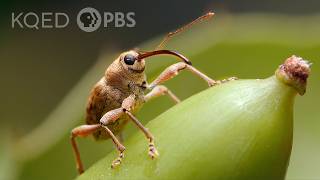
This Weevil Has Puppet Vibes But Drills Like a Power Tool | Deep Look
Nov 14, 2023
This fuzzy acorn weevil can’t crack open acorns like a woodpecker or chomp through them like a squirrel. Instead, she uses her incredibly long snout, called a rostrum, to power-drill through an acorn’s tough and resilient shell. And it's not just lunch on her mind – she's also making a nursery for her babies. WATCH Insectarium from PBS Terra! https://youtu.be/cgvQaY_COrg PALM WEEVILS episode: https://www.youtube.com/watch?v=S6a3Q5DzeBM Please join our community on PATREON! https://www.patreon.com/deeplook DEEP LOOK is an ultra-HD (4K) short video series created by KQED in San Francisco and presented by PBS Digital Studios. See the unseen at the very edge of our visible world. Explore big scientific mysteries by going incredibly small. — This tiny, fuzzy acorn weevil can’t crack open acorns like a woodpecker or chomp through them like a squirrel. Instead, she uses her incredibly long snout, called a rostrum, to power-drill through their tough and resilient shell. The weevil starts by probing an acorn’s surface with her supersensitive antennae. She likes the acorns that are still soft and green. Once she finds a good nut, she begins to chew. The weevil’s rostrum curves downward to let her bite straight into the acorn she’s standing on. Normally, this would mean the tunnel she makes would also curve. But as the weevil eats, she walks her body in a circle around the hole, drilling an arrow-straight tunnel. The naturally arched rostrum straightens as it drills. But this weevil has more than lunch on her mind – she’s also making a nursery. A few days after she deposits her eggs, larvae will hatch and chew their way out of the acorn. The larvae quickly burrow beneath the soil for protection, where they remain pupating into adults before emerging to start the cycle over.. --- Are acorn weevils harmful to oak trees? The weevils have no impact on mature oak trees. The larvae eat what's inside the acorn but don't harm the tree itself. --- Are acorn weevils pests? Yes, the weevils are considered pests for many species of oak tree, because they lay their eggs inside the acorn. Those seeds might be less likely to sprout than uninfested acorns. But some may still manage to grow into new oak seedlings. — Are there other species of weevils? There are approximately 60,000 species of weevils. Weevils are beetles known for elongated snouts. --- Do weevils carry disease? No. Though they are associated with some of the basic foods we consume, weevils are not associated with the transmission of any infectious diseases affecting human beings. ---+ Find additional resources and a transcript on KQED Science: https://www.kqed.org/science/1985068/this-weevil-has-puppet-vibes-but-drills-like-a-power-tool ---+ More Great Deep Look episodes: What Gall! The Crazy Cribs of Parasitic Wasps https://www.youtube.com/watch?v=lOgP5NzcTuA These Silk-Swinging Caterpillars Will Ruin Your Picnic https://www.youtube.com/watch?v=fv16qtBBdJI You'd Never Guess What an Acorn Woodpecker Eats https://www.youtube.com/watch?v=XvPaiDX_3JM ---+ Shoutout! 🏆Congratulations🏆 to these fans on our Deep Look Community Tab who correctly answer our GIF challenge! @nataliet8149 @pauljames5826 @yashpd2653 @aa-ron9485 @TheBestInsects See the question here: https://www.youtube.com/post/UgkxIl8H9A1nK0LPHl74ZNmGeTMGK8YBE8Qa ---+ Thank you to our Top Patreon Supporters ($10+ per month)! Burt Humburg Max Paladino Karen Reynolds Daisuke Goto Chris B Emrick Tianxing Wang Companion Cube David Deshpande Wade Tregaskis Laurel Przybylski Mark Jobes Carrie Mukaida El Samuels Jessica Hiraoka Noreen Herrington Louis O'Neill Levi Cai Jeremiah Sullivan Laurel Przybylski Elizabeth Ann Ditz LAUREL PRZYBYLSKI Titania Juang Roberta K Wright Jellyman Mehdi KW Syniurge SueEllen McCann xkyoirre TierZoo ---+ Follow Deep Look and KQED Science on social: https://www.tiktok.com/@deeplookofficial https://www.patreon.com/deeplook Instagram: https://www.instagram.com/kqedscience/ Twitter: https://www.twitter.com/kqedscience ---+ About KQED KQED, an NPR and PBS member station in San Francisco, serves Northern California and beyond with a public-supported alternative to commercial TV, radio and web media. Funding for Deep Look is provided in part by PBS Digital Studios and the members of KQED. #acornweevil #oaktree #acorns
-

Varroa Mites Are a Honeybee's 8-Legged Nightmare | Deep Look
Oct 24, 2023
Every year, up to half the honeybee colonies in the U.S. die. Varroa mites, the bees’ ghastly parasites, are one of the main culprits. After hitching a ride into a hive, a mite mom hides in a honeycomb cell, where she and her offspring feed on a growing bee. But beekeepers and scientists are helping honeybees fight back. TAKE OUR VIEWER SURVEY! https://to.pbs.org/pbssurvey2023g BINDWEED BEES: https://youtu.be/gJHCoP4WqMc Join our community on PATREON! https://www.patreon.com/deeplook DEEP LOOK is an ultra-HD (4K) short video series created by KQED in San Francisco and presented by PBS Digital Studios. See the unseen at the very edge of our visible world. Explore big scientific mysteries by going incredibly small. Photo of varroa mite: D. Kucharski K. Kucharska/Shutterstock.com --- To feed, a varroa mite nestles between a honeybee’s protective plates. It digs in with its gnarly mouth, the gnathosoma. The mite sinks it into a crucial organ called the fat body, a layer of tissue that lines the bee’s abdomen. Sort of like the human liver, the fat body helps the bee break down harmful stuff, including pesticides. And it maintains the bee’s immune system. So, when varroa mites attack the fat body, they seriously weaken the bee. The mites can also transmit a virus that causes a bee to be born with deformed wings, no good for flying. --- Where do varroa mites come from? Varroa mites evolved on eastern honeybees in Asia, known by the scientific name Apis cerana. Only recently have the mites moved onto western honeybees (Apis mellifera), the species that beekeepers maintain in the Americas, Europe and Africa. Varroa mites were first seen in the U.S. in the 1980s. They are now a pest of western honeybees around the world. --- How do you get rid of varroa mites? Beekeepers monitor the number of varroa mites in their hives throughout the year. One test they perform is called the “sugar shake.” The test consists of measuring a half-cup of bees (about 300), putting them in a mesh-covered jar, adding 2 tablespoons of confectioners’ sugar, and shaking for about 30 seconds. This causes the mites to lose their grip on the bees. The beekeepers then empty the sugar onto a tray and count the number of mites that fell through the mesh. A varroa mite infestation that represents between 1% and 3% of bees in a hive is enough to prompt beekeepers to apply pesticides to kill the mites, says associate professor of cooperative extension in apiculture Elina L. Niño, who trains beekeepers at the University of California, Davis. An effort is underway to keep mites at bay by selectively breeding honeybees that can fight back. Scientists at the U.S. Department of Agriculture and private companies like VP Queen Bees in South Carolina are breeding bees that can sniff out varroa mites and uncap the cells they’re in before they can reproduce. This bee behavior is called varroa sensitive hygiene. At Purdue and Central State universities, researchers are using a different approach, breeding bees known as “mite-biters” or “ankle-biters” for their ability to kill varroa mites by chewing off their legs. ---+ Find additional resources and a transcript on KQED Science: https://www.kqed.org/science/1984850/varroa-mites-are-a-honeybees-8-legged-nightmare ---+ More great Deep Look episodes: Honey Bees Make Honey … and Bread? https://youtu.be/sAKkjD3nEv0?si=jz4FVmJElA_jip-P Busy Bees and Other Pollinators Playlist https://youtube.com/playlist?list=PLdKlciEDdCQCfoI8E24mbuk259unmiwG9&si=lprbSmYhVhcc_Tnk ---+ GIF CHALLENGE Shoutout! It was a tough question in our YouTube Community Tab GIF challenge! The organ the mites feed on is the "fat body," and its closest analog in humans in the liver. One fan got the question partially right, by answering "liver:" @bssn9469 Thanks! ---+ Thank you to our top Patreon supporters ($10+ per month)! Max Paladino Burt Humburg Karen Reynolds Daisuke Goto Chris B Emrick Tianxing Wang Companion Cube David Deshpande Wade Tregaskis Mark Jobes Laurel Przybylski Titania Juang Roberta K Wright Syniurge El Samuels KW Jellyman Jessica Hiraoka Carrie Mukaida Mehdi SueEllen McCann Louis O'Neill Noreen Herrington Jeremiah Sullivan xkyoirre Levi Cai TierZoo Elizabeth Ann Ditz ---+ Follow Deep Look and KQED Science on social: https://www.tiktok.com/@deeplookofficial https://www.patreon.com/deeplook Instagram: https://www.instagram.com/kqedscience/ Twitter: https://www.twitter.com/kqedscience ---+ About KQED KQED, an NPR and PBS member station in San Francisco, serves Northern California and beyond with a public-supported alternative to commercial TV, radio and web media. Funding for Deep Look is provided in part by PBS Digital Studios and the members of KQED #varroamites #deeplook #honeybees
-

Watch Ladybugs Go From Goth to Glam | Deep Look
Oct 5, 2023
Ladybugs may be the cutest insects around, but they don't start off that way. Also called lady beetles or ladybirds, they pop out of their eggs as prickly mini-monsters with an insatiable hunger for aphids. Once they've bulked up, they transform, shedding their terrifying looks, but keeping their killer vibes. SUBSCRIBE to Deep Look! https://www.youtube.com/user/kqeddeeplook?sub_confirmation=1 Please join our community on Patreon! https://www.patreon.com/deeplook DEEP LOOK is an ultra-HD (4K) short video series created by KQED San Francisco and presented by PBS Digital Studios. See the unseen at the very edge of our visible world. Explore big scientific mysteries by going incredibly small. --- The ladybug is the most beloved insect in the world. With their round candy-apple red body and polka-dot markings, the ladybug is a symbol of springtime and a welcome ally in the garden. After mating, a single female ladybug will lay dozens of bright golden-yellow eggs right next to her offspring’s future prey. Four to eight days later, the eggs hatch and the spiky little larvae crawl free. They look like miniature alligators, and they have the temperament to match. Ladybugs are aphid-eating machines, devouring dozens of the sap-sucking insects in a single day. --- Do ladybugs bite people? Ladybugs are capable of biting people using their jaw-like mandibles, but they tend not to. If a ladybug feels threatened, it will typically “bleed” a foul-smelling liquid called hemolymph as a deterrent. --- Should I buy ladybugs from the store for my garden? It’s better to welcome wild ladybugs into your garden rather than purchase them. One reason is that the ladybugs available at garden centers are typically taken from their natural habitat while they are hibernating during winter months, which means fewer ladybugs in the wild. Plus, ladybugs sold in stores are typically eager to migrate and don’t stay long in your garden. --- Why do ladybugs have spots? Many ladybugs have bright, contrasting colors to warn potential predators that they taste terrible. This is known as aposematic coloration. Ladybugs’ hemolymph “blood” contains a cocktail of toxic chemicals including alkaloids. Predators quickly learn that a ladybug’s conspicuous coloration means they aren’t good to eat. ---+ Find additional resources and a transcript on KQED Science: https://www.kqed.org/science/1984438/watch-ladybugs-go-from-goth-to-glam ---+ For more information: Ladybugs are Good for Your Garden, The Real Dirt Blog, written by UC Master Gardeners of Butte County https://ucanr.edu/blogs/blogcore/postdetail.cfm?postnum=46585 ---+ More Great Deep Look episodes: The Ladybug Love-In: A Valentine's Special | Deep Look https://youtu.be/c-Z6xRexbIU?si=HGd3aqsHuhE3uqOB Born Pregnant: Aphids Invade with an Onslaught of Clones | Deep Look https://youtu.be/vrzalLssomg?si=Y82f3NSfv_ggfZb1 Citrus Psyllids Bribe Ants With Strings Of Candy Poop | Deep Look https://youtu.be/MtPXows1FWs?si=wuej6KBwUP-G_94n ---+ Shoutout! 🏆Congratulations🏆 to these fans on our Deep Look Community Tab to correctly answer our GIF challenge! @Arvindvernekar8177 @_BL4CKB1RD_ @royalfelinetracygrant6113 ---+ Thank you to our Top Patreon Supporters ($10+ per month)! Max Paladino Burt Humburg Karen Reynolds Daisuke Goto Chris B Emrick Tianxing Wang Companion Cube David Deshpande Wade Tregaskis Laurel Przybylski Mark Jobes Laurel Przybylski LAUREL PRZYBYLSKI Titania Juang Roberta K Wright Syniurge El Samuels KW Jellyman Jessica Hiraoka Carrie Mukaida Mehdi SueEllen McCann Louis O'Neill Noreen Herrington Jeremiah Sullivan xkyoirre Levi Cai TierZoo Elizabeth Ann Ditz ---+ Follow Deep Look and KQED Science on social: https://www.tiktok.com/@deeplookofficial https://www.patreon.com/deeplook Instagram: https://www.instagram.com/kqedscience/ Twitter: https://www.twitter.com/kqedscience ---+ About KQED KQED, an NPR and PBS member station in San Francisco, serves Northern California and beyond with a public-supported alternative to commercial TV, radio and web media. Funding for Deep Look is provided in part by PBS Digital Studios and the members of KQED. #ladybug #insects #deeplook
-
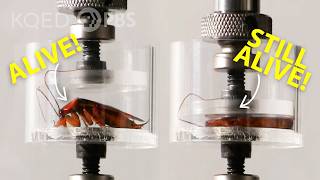
Cockroach vs. Hydraulic Press: Who Wins? | Deep Look
Sep 14, 2023
Do cockroaches -- those daring, disgusting disease vectors -- have anything at all to offer us? Scientists think so. They compressed American roaches with a hydraulic press, subjecting them to the force of 900 times their body weight. Don't worry (or do): They survived! How exactly do they do it? SUBSCRIBE to Deep Look! https://www.youtube.com/user/kqeddeeplook?sub_confirmation=1 Please join our community on Patreon! https://www.patreon.com/deeplook DEEP LOOK is an ultra-HD (4K) short video series created by KQED San Francisco and presented by PBS Digital Studios. See the unseen at the very edge of our visible world. Explore big scientific mysteries by going incredibly small. Cockroaches can cause asthma and allergies as they spread their saliva and poop around your home. But scientists think these daring, disgusting disease vectors have something more to offer us than salmonella. American roaches are one of the fastest insects on the planet. They’re also talented athletes, compressing their bodies while scurrying through incredibly tight cracks. The American cockroach can withstand compressive forces totaling over 900 times their body weight! Researchers are using what they’ve learned about roaches to build robots the size of insects, which can squeeze into places humans can’t – like piles of rubble left by major earthquakes or hurricanes. And maybe down the line, much smaller versions of these robots could even enter our bodies to perform life-saving tasks! ---+ Spider legs inspire researchers! Biomechanist and roboticist Kaushik Jayaram (@JayaramKaushik), who worked with us on our cockroach episode, also finds inspiration in the creepy, crawly spider! Specifically spider joints! Check out his work with spiders and robots in this paper: https://doi.org/10.1002/aisy.202300181 ---+ Pesticide resistant roaches? Professor of Urban Entomology Chow-Yang Lee (@chowyanglee), of the University of California, Riverside, studies many critters who cohabitate with humans. He’s been looking into how certain populations of German roaches (Blattella germanica) consistently evade our pesticides. Read more here: https://academic.oup.com/jee/article/115/1/259/6469283 ---+ Find additional resources and a transcript on KQED Science: https://www.kqed.org/science/1984261/cockroach-vs-hydraulic-press-who-wins ---+ More great Deep Look episodes: This Daring Fly Swims in a Shimmering Bubble Shield https://www.youtube.com/watch?v=T88hBWlxuMQ Have You Met a Hagfish? It’s About Slime https://www.youtube.com/watch?v=id1XEi7Jk7Y How Does the Mussel Grow Its Beard? https://www.youtube.com/watch?v=4vWtkzwFnS0 GIF CHALLENGE WINNERS: 🏆Congratulations🏆 to these 5 fans on our Deep Look Community Tab who came up with the 5 most popular new names for our friend, the American cockroach! @gabriellasteele727 / @jessehunter362 for "skitter critters" @avanelletheclockfriend2515 for "Rubbish runners, Scrap skidaddlers, Litter critters, Impervious invertebrates, Tenacious trash tenants @Weirdomanification for "Dysentery-dispensers" @ChasingMoonMoths for "Scurry peanuts or speedy Lincoln logs." And a special mention for @willsal529, for the astounding number of fun suggestions! Go here to see all the names our community proposed: https://www.youtube.com/channel/UC-3SbfTPJsL8fJAPKiVqBLg/community?lb=Ugkx_q7yMbve570eFb-PJgOh9teLG2W6Qupa ---+ Thank you to our top Patreon supporters ($10+ per month)! MaxPal Burt Humburg Karen Reynolds Daisuke Goto Chris B Emrick Tianxing Wang Companion Cube Wade Tregaskis David Deshpande Laurel Przybylski Mark Jobes Laurel Przybylski Porkchop LAUREL PRZYBYLSKI Titania Juang Cindy McGill Roberta K Wright Syniurge KW El Samuels Jellyman Carrie Mukaida Jessica Hiraoka Mehdi SueEllen McCann Louis O'Neill Noreen Herrington xkyoirre Elizabeth Ann Ditz Jeremiah Sullivan Levi Cai TierZoo ---+ Follow Deep Look and KQED Science on social: https://www.tiktok.com/@deeplookofficial https://www.patreon.com/deeplook Instagram: https://www.instagram.com/kqedscience Twitter: https://www.twitter.com/kqedscience ---+ About KQED KQED, an NPR and PBS member station in San Francisco, serves Northern California and beyond with a public-supported alternative to commercial TV, radio and web media. Funding for Deep Look is provided in part by PBS Digital Studios. Deep Look is a project of KQED Science, the largest science and environment reporting unit in California. KQED Science is supported by the Dirk and Charlene Kabcenell Foundation, Campaign 21 and the members of KQED. #deeplook
-

This Daring Fly Swims in a Shimmering Bubble Shield | Deep Look
Aug 24, 2023
Covered in a shiny bubble, the alkali fly scuba dives into the harsh waters of California's Mono Lake. Thanks to an abundance of hair and water-repellent wax, this remarkable insect remains dry while embarking on a quest for tasty algae and a place to lay its eggs. Learn more about Mono Lake's world-famous tufa towers at PBS TERRA's Untold Earth: https://www.youtube.com/watch?v=X6wUVIbXoS4 DEEP LOOK is an ultra-HD (4K) short video series created by KQED in San Francisco and presented by PBS Digital Studios. See the unseen at the very edge of our visible world. Explore big scientific mysteries by going incredibly small. — California’s Mono Lake is an incredibly harsh environment. It is three times saltier than the ocean and strongly alkaline. This landscape has striking limestone towers called tufas, creating an otherworldly setting. But in these extreme conditions, only a handful of species can survive: algae, nematodes, brine shrimp and the alkali fly. These flies embark on an impossible adventure: diving to eat and lay eggs while staying completely dry. The alkali fly has physical adaptations that allow them to thrive in these harsh waters. Their body is covered in a waxy substance to counter the high concentration of sodium carbonate in Mono Lake. They also have an impressive amount of hair, allowing them to form a protective air bubble. Despite its size, the alkali fly plays a vital role in Mono Lake's ecosystem and relies on a delicate balance to survive. --- Can you swim in Mono Lake? Yes. The increased level of salt makes people more buoyant, so, swimming in the lake is a very interesting experience. --- Why is Mono Lake drying up? Mono Lake is drying up due to reduced rainfall and water runoff from the Sierra Nevada. In 1941, the Los Angeles Department of Water & Power began diverting water from Mono Lake’s streams to meet the growing water demands. --- How are tufas formed? Tufas form underwater due to the interaction of calcium freshwater springs and the carbonate-rich lake water. When these two elements combine, a chemical reaction takes place, resulting in the formation of tufas. Tufa towers take decades or even centuries to grow. --- Are there fish in Mono Lake? No, there are no fish in Mono Lake. --- What makes an alkaline lake? A strongly alkaline environment means it has a pH value between 9 and 12. These alkaline lakes are characterized by high concentrations of carbonates. --- Are there other alkaline lakes? Yes. Some examples include Albert Lake and Pyramid Lake in the U.S., Lake Natron in Tanzania, and Lake Turkana in Kenya and Ethiopia. ---Who are the Native American tribes living in the Mono Lake Basin? Humans have called the Mono Basin home for thousands of years. The Kutzadika’a Paiute are the land’s native people. The Kutzadika’a People still live by Mono Lake and have maintained traditional practices, including harvesting kutsavi (the pupae of the alkali fly used as food). ---+ Find additional resources and a transcript on KQED Science: https://www.kqed.org/science/1983796/this-daring-fly-swims-in-a-shimmering-bubble-shield ---+ More Great Deep Look episodes: This Fly Torpedoes a Bindweed Bee’s Nest https://youtu.be/gJHCoP4WqMc Here’s How That Annoying Fly Dodges Your Swatter https://youtu.be/jBPFCvEhv9Y Leaf Miner Fly Babies Scribble All Over Your Salad https://youtu.be/QtbjUB4AnLI ---+ Shoutout! 🏆Congratulations🏆 to these fans on our Deep Look Community Tab to correctly answer our GIF challenge! @Ashuraj2733 @TheWhiteScatterbug @jamuojisan @Chris47368 @Ischemiaa See the challenge here: https://www.youtube.com/post/UgkxKWHbttsEnDmEtAOnpBz3z42N3OW6Q2sk ---+ Thank you to our Top Patreon Supporters ($10+ per month)! Burt Humburg Karen Reynolds Companion Cube Daisuke Goto David Deshpande Chris B Emrick Tianxing Wang Wade Tregaskis Laurel Przybylski Mark Jobes Kevin Judge Porkchop Cindy McGill Roberta K Wright Titania Juang El Samuels Rory B. Carrie Mukaida KW Jellyman Jessica Hiraoka Mehdi Noreen Herrington SueEllen McCann Louis O'Neill Nicolette Ray monoirre Jeremiah Sullivan Levi Cai TierZoo Elizabeth Ann Ditz Syniurge ---+ Follow Deep Look and KQED Science on social: https://www.tiktok.com/@deeplookofficial https://www.patreon.com/deeplook Instagram: https://www.instagram.com/kqedscience/ Twitter: https://www.twitter.com/kqedscience ---+ About KQED KQED, an NPR and PBS member station in San Francisco, serves Northern California and beyond with a public-supported alternative to commercial TV, radio and web media. Funding for Deep Look is provided in part by PBS Digital Studios and the members of KQED. #alkalifly #monolake #deeplook
-

This Fly Torpedoes a Bindweed Bee’s Nest | Deep Look
Aug 1, 2023
A “bee fly” looks a bit like a bee, but it’s a freeloader that takes advantage of a bindweed turret bee’s hard work. The bees dig underground nests and fill them with pollen they collect in the form of stylish “pollen pants.” As the bees are toiling on their nests, the flies drop their *own* eggs into them. But the bees employ a tricky defense against the flies. SUBSCRIBE to Deep Look! https://www.youtube.com/user/kqeddeeplook?sub_confirmation=1 Please join our community on Patreon! https://www.patreon.com/deeplook DEEP LOOK is an ultra-HD (4K) short video series created by KQED in San Francisco and presented by PBS Digital Studios. See the unseen at the very edge of our visible world. Explore big scientific mysteries by going incredibly small. --- In the spring in California, male bindweed turret bees get into brawls with their peers as they search for a female to mate with. Males pile onto each other and form so-called “mating balls,” an inaccurate name, since no mating is occurring. Rather, the males are getting into fights. The female they’re vying for is caught at the bottom, and sometimes the battle is so intense the males accidentally kill her. But, if she survives, she and the male who won steal away and mate. Once they’ve mated, females dig through compacted dirt to make a nest underground, where they’ll lay their eggs. The majority of the world’s bee species – 70 percent – are ground-nesting. The bindweed turret bees in this video chose a dirt parking lot near the town of Winters, in the Central Valley. These native bees are known by the scientific name Diadasia bituberculata. Females tirelessly scoop earth with their mandibles, softening it by dousing it with nectar they collected earlier. They work side by side, but each is “queen” of her own castle. As they dig out their nest, they often build a turret at the entrance. These dirt towers usually aren’t vertical: Many of them are tunnel-like, with a sideways entrance. Others curve down. With their entrances facing away from the sky, the turrets protect the bees’ nests when bee flies start dropping their eggs from the air. --- What is another name for a bee fly? Bee fly is the common name for the more than 4,000 species of flies in the family Bombyliidae. --- How do bee flies parasitize bees? The Paravilla fulvicoma bee flies in our video drop their eggs into the nests of bindweed turret bees. When the fly’s egg hatches into a larva, it digs tiny hooks into a bee larva. But the bee larva doesn’t die. It grows by feeding on the pollen that its mother packed for it inside the nest. As the bee larva grows, the fly larva sucks it dry and kills it. Then the fly finishes growing into an adult and pushes up through the ground to emerge the following spring. --- How do you tell a bee fly from a bee? Even though bee flies have hairy bodies like bees, if you look closely, you can tell them apart. Bee flies have big eyes that cover a large area of their heads. And bee flies’ antennae are short compared to bees’ antennae. ---+ Find a transcript on KQED Science: https://www.kqed.org/science/1983618/this-fly-torpedoes-a-bindweed-bees-nest ---+ More Great Deep Look episodes: Busy Bees and Other Pollinators Playlist https://youtu.be/XjOfbEWVBpE Honey Bees Make Honey ... and Bread?| https://youtu.be/sAKkjD3nEv0 This Bee Gets Punched by Flowers For Your Ice Cream https://youtu.be/rsUNxvXofgo Watch This Bee Build Her Bee-jeweled Nest https://youtu.be/oPbH1YhsdP8 ---+ Shoutout! 🏆Congratulations🏆 to these fans on our Deep Look Community Tab to correctly answer our GIF challenge! @sarabjorck6546 @royalfelinetracygrant6113 @ZxI_Puma @98SST @onabikewithadrone See the challenge here: https://www.youtube.com/post/UgkxoSbRieAiCkARAP0Hbi3bTxXNRNfJm-Bi ---+ Thank you to our Top Patreon Supporters ($10+ per month)! Burt Humburg Karen Reynolds Companion Cube Daisuke Goto David Deshpande Chris B Emrick Tianxing Wang Wade Tregaskis Laurel Przybylski Mark Jobes Kevin Judge Porkchop Cindy McGill Roberta K Wright Titania Juang El Samuels Rory B. Carrie Mukaida KW Jellyman Jessica Hiraoka Mehdi Noreen Herrington SueEllen McCann Louis O'Neill Nicolette Ray monoirre Jeremiah Sullivan Levi Cai TierZoo Elizabeth Ann Ditz Syniurge ---+ Follow Deep Look and KQED Science on social: https://www.tiktok.com/@deeplookofficial https://www.patreon.com/deeplook Instagram: https://www.instagram.com/kqedscience/ Twitter: https://www.twitter.com/kqedscience ---+ About KQED KQED, an NPR and PBS member station in San Francisco, serves Northern California and beyond with a public-supported alternative to commercial TV, radio and web media. Funding for Deep Look is provided in part by PBS Digital Studios and the members of KQED. #beeflies #nativebees #deeplook
-
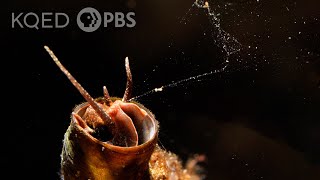
This Snail Goes Fishing With a Net Made of Slime | Deep Look
Jul 11, 2023
Most of the sea snails in this tide pool cruise around searching for food. But not the scaled wormsnail. It cements its shell to a rock and snags its meals using the one thing a snail has plenty of: mucus! SUBSCRIBE to Deep Look! https://www.youtube.com/user/kqeddeeplook?sub_confirmation=1 Please join our community on Patreon! https://www.patreon.com/deeplook DEEP LOOK is an ultra-HD (4K) short video series created by KQED San Francisco and presented by PBS Digital Studios. See the unseen at the very edge of our visible world. Explore big scientific mysteries by going incredibly small. --- While most sea snails spend their time grazing on algae or searching for prey, the scaled wormsnail spends its entire adult life stuck in the same spot. It cements its shell directly to a solid structure like rock. That means when it comes to getting food, the scaled wormsnail needs to get creative. So it uses the one thing a snail has plenty of: mucus. “They essentially use the same kind of mucus that a garden snail would glide on, and use that to make a web to catch their food,” says Rüdiger Bieler, a biologist at the Field Museum of Natural History in Chicago. Scaled wormsnails tend to live near shore where the waves churn up a stew of tasty morsels for this miniature fisher to catch. “They're taking live plankton and bits of seaweed … along with whatever edible debris that's floating in the water,” says Bieler. “They don't seem to be very choosy.” “It seems like a pretty lonely life. You can't get out and visit your neighbor and see new things. You're just sitting there and waiting for things to float by.” --- What do scaled wormsnails eat? Wormsnails use their mucus strands like a fishing net to collect food from seawater. The wormsnail will exude its net, which snags plankton as well as tiny bits of seaweed and detritus churned up by the waves. Then the wormsnail drags in and eats the net, along with all the tasty bits trapped within it. --- Why are vermetid snails bad for aquariums? Vermetid snails are a group of sea snails that belong to the family Vermetidae. Their name refers to the worm-like shape of their shells. Some species of vermetid snails can hitchhike their way into warm-water home aquariums, where they can damage coral by either attaching to it or by smothering and starving it with their mucus net. --- How do you get rid of vermetid snails in an aquarium? There are multiple techniques to get rid of unwanted vermetid snails in home aquariums. The simplest way is to dispose of the rocks or other solid items on which the snail has attached. Or the rocks can be soaked in a chemical solution to kill the snail and dissolve the shell. Some aquarists get rid of vermetid snails by physically prying their shell tower from the rock or coral. ---+ Read the entire article on KQED Science: https://www.kqed.org/science/1983180/this-snail-goes-fishing-with-a-net-made-of-slime ---+ For more information: Rüdiger Bieler studies mollusks, including wormsnails, at the Field Museum of Natural History, Chicago https://www.fieldmuseum.org/about/staff/profile/rudiger-bieler Seymour Marine Discovery Center at the UC Santa Cruz Coastal Science Campus https://seymourcenter.ucsc.edu/ ---+ More Great Deep Look episodes: This Adorable Sea Slug is a Sneaky Little Thief | Deep Look https://youtu.be/KLVfWKxtfow Watch These Cunning Snails Stab and Swallow Fish Whole | Deep Look https://youtu.be/jYMjLgPFSso Everything You Never Wanted to Know About Snail Sex | Deep Look https://youtu.be/UOcLaI44TXA ---+ Shoutout! 🏆Congratulations🏆 to these fans on our Deep Look Community Tab to correctly answer our GIF challenge! @carl_smiley_face1396 @lindroe4446 @Chris47368 @albertwhiskers @Formula_Zero_EX ---+ Thank you to our Top Patreon Supporters ($10+ per month)! Burt Humburg Karen Reynolds Companion Cube Daisuke Goto David Deshpande Chris B Emrick Tianxing Wang Wade Tregaskis Laurel Przybylski Mark Jobes Laurel Przybylski Kevin Judge Porkchop Cindy McGill Roberta K Wright Titania Juang El Samuels Rory B. Carrie Mukaida KW Jellyman Jessica Hiraoka Mehdi Noreen Herrington SueEllen McCann Louis O'Neill Nicolette Ray monoirre Jeremiah Sullivan Levi Cai TierZoo Elizabeth Ann Ditz Syniurge ---+ Follow Deep Look and KQED Science on social: https://www.tiktok.com/@deeplookofficial https://www.patreon.com/deeplook Instagram: https://www.instagram.com/kqedscience/ Twitter: https://www.twitter.com/kqedscience ---+ About KQED KQED, an NPR and PBS member station in San Francisco, serves Northern California and beyond with a public-supported alternative to commercial TV, radio and web media. Funding for Deep Look is provided in part by PBS Digital Studios and the members of KQED. #wormsnail #vermetid #deeplook
-
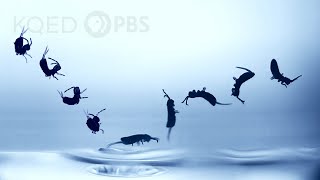
Springtails Do Their Own Stunts | Deep Look
Jun 20, 2023
Step right up to see tiny springtails spin through the air with the greatest of ease! In ponds and streams, they skyrocket out of the reach of hungry insects like water striders by slapping a tail-like appendage against the water. And you won’t believe how they stick the landing. SUBSCRIBE to Deep Look! https://www.youtube.com/user/kqeddeeplook?sub_confirmation=1 Please join our community on Patreon! https://www.patreon.com/deeplook DEEP LOOK is an ultra-HD (4K) short video series created by KQED San Francisco and presented by PBS Digital Studios. See the unseen at the very edge of our visible world. Explore big scientific mysteries by going incredibly small. Semiaquatic springtails are as tiny as a poppy seed, which makes them a tasty snack to insects such as water striders in streams and ponds. But springtails have a secret superpower that allows them to evade their predators: the furcula. They use this tail-like appendage to jump off the water’s surface 150 times faster than the blink of an eye. Their explosive jumps can propel them as high as the equivalent of a six-story building for humans. So, once they’re up in the air, how do they land, ready to escape again? Scientists at Georgia Tech filmed semiaquatic springtails they put in a wind tunnel. The high-speed footage showed that springtails right themselves in the air by curving their bodies into the shape of a U. They land upright with the help of a droplet of water they collect with a tube on their abdomen called a collophore. “They don’t bounce away,” said Víctor Ortega-Jiménez, of the University of Maine, who carried out the research while at Georgia Tech. “The drop of water acts like a glue.” --- Are springtails insects? Even though, like insects, they have six legs, springtails aren’t considered insects because they keep their mouthparts tucked away, rather than exposed. Their furcula is another unique feature that sets them apart. --- How small are springtails? A springtail is 1 to 5 millimeters long, or one-sixteenth to one-fifth of an inch. --- How many springtail species exist? Scientists have identified more than 9,000 species of springtails, also known as collembolans. ---+ Find a transcript on KQED Science: https://www.kqed.org/science/1983076/springtails-do-their-own-stunts ---+ More Great Deep Look episodes: What Makes This Frog’s Tongue So Fast AND Sticky? https://youtu.be/USxQgEp1GN8 Earthworm Love is Cuddly … and Complicated https://youtu.be/xjpo6OkuYy0 This Mushroom Can Fly https://youtu.be/_EBipTLgPUw ---+ Shoutout! 🏆Congratulations🏆 to these fans on our Deep Look Community Tab for correctly answering our GIF challenge! Renkuka Karki Princess Pie Girl Rotation [Formula Zero EX_] ---+ Thank you to our Top Patreon Supporters ($10+ per month)! Burt Humburg Karen Reynolds Companion Cube Daisuke Goto David Deshpande Chris B Emrick Tianxing Wang Wade Tregaskis Laurel Przybylski Mark Jobes Laurel Przybylski Kevin Judge Porkchop Cindy McGill Roberta K Wright Titania Juang El Samuels Rory B. Carrie Mukaida KW Jellyman Jessica Hiraoka Mehdi Noreen Herrington SueEllen McCann Louis O'Neill Nicolette Ray monoirre Jeremiah Sullivan Levi Cai TierZoo Elizabeth Ann Ditz Syniurge ---+ Follow Deep Look and KQED Science on social: https://www.tiktok.com/@deeplookofficial https://www.patreon.com/deeplook Instagram: https://www.instagram.com/kqedscience/ Twitter: https://www.twitter.com/kqedscience ---+ About KQED KQED, an NPR and PBS member station in San Francisco, serves Northern California and beyond with a public-supported alternative to commercial TV, radio and web media. Funding for Deep Look is provided in part by PBS Digital Studios and the members of KQED. #springtail #deeplook
-

Gecko Grip: It’s Atomic (Really) | Deep Look
May 30, 2023
No suction cups, no Velcro, no glue. Geckos navigate nearly any surface with something far cooler: an electron dance at the atomic scale. SUBSCRIBE to Deep Look! https://www.youtube.com/user/kqeddeeplook?sub_confirmation=1 Please join our community on Patreon! https://www.patreon.com/deeplook DEEP LOOK is an ultra-HD (4K) short video series created by KQED San Francisco and presented by PBS Digital Studios. See the unseen at the very edge of our visible world. Explore big scientific mysteries by going incredibly small. Gecko feet aren't covered in suction cups or Velcro. They don’t squirt glue, or leave any footprints. Their secret is a herculean amount of grip -- at the atomic scale. A gecko’s toes are covered in tiny hairs that branch out into millions of microscopic, spatula-shaped pads. Those pads, called spatulae, get so close to the surfaces on which a gecko moves, the electrons of the spatulae and those on the surface start to sync up. That dance is called Van der Waals force, and it’s what gives geckos their sticking power. ---+ What do gecko feet have to do with earthquakes? Biophysics Professor Kellar Autumn has been taking a very close look at gecko feet for decades. He’s especially interested in how the physics of gecko adhesion can be applied across disciplines, including in rate-and-state friction models used to predict seismic activity. Read more about his work here! https://issuu.com/eggermont/docs/zqissue17/8 ---+ How many species of geckos are there? There are 2,200 known living species of geckos. California Academy Research Associate and Villanova University Professor Aaron Bauer literally wrote the book on geckos. It’s called “Geckos: The Animal Answer Guide.” Bauer has discovered some 9% of the scientific world’s known geckos. Read about his recent discoveries in the 2022 “Proceedings of the California Academy of Sciences" here: https://www.dropbox.com/s/69y399u22ujxusb/Bavayia_PCAS_Nov_2022.pdf?dl=0 ---+ Find additional resources and a transcript on KQED Science: https://www.kqed.org/science/1982729/gecko-grip-its-atomic-really ---+ More Great Deep Look episodes: Snakes Smell in Stereo | Deep Look https://www.youtube.com/watch?v=s6jDsPXmo2I Watch Barn Owls Swallow Rodents Whole | Deep Look https://www.youtube.com/watch?v=x-mJkak30v0 Fire Ants Turn Into a Stinging Life Raft to Survive Floods | Deep Look https://www.youtube.com/watch?v=cfKr6rnpakE GIF CHALLENGE WINNERS: 🏆Congratulations🏆 to these fans on our Deep Look Community Tab who came up with *new* names for our friend, the gecko: 1. Gonzo (20 votes) by Call me Jephph 2. Gravity Doubters (6 votes) by Scrote Goblin 3. Sticklet (6 votes) by Sakshi Suryawanshi 4. Stickzard (4 votes) by Preet Budhwani and tied for 5th with 3 votes each: ANTIGRAVISAUR! by eklectiktoni Lyle by Neon Beige moon-eye by Herique Martins ---+ Thank you to our Top Patreon Supporters ($10+ per month)! Burt Humburg Karen Reynolds Daisuke Goto Companion Cube David Deshpande Chris B Emrick Tianxing Wang Wade Tregaskis Mark Jobes Blanca Vides Kevin Judge Laurel Przybylski Cindy McGill monoirre Roberta K Wright Supernovabetty Titania Juang Syniurge KW Carrie Mukaida Rory B. El Samuels Jessica Hiraoka Cristen Rasmussen Jellyman SueEllen McCann Kelly Hong Mehdi Laurel Przybylski Levi Cai TierZoo Nicolette Ray Jeremiah Sullivan Noreen Herrington Elizabeth Ann Ditz Louis O'Neill ---+ Follow Deep Look and KQED Science on social: https://www.tiktok.com/@deeplookofficial https://www.patreon.com/deeplook Instagram: https://www.instagram.com/kqedscience Twitter: https://www.twitter.com/kqedscience ---+ About KQED KQED, an NPR and PBS member station in San Francisco, CA, serves Northern California and beyond with a public-supported alternative to commercial TV, radio and web media. Funding for Deep Look is provided in part by PBS Digital Studios. Deep Look is a project of KQED Science, the largest science and environment reporting unit in California. KQED Science is supported by the Dirk and Charlene Kabcenell Foundation, Campaign 21 and the members of KQED. #deeplook
-

The Twisted Truth About Snake Tongues | Deep Look
May 9, 2023
To us, a snake's forked tongue evokes danger and deceit. But the tongue's two sensitive tips, called tines, actually help the snake smell in stereo. That's bad news if you're a mouse ... SUBSCRIBE to Deep Look! https://www.youtube.com/user/kqeddeeplook?sub_confirmation=1 Please join our community on Patreon! https://www.patreon.com/deeplook DEEP LOOK is an ultra-HD (4K) short video series created by KQED San Francisco and presented by PBS Digital Studios. See the unseen at the very edge of our visible world. Explore big scientific mysteries by going incredibly small. --- It’s the most infamous tongue in the world. But for snakes, that flicking tongue is the way they experience the world around them. “In snakes, the tongue has been so reduced to this little skinny, highly protrusive organ,” says the University of Connecticut’s Kurt Schwenk, who studies the unique ways snakes and lizards use their tongues. Like us, snakes have nostrils to breathe in air and sense odor. But snakes have a whole second system to help them track down prey, find mates and avoid predators. In a single second-long flick, a snake might wave its tongue up and down as many as 15 times to collect odor molecules. As the snake retracts its tongue, it will often drag the forked tips on the ground. “Back inside the mouth, each of the tongue tips fits into a separate groove once it comes into the mouth,” says Schwenk. “Those two grooves go back separately to the opening of the vomeronasal organs.” The two vomeronasal organs, which act like a second odor-collecting system, allow the snake to pick up tiny concentrations of scents. By having two vomeronasal organs, one each? on the right and left side, the snake can smell in stereo. --- How do snakes move? Snakes don’t have limbs, so they use their long, flexible bodies to crawl on surfaces. Undulating waves of muscular contractions create forward momentum, and scales on their bellies help snakes get traction on the ground to push forward. --- Why do snakes shed their skin? As snakes grow, their skin doesn’t stretch, so they periodically shed it. The process of shedding, called ecdysis, also allows snakes to replace worn or damaged scales and get rid of parasites on the skin’s surface. --- Why do snakes hiss? Snakes hiss as a warning to predators and other threats. To make the hiss sound, a snake will force air through its glottis, an organ it uses to breathe. ---+ Find additional resources and a transcript on KQED Science: https://www.kqed.org/science/1982590/why-do-snakes-have-forked-tongues ---+ For more information: Kurt Schwenk at the University of Connecticut studies how snakes and lizards use their tongues to feed and sense the world around them. ---+ More Great Deep Look episodes: Look Inside a Rattlesnake's Rattle | Deep Look https://youtu.be/ZO4IAZycUik These Lizards Have Been Playing Rock-Paper-Scissors for 15 Million Years | Deep Look https://youtu.be/rafdHxBwIbQ Nature's Mood Rings: How Chameleons Really Change Color | Deep Look https://youtu.be/Kp9W-_W8rCM ---+ Shoutout! 🏆Congratulations🏆 to these fans on our Deep Look Community Tab to correctly answer our GIF challenge! Palak Gupta RGAMeijer Siddarth Chris47368 ---+ Thank you to our Top Patreon Supporters ($10+ per month)! Burt Humburg Karen Reynolds Daisuke Goto Companion Cube David Deshpande Chris B Emrick Tianxing Wang Wade Tregaskis Mark Jobes Blanca Vides Kevin Judge Laurel Przybylski Cindy McGill monoirre Roberta K Wright Supernovabetty Titania Juang Syniurge KW Carrie Mukaida Rory B. El Samuels Jessica Hiraoka Cristen Rasmussen Jellyman SueEllen McCann Kelly Hong Mehdi Laurel Przybylski Levi Cai TierZoo Nicolette Ray Jeremiah Sullivan Noreen Herrington Elizabeth Ann Ditz Louis O'Neill ---+ Follow Deep Look and KQED Science on social: https://www.tiktok.com/@deeplookofficial https://www.patreon.com/deeplook Instagram: https://www.instagram.com/kqedscience/ Twitter: https://www.twitter.com/kqedscience ---+ About KQED KQED, an NPR and PBS member station in San Francisco, serves Northern California and beyond with a public-supported alternative to commercial TV, radio and web media. Funding for Deep Look is provided in part by PBS Digital Studios and the members of KQED.
-
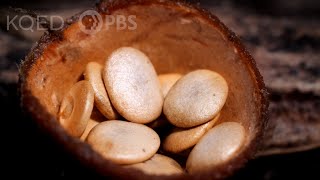
This Mushroom Can Fly | Deep Look
Apr 18, 2023
Bird’s nest fungi look just like a tiny bird's nest. But those little eggs have no yolks. Each one is a spore sac waiting for a single raindrop to catapult it on a journey with a layover inside the bowels of an herbivore. SUBSCRIBE to Deep Look! https://www.youtube.com/user/kqeddeeplook?sub_confirmation=1 Please join our community on Patreon! https://www.patreon.com/deeplook DEEP LOOK is an ultra-HD (4K) short video series created by KQED San Francisco and presented by PBS Digital Studios. See the unseen at the very edge of our visible world. Explore big scientific mysteries by going incredibly small. --- The spore sacs, known as peridioles, sit in their splash cup, biding their time. When a raindrop hits the cup, a peridiole hurtles off in milliseconds. As it flies, the peridiole unfurls a cord and sometimes attaches to a blade of grass. When a hungry herbivore, such as a deer, eats the grass, it spreads the fungus’s spores in its droppings. --- How big are bird’s nest fungi? A couple of bird’s nest fungi would fit on your thumbnail. Their splash cups are about 10 millimeters in diameter. An individual peridiole can be just 1 millimeter wide. --- How far do bird’s nest fungi travel? Experiments carried out by Miami University mycologist Nik Money and then graduate student Maribeth Hassett in 2012 found that when a raindrop falls on a bird’s nest fungus and sends a peridiole flying, it can land somewhere between a few centimeters and a bit over a meter away. How far it travels varies, depending on the bird’s nest fungi species. Money hypothesizes that herbivores such as deer eat blades of grass onto which peridioles have attached. He believes the fungus’s spores then travel inside the deer until the animal deposits them on the ground in its droppings. --- Are bird’s nest fungi edible? They’re not known to be poisonous, but they’re so small, it’s probably not worth the attempt to eat them. ---+ Find a transcript on KQED Science: https://www.kqed.org/science/1981958/this-mushroom-can-fly ---+ More Great Deep Look episodes: This Mushroom Starts Killing You Before You Even Realize It https://youtu.be/bl9aCH2QaQY This Killer Fungus Turns Flies Into Zombies https://youtu.be/C2Jw5ib-s_I This Mushroom Fakes Its Own Death to Trick Flies https://youtu.be/Bd6RESaCxc4 ---+ Shoutout! 🏆Congratulations🏆 to these fans on our Deep Look Community Tab who correctly answered our GIF challenge! Kamea Webster The answers were "peridioles" and "splash dispersal." https://www.youtube.com/channel/UC-3SbfTPJsL8fJAPKiVqBLg/community?lb=UgkxE8g9NEKHK7USs9o5bisZBa0FfnnFLzje ---+ Thank you to our Top Patreon Supporters ($10+ per month)! Burt Humburg Karen Reynolds Daisuke Goto Companion Cube David Deshpande Chris B Emrick Tianxing Wang Wade Tregaskis Mark Jobes Blanca Vides Kevin Judge Cindy McGill Laurel Przybylski Supernovabetty monoirre Titania Juang Roberta K Wright KW Syniurge El Samuels Carrie Mukaida Jessica Hiraoka Cristen Rasmussen Jellyman Mehdi Kelly Hong Noreen Herrington Laurel Przybylski SueEllen McCann Caitlin McDonough Louis O'Neill Nicolette Ray Jeremiah Sullivan Levi Cai TierZoo Elizabeth Ann Ditz Rory B. ---+ Follow Deep Look and KQED Science on social: https://www.tiktok.com/@deeplookofficial https://www.patreon.com/deeplook Instagram: https://www.instagram.com/kqedscience/ Twitter: https://www.twitter.com/kqedscience ---+ About KQED KQED, an NPR and PBS member station in San Francisco serves Northern California and beyond with a public-supported alternative to commercial TV, radio and web media. Funding for Deep Look is provided in part by PBS Digital Studios and the members of KQED. #birdsnestfungi #deeplook
-

What Makes This Frog's Tongue So Fast AND Sticky? | Deep Look
Mar 28, 2023
How are frogs and toads so amazing at catching bugs? They smack ’em with a supersoft tongue covered in special spit, which flows into every nook and cranny of their target. Then, in less than a second, that spit transforms into a tacky glue, yanking the meal back into the toad’s maw. SUBSCRIBE to Deep Look! https://www.youtube.com/user/kqeddeeplook?sub_confirmation=1 Please join our community on Patreon! https://www.patreon.com/deeplook DEEP LOOK is a ultra-HD (4K) short video series created by KQED San Francisco and presented by PBS Digital Studios. See the unseen at the very edge of our visible world. Explore big scientific mysteries by going incredibly small. Toads nab their prey 5 times faster than the blink of an eye. How do they do it? They pop their lower jaw open, and launch their supersoft tongue at their meal, enveloping their prey. When their unique saliva hits prey at a high speed, it thins out dramatically, pouring into every nook and cranny the tongue touches. Then it becomes sticky again, drawing that meal down the hatch. ---+ How does a toad get insects OFF its tongue? Scientists at the University of Florida put tiny metal markers on cane toads’ tongues and filmed X-ray footage of them eating to see where that tongue went after the toad mouth closed. They found that the toad basically swallows its own tongue in order to scrape off its prey with a rigid piece of cartilage called a hyoid. See more images from their work here: https://academic.oup.com/iob/article/4/1/obac045/6769806?login=false ---+ How does a toad catch prey? It’s a combo of that super-soft tongue that helps envelop prey … and some very special spit. A toad’s saliva starts off thick and sticky. but when the saliva hits prey at a high speed, it thins out dramatically, pouring into every nook and cranny the tongue touches. ---+ More Great Deep Look episodes: How Does the Mussel Grow its Beard? | Deep Look https://www.youtube.com/watch?v=4vWtkzwFnS0 This Parasite is Cramping The Monarch Butterfly’s Style | Deep Look https://www.youtube.com/watch?v=3DC8INr7tvQ Barnacles Go To Unbelievable Lengths To Hook Up | Deep Look https://www.youtube.com/watch?v=lfnkFxg1gMw GIF CHALLENGE WINNERS: 🏆Congratulations🏆 to these fans on our Deep Look Community Tab who correctly answered our GIF challenge! Dario Brittany Skyy Axqu Snata Chakraborty Evelo ---+ Thank you to our Top Patreon Supporters ($10+ per month)! Burt Humburg Karen Reynolds Daisuke Goto Companion Cube David Deshpande Chris B Emrick Tianxing Wang Wade Tregaskis Mark Jobes Blanca Vides Kevin Judge monoirre Laurel Przybylski Cindy McGill Titania Juang Roberta K Wright Supernovabetty KW Rory B. Syniurge El Samuels Jellyman Mehdi Jessica Hiraoka Cristen Rasmussen Carrie Mukaida Kelly Hong SueEllen McCann Noreen Herrington Laurel Przybylski Nicolette Ray Caitlin McDonough Elizabeth Ann Ditz Levi Cai Delphine Tseng Louis O'Neill TierZoo Jeremiah Sullivan ---+ Follow Deep Look and KQED Science on social: https://www.tiktok.com/@deeplookofficial https://www.patreon.com/deeplook Instagram: https://www.instagram.com/kqedscience Twitter: https://www.twitter.com/kqedscience ---+ About KQED KQED, an NPR and PBS affiliate in San Francisco, CA, serves Northern California and beyond with a public-supported alternative to commercial TV, Radio and web media. #deeplook
-

How Does the Mussel Grow its Beard? | Deep Look
Mar 7, 2023
Mussels create byssal threads, known as the mussel's "beard," to attach themselves both to rocks and to each other. They use their sensitive foot to mold the threads from scratch and apply a waterproof adhesive that makes superglue jealous. SUBSCRIBE to Deep Look! https://www.youtube.com/user/kqeddeeplook?sub_confirmation=1 DEEP LOOK is an ultra-HD (4K) short video series created by KQED San Francisco and presented by PBS Digital Studios. See the unseen at the very edge of our visible world. Explore big scientific mysteries by going incredibly small. --- A day at the beach isn’t all it’s cracked up to be for mussels that make their home along the rough and tumble California coast. To keep from being swept away by the pummeling waves, they grow 50-100 strings called byssal fibers to attach themselves to the rocks and each other. Those fibers are collectively called the byssus, otherwise known as the mussel’s “beard.” So, how does the mussel create the byssal threads? Turns out mussels have a thread-making factory in their foot. The foot, which looks like a little tongue, has a groove that runs its length. “The mussel squirts protein building blocks, which are liquid, into the groove channel. Then they become solid in just a matter of minutes,” says Matthew Harrington, a researcher at McGill University who takes inspiration from nature to create better and more sustainable materials. The waterproof glue that the mussel uses to attach each thread to the rock hardens in water. Having a glue like that would be very useful for humans, especially in medical and dental situations where the adhesive needs to stick in a wet environment. “If you’ve tried to put a piece of tape or glue onto a wet surface, even a slightly damp surface, you know it doesn’t stick,” says Harrington. “But mussels figured out how to glue things to a wet surface. It’s really interesting how they solved a problem that we, as engineers, have been working on for over 100 years.” --- What do mussels eat? Mussels are filter feeders. They suck in water, and they filter out tiny bits of food like algae and detritus churned up by waves. --- What are mussels made of? Mussels build their shells out of calcium carbonate, which they pull from the water. --- How do mussels attach to rocks? Mussels use their byssal threads, or “beards,” to connect themselves to rocks. In addition to their strong shell, keeping themselves attached to a rock makes it harder for predators to attack them. ---+ Find additional resources and a transcript on KQED Science: https://www.kqed.org/science/1981819/yep-mussels-grow-beards-with-their-feet ---+ For more information: Harrington Lab at McGill University studies how mussels make byssal threads to create better and more sustainable materials: http://harrington.lab.mcgill.ca/ Messersmith Research Lab studies the glue that mussels use to connect to rocks, in order to create adhesives for humans to use in situations like surgery, where the adhesive needs to harden in a wet environment: https://bioinspiredmaterials.berkeley.edu/ ---+ More Great Deep Look episodes: Barnacles Go to Unbelievable Lengths to Hook Up | Deep Look https://youtu.be/lfnkFxg1gMw These Feisty Hermit Crabs Brawl Over Snail Shells | Deep Look https://youtu.be/zCsbTcmtsoA Ever Seen a Starfish Gallop? | Deep Look https://youtu.be/9rxf_2EgwfE ---+ Shoutout! 🏆Congratulations🏆 to these fans on our Deep Look Community Tab who correctly answered our GIF challenge! Scatman John Edison Lewis Cordon Grouch Tragoudistros.MPH MegaPiglatin ---+ Thank you to our Top Patreon Supporters ($10+ per month)! Burt Humburg Karen Reynolds Daisuke Goto Companion Cube David Deshpande Chris B Emrick Tianxing Wang Wade Tregaskis Mark Jobes Blanca Vides Kevin Judge monoirre Laurel Przybylski Cindy McGill Titania Juang Roberta K Wright Supernovabetty KW Rory B. Syniurge El Samuels Jellyman Mehdi Jessica Hiraoka Cristen Rasmussen Carrie Mukaida Kelly Hong SueEllen McCann Noreen Herrington Laurel Przybylski Nicolette Ray Caitlin McDonough Elizabeth Ann Ditz Levi Cai Delphine Tseng Louis O'Neill TierZoo Jeremiah Sullivan ---+ Follow Deep Look and KQED Science on social: https://www.tiktok.com/@deeplookofficial https://www.patreon.com/deeplook Instagram: https://www.instagram.com/kqedscience/ Twitter: https://www.twitter.com/kqedscience ---+ About KQED KQED, an NPR and PBS affiliate in San Francisco, California, serves Northern California and beyond with a public-supported alternative to commercial TV, radio and web media. Funding for Deep Look is provided in part by PBS Digital Studios and the members of KQED. #musselbeard #byssalthread #deeplook
-

Earthworm Love Is Cuddly ... and Complicated | Deep Look
Feb 14, 2023
Earthworms know a thing or two about romance. They cozy up with a mate inside tubes of slime, then follow a series of intricate steps to make cocoons full of baby worms. ** TAKE OUR NEWSLETTER SURVEY: https://survey.alchemer.com/s3/7186645/Deep-Look-Survey DEEP LOOK is an ultra-HD (4K) short video series created by KQED in San Francisco and presented by PBS Digital Studios. See the unseen at the very edge of our visible world. Explore big scientific mysteries by going incredibly small. --- You can tell an earthworm is ready to mate once it has grown a fleshy patch called a clitellum. When it sidles up to another earthworm, their bodies point in opposite directions, and the worms surround each other with tubes of slime exuded from their skin. The earthworms embrace by using flaps on their clitella, and exchange sperm that travels outside their bodies. As they snuggle, the sperm flows into internal storage sacs. After mating, an earthworm produces a sheath with its clitellum that it shimmies down its body. The protein-rich ring moves over tiny holes, where it gathers eggs and some of the collected sperm. Then, the ring slips off the worm to become a cocoon with one or more developing earthworms inside. --- How do earthworms help the soil? Earthworms eat tiny bits of degraded plants, which have bacteria and fungi growing on them. This organic matter might be in the soil or in leaf litter on the surface. Some earthworms eat manure. When they poop out the remains, earthworms make nutrients like nitrogen available for plants to grow. And the earthworms that live underground spread around their nutritious poop, known as castings. “Subsoil comes up to the top, topsoil goes down towards the middle or bottom,” said Sam James, who studies earthworms at the University of Iowa. “And you can see the difference in colors of these two layers of soil.” Earthworms also create channels in the soil through which air and water can move, he added. --- What is worm composting? Earthworms such as the species Eisenia fetida can be kept in a bin and fed certain types of food scraps. Using earthworms to dispose of leftovers in this way is also known as vermicomposting. --- Can earthworms reproduce without sex? Yes. Some earthworms can reproduce on their own, through a process called parthenogenesis. These earthworms are all mothers — they don’t make sperm, only eggs. Their offspring develop from eggs that divide into identical copies. “They just clone themselves,” James said. “So what it means is a single individual can start a new population.” ---+ Find a transcript on KQED Science: https://www.kqed.org/science/1981501/earthworm-love-is-cuddly-and-complicated ---+ More Great Deep Look episodes: Watch This Bee Build Her Bee-jeweled Nest https://youtu.be/oPbH1YhsdP8 Born Pregnant: Aphids Invade with an Onslaught of Clones https://youtu.be/vrzalLssomg You Can’t Unsee the Assassin Bug’s Dirty Work https://youtu.be/bdzK-pTadQs ---+ Shoutout! 🏆Congratulations🏆 to these fans on our Deep Look Community Tab to correctly answer our GIF challenge! SHABOOLA Vizal Pepe Pueblo Preet Budhwani Grim ---+ Thank you to our Top Patreon Supporters ($10+ per month)! Burt Humburg Karen Reynolds Companion Cube Daisuke Goto David Deshpande Chris B Emrick Tianxing Wang Wade Tregaskis Mark Jobes Blanca Vides Kevin Judge Laurel Przybylski Cindy McGill monoirre Roberta K Wright Titania Juang Supernovabetty Syniurge KW Carrie Mukaida El Samuels Jessica Hiraoka Jellyman Mehdi Nicky Orino Cristen Rasmussen Kelly Hong SueEllen McCann Noreen Herrington Louis O'Neill Laurel Przybylski Nicolette Ray Caitlin McDonough Jeremiah Sullivan Levi Cai TierZoo Delphine Tseng Elizabeth Ann Ditz Rory B. ---+ Follow Deep Look and KQED Science on social: https://www.tiktok.com/@deeplookofficial https://www.patreon.com/deeplook Instagram: https://www.instagram.com/kqedscience/ Twitter: https://www.twitter.com/kqedscience ---+ About KQED KQED, an NPR and PBS member station in San Francisco, serves Northern California and beyond with a public-supported alternative to commercial TV, radio and web media. Funding for Deep Look is provided in part by PBS Digital Studios. Deep Look is a project of KQED Science, the largest science and environment reporting unit in California. KQED Science is supported by the Dirk and Charlene Kabcenell Foundation, Campaign 21 and the members of KQED. #earthworm #deeplook
-

Have You Met a Hagfish? It’s About Slime | Deep Look
Jan 24, 2023
What keeps the boneless, jawless hagfish thriving after more than 300 million years? SLIME. The goop it exudes – a mix of mucus and special protein cells– expands to 10,000 times its original volume in less than half a second, potentially clogging the gills of competitors. SUBSCRIBE to Deep Look! https://www.youtube.com/user/kqeddeeplook?sub_confirmation=1 Please join our community on Patreon! https://www.patreon.com/deeplook DEEP LOOK is a ultra-HD (4K) short video series created by KQED San Francisco and presented by PBS Digital Studios. See the unseen at the very edge of our visible world. Explore big scientific mysteries by going incredibly small. ---+ What happens when a predator bites into a hagfish? That predator will get a mouthful of slime! When threatened, the hagfish releases slime from pores that run alongside its body. That slime swells to more than a liter in less than half a second. ---+ Why does a hagfish have loose, baggy skin? The hagfish's loose skin is a first line of defense. Its vital organs move out of harm's way inside of that baggie onesie, allowing the hagfish time to release slime. ---+ Find additional resources and a transcript on KQED Science: https://www.kqed.org/science/1981309/how-hagfish-unleash-a-torrent-of-slime ---+ More Great Deep Look episodes: Banana Slugs: Secret of the Slime https://youtu.be/mHvCQSGanJg You're Not Hallucinating. That's Just Squid Skin. https://youtu.be/0wtLrlIKvJE ---+ GIF CHALLENGE WINNERS: 🏆Congratulations 🏆to the following 5 fans who gave us the best WRONG ANSWERS for our Community Tab GIF Challenge, "Why does the hagfish tie itself in knots?" https://www.youtube.com/channel/UC-3SbfTPJsL8fJAPKiVqBLg/community?lb=UgkxkwoIIpGsw9TtPFu0-Uep91tiWjHn7XTz Mister Pomelo 39 votes Frankie Aguayo 18 votes TheWhiteScatterbug 17 votes Alex Da Cat 10 votes PotatoCatStar 7 votes We also had one *correct* answer: & Leo ---+ Thank you to our Top Patreon Supporters ($10+ per month)! Burt Humburg Karen Reynolds Companion Cube Daisuke Goto David Deshpande Chris B Emrick Tianxing Wang Wade Tregaskis Mark Jobes Blanca Vides Laurel Przybylski Kevin Judge Cindy McGill monoirre Supernovabetty Roberta K Wright Titania Juang El Samuels Jessica Hiraoka Syniurge Carrie Mukaida KW Nicky Orino Mehdi Jellyman Cristen Rasmussen Kelly Hong Laurel Przybylski SueEllen McCann Noreen Herrington Nicolette Ray Shelley Pearson Cranshaw Louis O'Neill Caitlin McDonough Jeremiah Sullivan Delphine Tseng Levi Cai Elizabeth Ann Ditz TierZoo ---+ Follow Deep Look and KQED Science on social: https://www.tiktok.com/@deeplookofficial https://www.patreon.com/deeplook Instagram: https://www.instagram.com/kqedscience/ Twitter: https://www.twitter.com/kqedscience ---+ About KQED KQED, an NPR and PBS affiliate in San Francisco, CA, serves Northern California and beyond with a public-supported alternative to commercial TV, Radio and web media. Funding for Deep Look is provided in part by PBS Digital Studios. Deep Look is a project of KQED Science, the largest science and environment reporting unit in California. KQED Science is supported by the Dirk and Charlene Kabcenell Foundation, Campaign 21 and the members of KQED. #hagfish #slime #deeplook
-
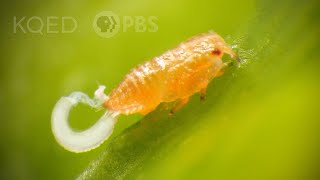
Citrus Psyllids Bribe Ants With Strings Of Candy Poop | Deep Look
Dec 13, 2022
Asian citrus psyllids transmit a disease that can ruin your oranges. Even worse, Argentine ants protect them in exchange for the psyllids' delicate ribbons of sugary poop, called honeydew. So, researchers are helping orange growers fight back with invisible lasers, ghastly wasps and more trickery. SUBSCRIBE to Deep Look! https://www.youtube.com/user/kqeddeeplook?sub_confirmation=1 Please join our community on Patreon! https://www.patreon.com/deeplook DEEP LOOK is a ultra-HD (4K) short video series created by KQED San Francisco and presented by PBS Digital Studios. See the unseen at the very edge of our visible world. Explore big scientific mysteries by going incredibly small. --- A tiny insect called the Asian citrus psyllid is threatening your oranges, lemons and limes. Smaller than a grain of rice, the agricultural pest sucks the sap from citrus trees and in doing so spreads a disease that ruins the fruit and eventually kills the citrus trees. “It's pretty straightforward to tell if you have an Asian citrus psyllid infestation in your citrus,” says Mark Hoddle, who leads a laboratory at UC Riverside that studies the pest and how to beat it. “Just check the tender young green leaves at the tips of the branches. If you see the white curly cues, the insect poop dripping off of those leaves, that's almost certainly a characteristic symptom of an Asian citrus psyllid infestation.” Hoddle’s team is studying novel ways to keep psyllids out of citrus orchards, but that task is complicated by the psyllid’s relationship with another insect, the Argentine ant. “Their relationship is rather sinister,” says Hoddle. “The Argentine ants harvest the honey dew that the Asian citrus psyllid nymphs excrete because it's nice and sugary and the ants love eating sugar. In return for providing that sweet delicacy, the ants protect the Asian citrus psyllids from their natural enemies like the predators and the parasitic wasps that we have introduced from Pakistan.” “The psyllids need protection from the ants because they lack defense systems,” says Hoddle. “They have recruited mercenaries to protect them.” So to protect the valuable citrus industry, Hoddle and his team are going after the psyllids’ ant bodyguards. -- --- What is the Asian citrus psyllid? The Asian citrus psyllid (Diaphorina citri) is a tiny insect, smaller than a grain of rice, that can spread a plant disease called citrus greening. The agricultural pest sucks the sap of citrus trees and produces strings of sugary poop. ---What is citrus greening? Also called huánglóngbìng or HLB, citrus greening is a disease caused by a bacterial infection that causes green bitter fruit and eventually kills citrus trees. Asian citrus psyllids transmit the disease when they feed on citrus trees. --- What does citrus greening look like? Citrus greening often causes patches of leaves to turn a blotchy yellow and fruit that is green and bitter. These yellow patches are typically asymmetric, which helps tell it apart from other issues like nutrient deficiencies. Trees eventually lose their leaves, stop producing fruit and die. ---+ Find additional resources and a transcript on KQED Science: https://www.kqed.org/science/1980896/citrus-psyllids-bribe-ants-with-strings-of-candy-poop ---+ For more information: Hoddle lab at UC Riverside https://biocontrol.ucr.edu/asian-citrus-psyllid ---+ Shoutout! 🏆Congratulations🏆 to these fans on our Community Tab for tackling our GIF challenge! All 3 answers:「Formula Zero EX」 2 out of 3: Hyperion Muhammad Haziq Hilmi 1012 Preet Budhwani hussain e IncoherentBabbler ---+ Thank you to our Top Patreon Supporters ($10+ per month)! Burt Humburg Karen Reynolds Companion Cube Allison & Maka Masuda Daisuke Goto David Deshpande Chris B Emrick Tianxing Wang Wade Tregaskis Mark Jobes Blanca Vides Kevin Judge Laurel Przybylski monoirre Supernovabetty Roberta K Wright Titania Juang Syniurge El Samuels KW Carrie Mukaida Nicky Orino Jellyman Cristen Rasmussen Mehdi Kelly Hong Cindy McGill SueEllen McCann Shelley Pearson Cranshaw Laurel Przybylski Nicolette Ray Noreen Herrington Louis O'Neill Caitlin McDonough Elizabeth Ann Ditz Jeremiah Sullivan Delphine Tseng Levi Cai TierZoo ---+ Follow Deep Look and KQED Science on social: https://www.tiktok.com/@deeplookofficial https://www.patreon.com/deeplook Instagram: https://www.instagram.com/kqedscience/ Twitter: https://www.twitter.com/kqedscience ---+ About KQED KQED, an NPR and PBS affiliate in San Francisco, CA, serves Northern California and beyond with a public-supported alternative to commercial TV, Radio and web media. Funding for Deep Look is provided in part by PBS Digital Studios. Deep Look is a project of KQED Science, the largest science and environment reporting unit in California. KQED Science is supported by the Dirk and Charlene Kabcenell Foundation, Campaign 21 and the members of KQED. #citruspsyllid