
Oksana Kovalenko
Language-learning writer · Published May 22, 2026
How to Learn English Effectively: The Science of Languages Without the Marketing
You downloaded three apps, finished half a textbook, watched a few YouTube videos, and a year later you can still barely follow a normal podcast. The problem is not effort. The problem is that most advice about learning English ignores forty years of research on how humans actually acquire languages.
Why Method Matters More Than Hours
Two learners can spend the same number of hours studying English and end up at completely different levels. The one who reads novels and listens to podcasts daily will outpace the one who grinds flashcards and grammar drills, even with less time invested. The reason is not motivation. It is method.
The research on language acquisition has consolidated around a few principles. They are not secrets and they are not new. They are also not what most apps and courses sell, because the real principles are slow, boring, and free.
Spaced Repetition

Spaced repetition is the single most-evidence-backed technique for vocabulary learning. The basic idea: review a word right before you would have forgotten it. Each successful review extends the next interval. Words you nearly forget get scheduled again soon. Words you remember easily move further out.
This is what apps like Anki, SuperMemo, and most flashcard tools implement. It is also what tap-to-translate workflows naturally produce when paired with a memory system: each word you tap appears again before it fades, then again less often, then occasionally for the rest of your life.
What spaced repetition is good at:
- Cementing vocabulary you have already met
- Holding onto words you would otherwise forget
- Building large word banks efficiently
What spaced repetition is bad at:
- Teaching new vocabulary in isolation (cards work as reminders, not introductions)
- Producing fluent speech (memorizing 5,000 cards does not make you fluent)
- Teaching grammar in context
The right way to use spaced repetition: pair it with input. Meet a word inside a real podcast or book, add it to a card with the original sentence, review it spaced. The card becomes a hook back into the context where you first met it.
Comprehensible Input (Krashen)
Stephen Krashen is a linguist whose research on second-language acquisition shaped most modern approaches. His key idea is the Input Hypothesis: you acquire a language by understanding input that is just above your current level. He calls this “i+1,” where “i” is your current ability and “+1” is the slight stretch.
What this means in practice:
- Reading and listening matter more than speaking and writing for acquisition. Output reinforces what you already know. Input introduces new structures and vocabulary.
- Your input should be 80-95% comprehensible. Below that, you struggle and absorb nothing. Above that, you are not learning, you are reviewing.
- The unconscious does most of the work. You are not memorizing rules. You are absorbing patterns through repeated exposure.
Krashen’s framework also includes a sharp claim: explicit grammar study, in his view, produces “learning” but not “acquisition.” You can know a rule and still produce the wrong sentence under time pressure. Real fluency comes from input, not from memorized rules.
Many linguists disagree with the strong version of this claim, but the input-heavy approach has held up in dozens of studies. For most learners, the bottleneck is not grammar knowledge. It is input volume.
Input Before Output
A practical corollary: you cannot speak fluently before you can listen fluently. You cannot write well before you can read well. Output skills lag input skills by months or years.
This is why courses that push you to “speak from day one” often produce confident but error-ridden speakers who plateau early. Their output exceeds their input, and they stabilize at the level their input can support.
The reverse approach: load up on input for the first 6-12 months, with light output, and your speaking will arrive later but more solid. The “silent period” that some learners go through is normal and healthy. Babies don’t speak until they have heard a year of language. Adults can compress this, but the principle holds.
Concretely, for a B1 learner aiming at B2:
- 70% of your time: reading and listening to real content (podcasts, novels, YouTube)
- 20%: vocabulary work and writing
- 10%: speaking practice
For a B2 learner aiming at C1, you can shift toward more output because your input bank is bigger.
The Plateau Problem

Every learner hits the plateau. It is the part where your daily progress becomes invisible and you start to wonder if you are improving at all.
The plateau is real. It is also predictable. Here is what is happening:
- The vocabulary you do not yet know is increasingly rare. You are no longer meeting “happy” and “tired” but words like “esoteric” and “indispensable.”
- The grammar structures you do not yet know appear only in formal writing or specialized speech.
- Your existing skills are good enough for daily life, so you stop being challenged.
The fix is not “try harder.” The fix is “find harder content.” If you are stuck at B2 and the same beginner podcasts feel easy, switch to a native podcast that is currently too hard. Sit with the discomfort. Tap unfamiliar words. After two weeks, the discomfort becomes manageable. After two months, you are at C1.
The plateau is where most learners give up. It is also where the real fluency happens.
Immersion vs Structured Study
Two camps argue about this constantly. The truth is they are both right, for different stages.
Pure structured study (textbooks, courses, grammar drills)
Works well for A0-A1. You need a basic foundation. Trying to learn English from native podcasts when you know fifty words is a waste of time.
Stops working around B1. The structured approach is too slow once you have the basics. You need volume of input that no textbook can provide.
Pure immersion (only real content, no textbooks)
Works well for B1-C1. Once you have the foundation, immersion drives most of the gains.
Stops working at C1 sometimes. To reach C2, you may need to study formal register, specialized vocabulary, and writing conventions deliberately.
The hybrid that actually works
- A0-A1: 70% structured, 30% input. Build the foundation.
- A2-B1: 50/50. Add real content.
- B1-B2: 30% structured, 70% input. Vocabulary and listening grow fast.
- B2-C1: 10% structured, 90% input. Just consume.
- C1-C2: Structured study returns for specialized purposes (academic writing, formal register).
If you are reading this article, you are probably B1-B2 or beyond, which means input should be 70% or more of your study time.
How Long Does It Actually Take
The honest answer that most apps avoid:
- A0 to A1: 60-100 hours.
- A1 to A2: 100-200 hours.
- A2 to B1: 200-400 hours.
- B1 to B2: 400-600 hours.
- B2 to C1: 600-800 hours.
- C1 to C2: 800-1,000+ hours.
These are rough numbers from FSI and similar institutions. The progression is exponential, not linear.
At 30 minutes a day, B1 to B2 takes about 2.5 years. At an hour a day, around 18 months. At two hours a day (which most working adults cannot sustain), around a year.
You can speed this up with immersion (living in an English-speaking country) by maybe 2-3x. You cannot speed it up to “fluent in 3 months” no matter what TikTok says.
Common Myths Worth Killing
”Learn English while you sleep”
There is no good evidence that playing audio while you sleep produces measurable learning gains. Your brain processes sound but does not encode it into long-term memory the way conscious attention does. The studies showing minor effects measure mostly mood priming, not vocabulary acquisition.
The actual fix: spend the hour you were going to sleep-listen on conscious listening with attention. You will learn 10-100x more.
”Fluent in 30 days”
Possible for languages closely related to your own (Spanish for an Italian speaker, Dutch for a German), and only to A2 or low B1 at best. For most learners from non-related language backgrounds, 30 days is not enough time to make a serious dent.
The apps that promise this are selling the feeling of progress, not the progress itself.
”You’re too old to learn”
The “critical period hypothesis” applies mainly to native-like accents. Adults can absolutely learn languages, often faster than children when measured by hours spent vs progress made. Children win by spending 10+ hours a day immersed for years. Adults can match or beat that pace per hour, but rarely have the hours.
The “I’m too old” excuse is mostly wrong. The actual obstacle is time and motivation, not biology.
”If I just talk a lot, I’ll get fluent”
Talking helps when you have input. Talking without input produces a learner who can produce sentences but cannot understand what comes back. You become fluent at speaking your own broken English, which is not the goal.
”Grammar will fix itself if I just listen”
For some structures, yes. For others (articles, irregular verbs, prepositions), exposure alone often leaves gaps. A targeted grammar review every few months helps lock things in.
”I need a teacher”
Helpful, not required. Native speakers of English become fluent in the language by being born into it, not by being taught. Adults can replicate this with enough comprehensible input and active correction. Tutors are useful for accountability and specific feedback. They are not the bottleneck.
”Apps with streaks will get me to fluency”
Streaks produce engagement, not fluency. Doing ten minutes of an app every day for a year produces a much weaker result than doing 30 minutes of real content reading three times a week. The streak optimizes for the app’s metrics, not your skills.
The Science of Forgetting
Hermann Ebbinghaus’s forgetting curve, from the 1880s, still holds: without review, you forget about 50% of new information in a day and 80% in a week.
This is why one-time exposure to a word does almost nothing. Repeated exposure across days and weeks is what cements memory. Spaced repetition tools exploit this. So does real content where the same vocabulary recycles naturally.
Three implications:
- Review beats novelty. Encountering the same 500 high-frequency words 50 times each is better than encountering 5,000 words once.
- Spacing beats cramming. Twenty minutes a day for ten days beats four hours in one sitting.
- Sleep consolidates. Don’t skip sleep to study. The consolidation happens overnight.
What an Effective Weekly Routine Looks Like
A realistic schedule for a working adult at B1-B2 level, aiming for B2-C1:
Daily (45-60 min)
- 20 min reading a novel or article at your level (just above is fine, with tap-to-translate)
- 20 min listening to a podcast at native speed (with transcript or subtitles available)
- 5-10 min reviewing vocabulary from earlier days
Weekly (1-2 hours total)
- One session of focused grammar work (a chapter from Murphy, or any grammar workbook)
- One short writing exercise (a journal entry, a comment, a forum post)
- One conversation, either with a tutor (italki, Preply) or a language exchange partner (Tandem, Hellotalk)
Monthly
- Track your progress (vocabulary count, comprehension of a benchmark podcast, your speed of reading)
- Adjust difficulty: if your current input is too easy, switch to harder content
This routine produces measurable progress in 2-3 months. The key is consistency, not intensity.
Common Mistakes

- Switching methods every two weeks. Pick one approach and run it for three months before evaluating.
- Watching content that is too easy. Learner content has its place, but if you stay at A2-level podcasts forever, you stay at A2.
- Watching content that is too hard. 50% comprehension is too little to absorb anything. Aim for 80-95%.
- Studying without reviewing. New words you never revisit are wasted.
- Studying without producing. Pure passive intake leaves you with strong listening and weak speaking.
- Producing without input. Pure output produces confident but inaccurate speech.
- Comparing yourself to natives. Natives had 20+ years of full immersion. You don’t.
- Comparing yourself to other learners. You don’t know their history, their daily time, or their starting point. Compare yourself to yourself six months ago.
- Treating English as a project with an endpoint. It is more useful to treat it as a habit. You don’t finish reading or finish working out. You just keep going.
Where Clue Fits In
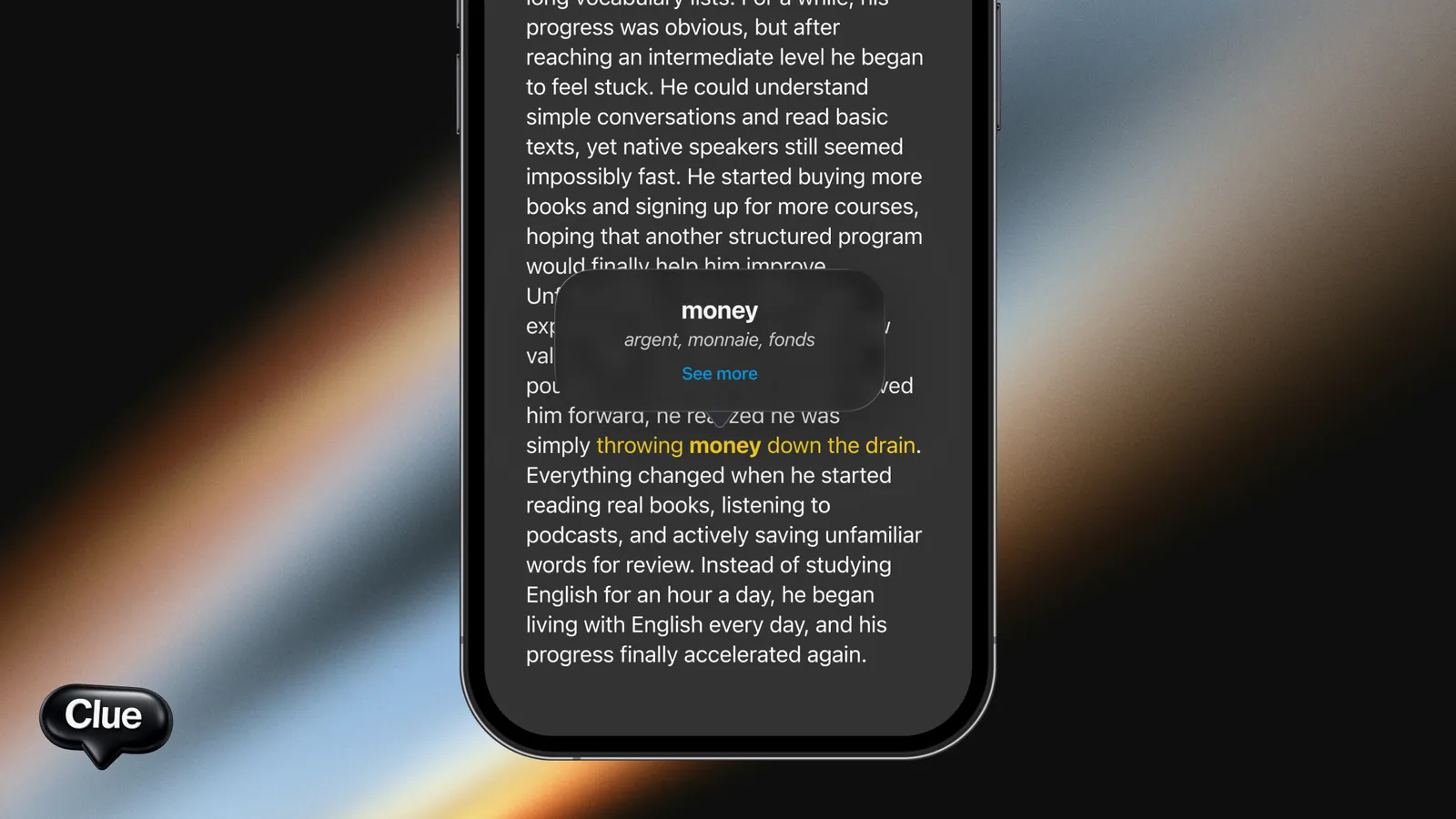
Clue is built around the input-first principle. You consume real content (podcasts, books, YouTube, articles), you tap unfamiliar words, and the words enter a spaced review system in the background. Over months, the words you met in context get reinforced. The ones you do not meet again fade naturally. The ones you meet often stick without effort.
This is the closest we can get to how native speakers actually learn vocabulary: through repeated, contextual exposure. We did not invent the principle. We just built the tool that makes it less friction.
Frequently Asked Questions
What’s the single best thing I can do to improve my English?
For most learners at B1+, the answer is: 30 minutes of real content (podcast or book) every day, with a way to look up words quickly. This single habit, sustained, beats most other interventions.
Is Duolingo enough?
No, especially past A2. Duolingo is a great supplement for streaks and basic vocabulary recycling, but it cannot produce B2+ fluency on its own because it never exposes you to real native content.
How important is a tutor?
Useful but not essential. Tutors provide accountability, feedback, and conversation practice. If you cannot afford one, language exchange apps and online communities give you most of the conversation benefit for free.
Should I learn American or British English?
Whichever you encounter most. If your media diet is mostly American (YouTube, Netflix), default to American. If it is mostly British (BBC, Guardian), default to British. Mixing slightly is fine. Native speakers do not police it.
Will AI tools replace my study routine?
Tools like ChatGPT and Claude are useful for asking questions about grammar, getting writing feedback, and producing examples. They do not replace input. You still need to read books, listen to podcasts, watch videos.
How do I know I’m actually improving?
Three benchmarks: a podcast that was hard six months ago that is now easy. A novel that was slow that is now smooth. A conversation in English that you held without going to translation. If any of those happened recently, you are improving.
What if I lose motivation?
Switch content, not method. If you are bored of learner podcasts, listen to true crime in English. If you are tired of grammar books, read a novel. The method is consistent; the content should change as often as needed.
Is it OK to use my native language while learning English?
Yes, especially early on. Native-language explanations and translations are faster than English-only dictionaries when you are still building. As you progress, lean more on English-only definitions. Don’t make yourself suffer for purity.
Closing
Learning English is not a mystery. It is a routine. Find content you actually want to consume, expose yourself to it daily, review what you meet, accept that the plateau is real, and trust the slow accumulation. Most people who fail to reach fluency do not fail because they were stupid or old or untalented. They fail because they tried six methods in six months and never gave any of them enough time to work. Pick one approach, stick with it for half a year, and you will be in a different place.
Read in other languages
Related articles
- English Phrases for Everyday Situations: What to Actually Say in 10 Common Moments You know the grammar, you know the vocabulary, and then a waiter asks "Are you all set?" and you freeze for two seconds because no one ever taught you…
- Business English: What Actually Matters in Real Work, by an Intermediate Learner's Standards You can hold a conversation in English, you can read a contract slowly, and then you walk into your first international meeting and realize that everyone…
- Learn English in Your Sleep? Debunking Passive Learning Myths and What Actually Works You've seen the ads: "Learn English while you sleep," "Absorb vocabulary passively," "Just listen and the language comes naturally." Some of this is outrig
- English for Portuguese Speakers Learn English from real podcasts, YouTube, and books with one-tap Portuguese translations. Offline dictionary, designed for Brazilian and European Portuguese speakers.