 Open in Clue
 Videos to Learn English 101
-

Protecting Privacy with MATH (Collab with the Census)
Sep 12, 2019
This video was made in collaboration with the US Census Bureau and fact-checked by Census Bureau scientists. Any opinions and errors are my own. For more information, visit https://census.gov/about/policies/privacy/statistical_safeguards.html or search "differential privacy" at http://census.gov. REFERENCES Differential Privacy in the Wild: http://www.vldb.org/pvldb/vol9/p1611-machanavajjhala.pdf Harvard University Privacy Tools Project: https://privacytools.seas.harvard.edu/differential-privacy Simons Institute Workshop Video Recordings and Articles Archive: https://simons.berkeley.edu/workshops/schedule/6281 Cynthia Dwork (key inventor of Differential Privacy), giving a great intro talk about differential privacy: https://www.youtube.com/watch?v=lg-VhHlztqo Shiva P Kasiviswanathan and Adam Smith. On the semantics of differential privacy: A Bayesian formulation. Journal of Privacy and Confidentiality, 6(1):1–16, 2014. Shiva Prasad Kasiviswanathan and Adam Smith. On the ‘semantics’ of differential privacy: A Bayesian formulation. 2015. https://arxiv.org/abs/0803.3946 Daniel Kifer and Ashwin Machanavajjhala. A rigorous and customizable framework for privacy. In ACM Symposium on Principles of Database Systems (PODS), 2012. Daniel Kifer and Ashwin Machanavajjhala. Pufferfish: A framework for mathematical privacy definitions. ACM Trans. Database Syst., 39(1):3, 2014. Support MinutePhysics on Patreon! http://www.patreon.com/minutephysics Link to Patreon Supporters: http://www.minutephysics.com/supporters/ MinutePhysics is on twitter - @minutephysics And facebook - http://facebook.com/minutephysics And Google+ (does anyone use this any more?) - http://bit.ly/qzEwc6 Minute Physics provides an energetic and entertaining view of old and new problems in physics -- all in a minute! Created by Henry Reich
-

How to Build a Lava Moat (with xkcd)
Aug 30, 2019
Where to Buy "How To" by Randall Munroe: · PRH.com: https://bit.ly/2L2G5hy · Amazon: https://bit.ly/2zfy974 · Barnes and Noble: https://bit.ly/2Zozxmt · IndieBound: https://bit.ly/2ZfwSre · Books-A-Million: https://bit.ly/2ZfxD3y · Apple Books: https://bit.ly/33TK3kX The world's most entertaining and useless self-help guide, from the brilliant mind behind the wildly popular webcomic xkcd and the #1 New York Times bestsellers What If? and Thing Explainer For any task you might want to do, there's a right way, a wrong way, and a way so monumentally complex, excessive, and inadvisable that no one would ever try it. How To is a guide to the third kind of approach. It's full of highly impractical advice for everything from landing a plane to digging a hole. Bestselling author and cartoonist Randall Munroe explains how to predict the weather by analyzing the pixels of your Facebook photos. He teaches you how to tell if you're a baby boomer or a 90's kid by measuring the radioactivity of your teeth. He offers tips for taking a selfie with a telescope, crossing a river by boiling it, and powering your house by destroying the fabric of space-time. And if you want to get rid of the book once you're done with it, he walks you through your options for proper disposal, including dissolving it in the ocean, converting it to a vapor, using tectonic plates to subduct it into the Earth's mantle, or launching it into the Sun. By exploring the most complicated ways to do simple tasks, Munroe doesn't just make things difficult for himself and his readers. As he did so brilliantly in What If?, Munroe invites us to explore the most absurd reaches of the possible. Full of clever infographics and amusing illustrations, How To is a delightfully mind-bending way to better understand the science and technology underlying the things we do every day. REFERENCES How To (Randall Munroe) - see above for links! Rock melting points http://hyperphysics.phy-astr.gsu.edu/hbase/Geophys/meltrock.html Syracuse University Researchers Make Lava Using Keweenawan Basalt http://lavaproject.syr.edu/making-lava/making.html BEDROCK GEOLOGY OF WISCONSIN MAP: UNIVERSITY OF WISCONSIN–EXTENSION Geological and Natural History Survey Electric Furnace https://www.amazon.com/Automatic-Electric-Refining-Precious-Aluminum/dp/B07LCKKFWX/ Large Geothermal Power Plants https://www.worldatlas.com/articles/largest-geothermal-power-plants-in-the-world.html https://www.calpine.com/operations/power-operations/our-locations/california/ridge-line Coal Power Plant Capacity https://www.talenenergy.com/plant/colstrip/ The size of an A19 or A21 Lightbulb https://blog.1000bulbs.com/home/a21-vs-a19 Low melting point Vanadate glass https://iopscience.iop.org/article/10.1143/JJAP.50.088002 Support MinutePhysics on Patreon! http://www.patreon.com/minutephysics Link to Patreon Supporters: http://www.minutephysics.com/supporters/ MinutePhysics is on twitter - @minutephysics And facebook - http://facebook.com/minutephysics And Google+ (does anyone use this any more?) - http://bit.ly/qzEwc6 Minute Physics provides an energetic and entertaining view of old and new problems in physics -- all in a minute! Created by Henry Reich
-

Why Some Days Aren’t 24 Hours
Aug 23, 2019
Check out the "What is a Day?" interactive video at https://labs.minutelabs.io/what-is-a-day/ It's super cool!! (and made by Jasper Palfree & the MinuteEarth/MinutePhysics team) The MinutePhysics video about Why December Has the Longest Days: https://www.youtube.com/watch?v=nZMMuv0Ltyo This video is about the length of a solar day vs a stellar day vs a mean standard day, what they all have to do with each other and the earth's orbit, eccentricity, axial tilt, and so on. Also, aliens and asteroids. It'll explain the equation of time, and why the longest day is in December. The lab will also show you what days are like on all the other planets - Mercury, Venus, Mars, Jupiter, Saturn, Uranus, Neptune, and even - though it's not a planet - Pluto. Support MinutePhysics on Patreon! http://www.patreon.com/minutephysics Link to Patreon Supporters: http://www.minutephysics.com/supporters/ MinutePhysics is on twitter - @minutephysics And facebook - http://facebook.com/minutephysics And Google+ (does anyone use this any more?) - http://bit.ly/qzEwc6 Minute Physics provides an energetic and entertaining view of old and new problems in physics -- all in a minute! Created by Henry Reich
-

Einstein's Biggest Blunder, Explained
Aug 1, 2019
Thanks to Brilliant for supporting MinutePhysics. Get 20% off a premium subscription at https://brilliant.org/MinutePhysics/ This video is about how Albert Einstein made a mistake when applying the Field Equations of General Relativity to cosmology (in particular, to a static, constant density universe), and solved the problem by introducing the cosmological constant, rather than allowing for a dynamic universe with a scale factor - that is, the Friedmann-Lemaitre-Robertson-Walker universe, first developed by Alexander Friedmann of Russia. Later, it was discovered by the Slipher and Hubble red-shift that the universe is indeed expanding, and even later, by Schwarz and company in 1998, that the expansion is accelerating - aka, dark energy. And the cosmological constant was re-introduced. Thanks to Grant Sanderson of http://www.youtube.com/3Blue1Brown for help with the fancy equation animation! REFERENCES The Einstein Field Equations https://en.wikipedia.org/wiki/Einstein_field_equations Interrogating the Legend of Einstein’s “Biggest Blunder” https://arxiv.org/abs/1804.06768 On the General Theory of Relativity (Einstein) https://einsteinpapers.press.princeton.edu/vol6-trans/110 The Foundation of the General Theory of Relativity (Albert Einstein) https://einsteinpapers.press.princeton.edu/vol6-trans/158 Cosmological Considerations in the General Theory of Relativity https://einsteinpapers.press.princeton.edu/vol6-trans/433 Einstein Wrongly Criticizes Alexander Friedmann https://einsteinpapers.press.princeton.edu/vol13-trans/301 Alexander Friedmann Corrects Einstein https://einsteinpapers.press.princeton.edu/vol13-trans/363 Einstein Admits his Mathematical Mistake https://einsteinpapers.press.princeton.edu/vol14-trans/77 The Field Equations of Gravitation https://einsteinpapers.press.princeton.edu/vol6-trans/129 George Gamow https://en.wikipedia.org/wiki/George_Gamow Mach’s Principle https://en.wikipedia.org/wiki/Mach%27s_principle Equivalence Principle https://en.wikipedia.org/wiki/Equivalence_principle Sean Carroll and William Press Paper https://preposterousuniverse.com/wp-content/uploads/cpt92.pdf Support MinutePhysics on Patreon! http://www.patreon.com/minutephysics Link to Patreon Supporters: http://www.minutephysics.com/supporters/ MinutePhysics is on twitter - @minutephysics And facebook - http://facebook.com/minutephysics And Google+ (does anyone use this any more?) - http://bit.ly/qzEwc6 Minute Physics provides an energetic and entertaining view of old and new problems in physics -- all in a minute! Created by Henry Reich
-
The Portal Paradox
Jun 28, 2019
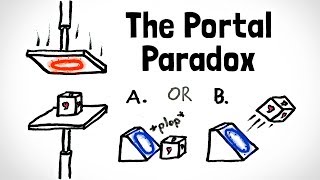
Go to https://nebula.tv/minutephysics to get access to Nebula, plus you'll get a 20% discount on an annual subscription. This video is about the Portal Paradox - a paradox in the video game Portal (and Portal 2) regarding whether or not a companion cube passing through a moving portal plops out of the other end with no speed (velocity, momentum), or shoots out at high speed. It’s a question of conservation of momentum, relativity of velocities, wormholes, 3D printers and quantum teleportation, glitches, and more. REFERENCES Conservation of momentum https://en.wikipedia.org/wiki/Momentum#Conservation_in_a_continuum Principle of Locality https://en.wikipedia.org/wiki/Principle_of_locality YouTube video of testing the Portal 2 game engine on the portal Paradox https://youtu.be/S85nudR6D-Y Tutorial for how to program the Portal portals on your own: https://www.gamasutra.com/view/feature/132164/games_demystified_portal.php Support MinutePhysics on Patreon! http://www.patreon.com/minutephysics Link to Patreon Supporters: http://www.minutephysics.com/supporters/ MinutePhysics is on twitter - @minutephysics And facebook - http://facebook.com/minutephysics And Google+ (does anyone use this any more?) - http://bit.ly/qzEwc6 Minute Physics provides an energetic and entertaining view of old and new problems in physics -- all in a minute! Created by Henry Reich
-
Our Ignorance About Gravity
Jun 20, 2019
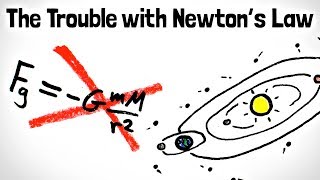
Thanks to the Heising Simons Foundation (https://www.hsfoundation.org/) for their support of this video, and of short range gravity research. This video is about how little we know about the behavior of gravity at short length and distance scales, what the constraints are on the inverse square law/Newton's law of universal gravitation, at the human and microscopic and atomic scales. Only on solar system scales or larger do we have good constraints on Newton's law of gravitation. REFERENCES Review of short-range gravity experiments in the LHC era https://arxiv.org/abs/1408.3588v2 Zeptonewton force sensing with nanospheres in an optical lattice https://arxiv.org/abs/1603.02122 Large extra dimensions https://en.wikipedia.org/wiki/Large_extra_dimension Search for Screened Interactions Associated with Dark Energy Below the 100 μm Length Scale https://arxiv.org/abs/1604.04908 Tests of the Gravitational Inverse-Square Law below the Dark-Energy Length Scale https://arxiv.org/abs/hep-ph/0611184v1 Photon Mass Experiment http://dx.doi.org/10.1119/1.13149 Torsion balance experiments: A low-energy frontier of particle physics E.G. Adelberger, J.H. Gundlach, B.R. Heckel, S. Hoedl, S. Schlamminger doi:10.1016/j.ppnp.2008.08.002 TESTS OF THE GRAVITATIONAL INVERSE-SQUARE LAW E.G. Adelberger, B.R. Heckel, and A.E. Nelson Annu. Rev. Nucl. Part. Sci. 2003. 53:77–121 doi: 10.1146/annurev.nucl.53.041002.110503 Physical Review A, Vol 33, No 1: Improved result for the accuracy of Coulomb's law: A review of the Williams, Faller, and Hill experiment. Lewis P. Fulcher. Support MinutePhysics on Patreon! http://www.patreon.com/minutephysics Link to Patreon Supporters: http://www.minutephysics.com/supporters/ MinutePhysics is on twitter - @minutephysics And facebook - http://facebook.com/minutephysics And Google+ (does anyone use this any more?) - http://bit.ly/qzEwc6 Minute Physics provides an energetic and entertaining view of old and new problems in physics -- all in a minute! Created by Henry Reich
-

I Had to Build a Custom Mute Switch for my Violin
Jun 4, 2019
Thanks to Brilliant for supporting this video! The first 200 people to go to https://brilliant.org/MinutePhysics will get 20% off a premium subscription to Brilliant. Support MinutePhysics on Patreon! http://www.patreon.com/minutephysics This video is about how I designed and made my own custom mute guitar pedal for my clip-on mic and piezo pickup on my violin (fiddle). The mic is an AT Pro35 phantom powered XLR condensor microphone, and the pickup is a Fishman V200 piezoelectric transducer. I got all of the parts from PartsExpress. Thanks to my band (https://www.youtube.com/channel/UCEKRoVVSZKGih6v_xK4LAdw), Caleb, Pete, Paul and Troy, and to Hannah for filming. Link to Patreon Supporters: http://www.minutephysics.com/supporters/ REFERENCES: Gearslutz mute wiring for phantom powered vs dynamic/line-level microphones: https://www.gearslutz.com/board/geekslutz-forum/813680-how-wire-external-xlr-off-switch-pedal.html Beavis Audio Research: http://beavisaudio.com/techpages/ Pickups on wikipedia: https://en.wikipedia.org/wiki/Pickup_%28music_technology%29 Microphone mute pedal on “I like to make stuff” https://iliketomakestuff.com/make-microphone-mute-pedal/ Balanced vs unbalanced audio: http://www.aviom.com/blog/balanced-vs-unbalanced/ Balanced signals on wikipedia: https://en.wikipedia.org/wiki/Balanced_audio Phantom Power: http://acousticguitar.com/everything-you-need-to-know-about-microphone-phantom-power/ Phantom Power explained on Sweetwater: https://www.sweetwater.com/insync/how-phantom-power-works/ Piezoelectricity: https://en.wikipedia.org/wiki/Piezoelectricity#Mechanism MinutePhysics is on twitter - @minutephysics And facebook - http://facebook.com/minutephysics And Google+ (does anyone use this any more?) - http://bit.ly/qzEwc6 Minute Physics provides an energetic and entertaining view of old and new problems in physics -- all in a minute! Created by Henry Reich
-
How Shor's Algorithm Factors 314191
May 22, 2019
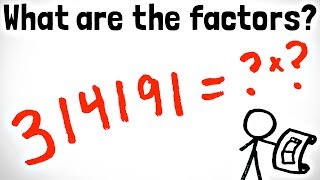
Go to http://www.dashlane.com/minutephysics to download Dashlane for free, and use offer code minutephysics for 10% off Dashlane Premium! Watch the main video: https://www.youtube.com/watch?v=lvTqbM5Dq4Q Support MinutePhysics on Patreon! http://www.patreon.com/minutephysics This video explains how Shor’s Algorithm factors the pseudoprime number 314191 into its prime factors using a quantum computer. The quantum computation relies on the number-theoretic analysis of the factoring problem via modular arithmetic mod N (where N is the number to be factored), and finding the order or period of a random coprime number mod N. The exponential speedup comes in part from the use of the quantum fast fourier transform which achieves interference among frequencies that are not related to the period (period-finding is the goal of the QFT FFT). REFERENCES RSA Numbers (sample large numbers to try factoring) https://en.wikipedia.org/wiki/RSA_numbers IBM on RSA https://www.ibm.com/support/knowledgecenter/en/SSB23S1.1.0.13/gtps7/s7pkey.html Modulo Multiplication Group Tables http://mathworld.wolfram.com/ModuloMultiplicationGroup.html Difference of squares factorization https://en.wikipedia.org/wiki/Difference_of_two_squares Euclid’s Algorithm https://en.wikipedia.org/wiki/Euclideanalgorithm Rational sieve for factoring https://en.wikipedia.org/wiki/Rational_sieve General Number field Sieve https://en.wikipedia.org/wiki/Generalnumberfieldsieve Scott Aaronson blog post about Shor’s Algorithm https://www.scottaaronson.com/blog/?p=208 Experimental implementation of Shor’s Algorithm (factoring 15, 21, and 35) https://arxiv.org/pdf/1903.00768.pdf Adiabatic Quantum Computation factoring the number 291311 https://arxiv.org/pdf/1706.08061.pdf Scott Aaronson course notes https://www.scottaaronson.com/qclec/ https://www.scottaaronson.com/qclec/combined.pdf Shor’s Algorithm on Quantiki https://www.quantiki.org/wiki/shors-factoring-algorithm TLS And SSL use RSA encryption https://en.wikipedia.org/wiki/TransportLayerSecurity Dashlane security whitepaper https://www.dashlane.com/download/DashlaneSecurityWhitePaperOctober2018.pdf Link to Patreon Supporters: http://www.minutephysics.com/supporters/ MinutePhysics is on twitter - @minutephysics And facebook - http://facebook.com/minutephysics Minute Physics provides an energetic and entertaining view of old and new problems in physics -- all in a minute! Created by Henry Reich
-

How Quantum Computers Break Encryption | Shor's Algorithm Explained
May 1, 2019
Go to http://www.dashlane.com/minutephysics to download Dashlane for free, and use offer code minutephysics for 10% off Dashlane Premium! Support MinutePhysics on Patreon! http://www.patreon.com/minutephysics This video explains Shor’s Algorithm, a way to efficiently factor large pseudoprime integers into their prime factors using a quantum computer. The quantum computation relies on the number-theoretic analysis of the factoring problem via modular arithmetic mod N (where N is the number to be factored), and finding the order or period of a random coprime number mod N. The exponential speedup comes in part from the use of the quantum fast fourier transform which achieves interference among frequencies that are not related to the period (period-finding is the goal of the QFT FFT). REFERENCES RSA Numbers (sample large numbers to try factoring) https://en.wikipedia.org/wiki/RSA_numbers IBM on RSA https://www.ibm.com/support/knowledgecenter/en/SSB23S1.1.0.13/gtps7/s7pkey.html Modulo Multiplication Group Tables http://mathworld.wolfram.com/ModuloMultiplicationGroup.html Difference of squares factorization https://en.wikipedia.org/wiki/Difference_of_two_squares Euclid’s Algorithm https://en.wikipedia.org/wiki/Euclideanalgorithm Rational sieve for factoring https://en.wikipedia.org/wiki/Rational_sieve General Number field Sieve https://en.wikipedia.org/wiki/Generalnumberfieldsieve Scott Aaronson blog post about Shor’s Algorithm https://www.scottaaronson.com/blog/?p=208 Experimental implementation of Shor’s Algorithm (factoring 15, 21, and 35) https://arxiv.org/pdf/1903.00768.pdf Adiabatic Quantum Computation factoring the number 291311 https://arxiv.org/pdf/1706.08061.pdf Scott Aaronson course notes https://www.scottaaronson.com/qclec/ https://www.scottaaronson.com/qclec/combined.pdf Shor’s Algorithm on Quantiki https://www.quantiki.org/wiki/shors-factoring-algorithm TLS And SSL use RSA encryption https://en.wikipedia.org/wiki/TransportLayerSecurity Dashlane security whitepaper https://www.dashlane.com/download/DashlaneSecurityWhitePaperOctober2018.pdf Link to Patreon Supporters: http://www.minutephysics.com/supporters/ MinutePhysics is on twitter - @minutephysics And facebook - http://facebook.com/minutephysics Minute Physics provides an energetic and entertaining view of old and new problems in physics -- all in a minute! Created by Henry Reich
-

Why Do Compressed Air Cans Get Cold?
Apr 3, 2019
Thanks to http://brilliant.org/minutephysics for supporting MinutePhysics - get 20% a premium subscription at http://brilliant.org/minutephysics Support MinutePhysics on Patreon! http://www.patreon.com/minutephysics Link to Patreon Supporters: http://www.minutephysics.com/supporters/ This video is about compressed air cans (aka gas dusters) and why they get cold when you spray them. They cool off because the refrigerant inside (1,1-difluoroethane) is under pressure and boils off when the pressure lowers, and energy lost to the latent heat of vaporization cools the can a lot. Difluoroethane normally boils at -25°C (-13°F), but under ~6 atm (6 bar, 600 kpa) it is a liquid at room temperature. The gas also cools off slightly due to the Joule-Thompson effect of fluid expansion through a throttled valve. Difluoroethane is heavier than air and water soluble, so it is recommended to use it in a ventilated environment to clean your keyboard, etc. Also, 1,1-difluoroethane is a potent greenhouse gas. It is also known as Freon 152a, Ethylidene difluoride, Ethylidene fluoride, HFC-152a, R-152a, and DFE. Thanks to Tino and Hannah! REFERENCES CRC Air Duster Safety Data Sheet http://docs.crcindustries.com/msds/5185.pdf Latent Heat of vaporization https://en.wikipedia.org/wiki/Latentheat 1,1-difluoroethane chemical and physical properties https://webbook.nist.gov/cgi/cbook.cgi?ID=C75376&Mask=3FFF 1,1-difluoroethane on wikipedia https://en.wikipedia.org/wiki/1,1-Difluoroethane Free Expansion of Real Gases, Goussard, 1993 http://dx.doi.org/10.1119/1.17417 Joule-Thompson Expansion Course Notes http://tccc.iesl.forth.gr/education/local/Labs-PC-II/JT.pdf Properties of 1,1-difluoroethane http://www.inchem.org/documents/sids/sids/75376.pdf https://pubchem.ncbi.nlm.nih.gov/compound/11-difluoroethane Medical Effects of difluoroethane https://toxnet.nlm.nih.gov/cgi-bin/sis/search/a?dbs+hsdb:@term+@DOCNO+5205 MinutePhysics is on twitter - @minutephysics And facebook - http://facebook.com/minutephysics And Google+ (does anyone use this any more?) - http://bit.ly/qzEwc6 Minute Physics provides an energetic and entertaining view of old and new problems in physics -- all in a minute! Created by Henry Reich
-

How ISPs Violate the Laws of Mathematics
Mar 1, 2019
Get a free trial of Audible at https://audible.com/minutephysics or by texting 'minutephysics' to 500500 Support MinutePhysics on Patreon! http://www.patreon.com/minutephysics Link to Patreon Supporters: http://www.minutephysics.com/supporters/ MinutePhysics is on twitter - @minutephysics And facebook - http://facebook.com/minutephysics This joke video is about how Internet Service Providers (aka ISPs, internet companies, telecommunications companies, etc) violate the basic axioms of Zermelo-Fraenkel set theory. Like the axiom of choice (sometimes Well-ordering theorem), the Axiom of extensionality, Axiom of regularity (also called the Axiom of foundation), Axiom schema of specification, Axiom of pairing, Axiom of union, Axiom schema of replacement, Axiom of infinity, Axiom of power set. Minute Physics provides an energetic and entertaining view of old and new problems in physics -- all in a minute! Created by Henry Reich
-

Shells of Cosmic Time (ft. @AstroKatie)
Feb 7, 2019
Thanks to @AstroKatie (http://astrokatie.com, http://twitter.com/astrokatie) for the collaboration! Go to http://www.brilliant.org/minutephysics for free daily science puzzles Here's the original twitter thread https://twitter.com/astrokatie/status/1066526148149108736 Support MinutePhysics on Patreon! http://www.patreon.com/minutephysics Link to Patreon Supporters: http://www.minutephysics.com/supporters/ This video is about the cosmic distance scale and how we see objects farther away in space (ie at higher red shift) farther back in time because light takes time to reach us. Thus we can see not only stars and galaxies, but also the primordial stars & proto-galaxies, and even the remnants of the beginning of the universe itself: the CMB cosmic microwave background left over from the big bang. MinutePhysics is on twitter - @minutephysics And facebook - http://facebook.com/minutephysics Minute Physics provides an energetic and entertaining view of old and new problems in physics -- all in a minute! Created by Henry Reich
-

How To Make MUONS
Jan 24, 2019
To keep your brain sharp with quick daily math & science puzzles, head to http://www.brilliant.org/minutephysics This video is about how to create muons in a particle accelerator via bombardment of heavy nuclei with protons, which results in creation of charged pions (plus and minus). The pions then decay into muons and mu neutrinos, and the muons then decay into electrons or positrons and more neutrinos. Muons also form in the upper atmosphere due to cosmic rays, and the uses of muons includes experimental tests of time dilation in special relativity, catalyzing muonic cold nuclear fusion, and more. Muons on wikipedia: https://en.wikipedia.org/wiki/Muon Support MinutePhysics on Patreon! http://www.patreon.com/minutephysics Link to Patreon Supporters: http://www.minutephysics.com/supporters/ MinutePhysics is on twitter - @minutephysics And facebook - http://facebook.com/minutephysics And Google+ (does anyone use this any more?) - http://bit.ly/qzEwc6 Minute Physics provides an energetic and entertaining view of old and new problems in physics -- all in a minute! Created by Henry Reich
-
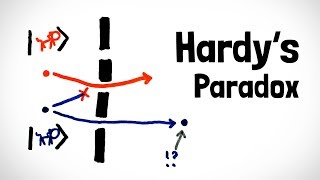
Hardy's Paradox | Quantum Double Double Slit Experiment
Dec 21, 2018
Need a last minute holiday gift idea? Go to https://www.brilliant.org/minutephysics for 20% off a premium subscription to Brilliant (can be given as a gift). Support MinutePhysics on Patreon! http://www.patreon.com/minutephysics Link to Patreon Supporters: http://www.minutephysics.com/supporters/ MinutePhysics is on twitter - @minutephysics And facebook - http://facebook.com/minutephysics And Google+ (does anyone use this any more?) - http://bit.ly/qzEwc6 This video is about Hardy's Paradox, wherein an electron and positron (or photons polarized horizontally and vertically) pass through Mach-Zehnder interferometers that overlap such that the particles have a chance of annihilating. If they do annihilate, then the interference pattern changes and there is a probability for both particles to be detected in the "dark arms" of the detector, that is, where previously there was no probability for detection for either particle. The paradox has implications for local realism, contextuality, lorentz elements of reality, and has been used as an experimental setup for weak measurements. Minute Physics provides an energetic and entertaining view of old and new problems in physics -- all in a minute! Created by Henry Reich
-
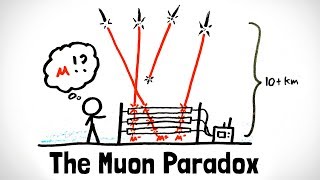
Impossible Muons
Nov 13, 2018
Thanks to Brilliant.org for supporting MinutePhysics! The first 200 people who go to http://www.brilliant.org/minutephysics will get 20% off a Premium Subscription to Brilliant. This video is about how terrestrial muons are part of our experimental proof of time dilation, length contraction, and special relativity in general. REFERENCES Cosmic Rays https://en.wikipedia.org/wiki/Cosmic_ray Terrestrial Cosmic Rays http://people.physics.tamu.edu/wwu/docs/P225/P225_Project_terrestrial%20cosmic%20rays.pdf Cosmic Ray Interaction Depth & Muon Production Altitude http://cosmic.lbl.gov/SKliewer/Cosmic_Rays/Interaction.htm Cosmic rays are stronger at the poles http://www.antarcticglaciers.org/glacial-geology/dating-glacial-sediments-2/cosmic-rays/ Cosmic Rays on Hyperphysics http://hyperphysics.phy-astr.gsu.edu/hbase/Astro/cosmic.html Exponential decay and mean lifetime https://en.wikipedia.org/wiki/Exponential_decay#Mean_lifetime Support MinutePhysics on Patreon! http://www.patreon.com/minutephysics Link to Patreon Supporters: http://www.minutephysics.com/supporters/ MinutePhysics is on twitter - @minutephysics And facebook - http://facebook.com/minutephysics And Google+ (does anyone use this any more?) - http://bit.ly/qzEwc6 Minute Physics provides an energetic and entertaining view of old and new problems in physics -- all in a minute! Created by Henry Reich
-

Legitimate Cold Fusion Exists | Muon-Catalyzed Fusion
Oct 26, 2018
Thanks to Brilliant.org for supporting MinutePhysics - the first 200 people to go to http://www.brilliant.org/minutephysics will get 20% off of a premium subscription to all of Brilliant's courses and puzzles. Support MinutePhysics on Patreon! http://www.patreon.com/minutephysics Link to Patreon Supporters: http://www.minutephysics.com/supporters/ This video is about the original cold fusion: μ muon-catalyzed cold fusion of deuterium, tritium, hydrogen, into helium-3 and helium 4. The problems with it are the half-life of muons and the sticking of muons to alpha particles. Also involved are neutrons, protons, break-even, etc. This has nothing to do with fusion by capture in palladium electrodes. REFERENCES: The original papers: L.W. Alvarez 1957, F.C. Frank 1947, and J.D. Jackson 1957 A History of Muon Catalyzed “Cold” Fusion http://large.stanford.edu/courses/2016/ph241/yoon1/ Fusion rates http://www.kayelaby.npl.co.uk/atomic_and_nuclear_physics/4_7/4_7_4.html Cold Fusion https://en.wikipedia.org/wiki/Cold_fusion#Proposed_mechanisms Muon Facilitated Fusion https://en.wikipedia.org/wiki/Muon-catalyzed_fusion MinutePhysics is on twitter - @minutephysics And facebook - http://facebook.com/minutephysics And Google+ (does anyone use this any more?) - http://bit.ly/qzEwc6 Minute Physics provides an energetic and entertaining view of old and new problems in physics -- all in a minute! Created by Henry Reich
-

How To Stop Structures from SHAKING: LEGO Saturn V Tuned Mass Damper
Aug 28, 2018
Thanks to LEGO for sponsoring this video. Find your own LEGOs at https://shop.lego.com/?cmp=SOC-OneMinutePhysics or https://shop.lego.com/product?p=21309&cmp=SOC-OneMinutePhysics This video is about Tuned Mass Dampers, which can be used to reduce or avoid unwanted vibrations, swaying, swinging, bending, etc on engineered structures ranging from buildings, skyscrapers, electricity power transmission lines, airplane engines, formula one race cars, etc. TMD's use damped coupled oscillators. REFERENCES Taipei Tower TMD Photo licensed from: Louie Psihoyos http://www.psihoyos.com Coupled oscillators: http://www.reed.edu/physics/faculty/wheeler/documents/Sophmore%20Class%20Notes%202007/Chapter%204.pdf Related things: https://en.wikipedia.org/wiki/Stockbridge_damper Applications: https://en.wikipedia.org/wiki/Tuned_mass_damper#Mass_dampers_in_automobiles Formula 1 cars: http://www.formula1-dictionary.net/mass_damper.html Aircraft engines: https://en.wikipedia.org/wiki/Centrifugal_pendulum_absorber Audio speaker cones: https://www.focal.com/en/tmd-tuned-mass-damper Support MinutePhysics on Patreon! http://www.patreon.com/minutephysics Link to Patreon Supporters: http://www.minutephysics.com/supporters/ MinutePhysics is on twitter - @minutephysics And facebook - http://facebook.com/minutephysics And Google+ (does anyone use this any more?) - http://bit.ly/qzEwc6 Minute Physics provides an energetic and entertaining view of old and new problems in physics -- all in a minute! Created by Henry Reich
-
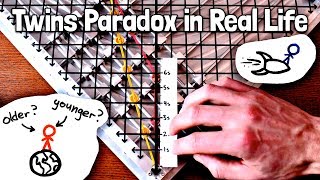
The Twins Paradox Hands-On Explanation | Special Relativity Ch. 8
Aug 14, 2018
Go to http://brilliant.org/MinutePhysics for 20% off a premium subscription to Brilliant! Mark Rober's youtube channel: https://www.youtube.com/markrober This video is chapter 8 in my series on special relativity, and it presents a hands-on explanation of the resolution to the Twins Paradox using the mechanical minkowski diagram, aka mechanical Lorentz transformation, aka spacetime globe. Of course, the Twins paradox can be resolved with an understanding of spacetime intervals, relative inertial frames of reference, etc, but this is a nice hands-on version where you actually measure the proper times on a real, physical spacetime diagram with a ruler. Support MinutePhysics on Patreon! http://www.patreon.com/minutephysics Link to Patreon Supporters: http://www.minutephysics.com/supporters/ MinutePhysics is on twitter - @minutephysics And facebook - http://facebook.com/minutephysics And Google+ (does anyone use this any more?) - http://bit.ly/qzEwc6 Minute Physics provides an energetic and entertaining view of old and new problems in physics -- all in a minute! Created by Henry Reich
-

The Physics of Caramel: How To Make a Caramelized Sugar Cube
Jul 24, 2018
Watch the original video in Spanish here: https://www.youtube.com/watch?v=J2Vkv5GQXww This video is about how the physics and chemistry of sugar (in particular, how it melts, and how it caramelizes) is more complicated than you might think. It involves fructose, sucrose, glucose, and a sticky mess. Credits: Gallium melting footage by WorkshopScience https://www.youtube.com/watch?v=jow4idr6HNs Chill Day by LAKEY INSPIRED https://soundcloud.com/lakeyinspired Support MinutePhysics on Patreon! http://www.patreon.com/minutephysics Link to Patreon Supporters: http://www.minutephysics.com/supporters/ MinutePhysics is on twitter - @minutephysics And facebook - http://facebook.com/minutephysics And Google+ (does anyone use this any more?) - http://bit.ly/qzEwc6 Minute Physics provides an energetic and entertaining view of old and new problems in physics -- all in a minute! Created by Henry Reich
-

Feynman's Lost Lecture (ft. 3Blue1Brown)
Jul 20, 2018
Check out Grant’s channel: 3blue1brown: https://www.youtube.com/3blue1brown This video recounts a lecture by Richard Feynman giving an elementary demonstration of why planets orbit in ellipses. See the excellent book by Judith and David Goodstein, "Feynman's lost lecture”, for the full story behind this lecture, and a deeper dive into its content. Tweet referenced at the start: https://twitter.com/3blue1brown/status/1016936129117937664 Music by Nathaniel Schroeder: https://soundcloud.com/drschroeder/elizabeth-the-mouse Music by Vincent Rubinetti: https://soundcloud.com/vincerubinetti/one-two-zeta Support MinutePhysics on Patreon! http://www.patreon.com/minutephysics Link to Patreon Supporters: http://www.minutephysics.com/supporters/ MinutePhysics is on twitter - @minutephysics And facebook - http://facebook.com/minutephysics And Google+ (does anyone use this any more?) - http://bit.ly/qzEwc6 Minute Physics provides an energetic and entertaining view of old and new problems in physics -- all in a minute! Created by Henry Reich
-

Spacetime Intervals: Not EVERYTHING is Relative | Special Relativity Ch. 7
Jul 10, 2018
Go to http://brilliant.org/MinutePhysics for 20% off a premium subscription to Brilliant! Mark Rober's youtube channel: https://www.youtube.com/markrober This video is chapter 7 in my series on special relativity, and it covers the idea that some things AREN'T relative: there IS a sense of absolute length and absolute time, which can be agreed upon from all moving perspectives (as long as they're inertial reference frames). In particular, proper length and proper time, aka the spacetime interval. Essentially, this is the spacetime version of the pythagorean theorem, and we'll explore it using the Lorentz transformations of lengths and time intervals, enacted with a mechanical minkowski diagram, aka mechanical Lorentz transformation, aka spacetime globe. Support MinutePhysics on Patreon! http://www.patreon.com/minutephysics Link to Patreon Supporters: http://www.minutephysics.com/supporters/ MinutePhysics is on twitter - @minutephysics And facebook - http://facebook.com/minutephysics And Google+ (does anyone use this any more?) - http://bit.ly/qzEwc6 Minute Physics provides an energetic and entertaining view of old and new problems in physics -- all in a minute! Created by Henry Reich
-

Extraterrestrial Cycloids - Why Are They on Europa?
Jun 26, 2018
Thanks to the James Webb Space Telescope (JWST) and Space Telescope Science Institute for supporting this video. This video is about the cycloid curves on Jupiter's moon Europa - they're ridges or valleys in the icy surface that formed due to some sort of geological or tectonic-esque phenomenon. The answer involves ping pong balls, the pacific ring of fire, subduction, tidal bulges, and tailcracking, REFERENCES Europa image: https://upload.wikimedia.org/wikipedia/commons/8/82/PIA19048_realistic_color_Europa_mosaic.jpg Europa “google maps” explorere: https://www.mapaplanet.org/explorer-bin/explorer.cgi?map=Europa&layers=europa_galileo_bw&west=180&south=-90&east=-180&north=90¢er_lat=0¢er=0&defaultcenter=on&grid=none&stretch=none&projection=SIMP&advoption=NO&info=NO&resolution=2 Cycloid: https://en.wikipedia.org/wiki/Cycloid Formation of Europa cycloid cracks: http://pirlwww.lpl.arizona.edu/HIIPS/Publications/hoppa_abstracts/cycloid.html Smashed ping pong ball: https://www.researchgate.net/figure/222359947_fig2_Ping-pong-balls-are-good-macroscopic-examples-for-shells-as-they-display-the-main Dented ping pong balls: http://www.katharine-yi.com/uploads/1/8/4/0/18406703/1399540277.png Support MinutePhysics on Patreon! http://www.patreon.com/minutephysics Link to Patreon Supporters: http://www.minutephysics.com/supporters/ MinutePhysics is on twitter - @minutephysics And facebook - http://facebook.com/minutephysics And Google+ (does anyone use this any more?) - http://bit.ly/qzEwc6 Minute Physics provides an energetic and entertaining view of old and new problems in physics -- all in a minute! Created by Henry Reich
-

Relativistic Addition of Velocity | Special Relativity Ch. 6
Jun 12, 2018
Go to http://brilliant.org/MinutePhysics for 20% off a premium subscription to Brilliant! Mark Rober's youtube channel: https://www.youtube.com/markrober This video is chapter 6 in my series on special relativity, and it covers the topic of relativistic addition of velocity: aka, how things that are moving relative to one inertial reference frame, which is moving relative to another reference frame, what speed or velocity are those things moving relative to the second frame. We'll show this using the Lorentz transformation of moving worldlines, enacted with a mechanical minkowski diagram, aka mechanical Lorentz transformation, aka spacetime globe. Support MinutePhysics on Patreon! http://www.patreon.com/minutephysics Link to Patreon Supporters: http://www.minutephysics.com/supporters/ MinutePhysics is on twitter - @minutephysics And facebook - http://facebook.com/minutephysics And Google+ (does anyone use this any more?) - http://bit.ly/qzEwc6 Minute Physics provides an energetic and entertaining view of old and new problems in physics -- all in a minute! Created by Henry Reich
-

Length Contraction and Time Dilation | Special Relativity Ch. 5
May 29, 2018
Go to http://brilliant.org/MinutePhysics for 20% off a premium subscription to Brilliant! Mark Rober's youtube channel: https://www.youtube.com/markrober This video is chapter 5 in my series on special relativity, and it covers how things that are moving (that is, moving relative to an inertial reference frame) at different speeds appear to be shorter in length... and longer in length. And shorter in time, and longer in time. It all makes sense, I promise, and is clear when you use the Lorentz transformation of coordinates of the events in question, enacted with a mechanical minkowski diagram, aka mechanical Lorentz transformation, aka spacetime globe. Support MinutePhysics on Patreon! http://www.patreon.com/minutephysics Link to Patreon Supporters: http://www.minutephysics.com/supporters/ MinutePhysics is on twitter - @minutephysics And facebook - http://facebook.com/minutephysics And Google+ (does anyone use this any more?) - http://bit.ly/qzEwc6 Minute Physics provides an energetic and entertaining view of old and new problems in physics -- all in a minute! Created by Henry Reich
-

Relativity of Simultaneity | Special Relativity Ch. 4
Apr 26, 2018
Go to http://brilliant.org/MinutePhysics for 20% off a premium subscription to Brilliant! Mark Rober's youtube channel: https://www.youtube.com/markrober The previous videos in this series: Chapter 1: Why Relativity is Hard https://www.youtube.com/watch?v=1rLWVZVWfdY& Chapter 2: Spacetime Diagrams https://www.youtube.com/watch?v=hTxWAQGgeQw Chapter 3: Lorentz Transformations https://www.youtube.com/watch?v=Rh0pYtQG5wI This video is chapter 4 in my series on special relativity, and it covers how things that appear simultaneous from one perspective in our universe aren't simultaneous from other moving perspectives - that is, from inertial reference frames moving at different speeds. This is explained via the Lorentz transformation of coordinates of the events in question, enacted with a mechanical minkowski diagram, aka mechanical Lorentz transformation, aka spacetime globe. Support MinutePhysics on Patreon! http://www.patreon.com/minutephysics Link to Patreon Supporters: http://www.minutephysics.com/supporters/ MinutePhysics is on twitter - @minutephysics And facebook - http://facebook.com/minutephysics And Google+ (does anyone use this any more?) - http://bit.ly/qzEwc6 Minute Physics provides an energetic and entertaining view of old and new problems in physics -- all in a minute! Created by Henry Reich
-

Lorentz Transformations | Special Relativity Ch. 3
Apr 3, 2018
Go to http://brilliant.org/MinutePhysics for 20% off a premium subscription to Brilliant! Mark Rober's youtube channel: https://www.youtube.com/markrober The previous videos in this series: Chapter 1: Why Relativity is Hard https://www.youtube.com/watch?v=1rLWVZVWfdY& Chapter 2: Spacetime Diagrams https://www.youtube.com/watch?v=hTxWAQGgeQw This video is chapter 3 in my series on special relativity, and it covers boosts, galilean transformations, newtonian relativity, and of course Lorentz transformations, the constancy of the speed of light, relative changes of velocity between inertial reference frames, etc - some of the stuff Einstein figured out. I introduce the mechanical minkowski diagram, aka mechanical Lorentz transformation, aka spacetime globe. Support MinutePhysics on Patreon! http://www.patreon.com/minutephysics Link to Patreon Supporters: http://www.minutephysics.com/supporters/ MinutePhysics is on twitter - @minutephysics And facebook - http://facebook.com/minutephysics And Google+ (does anyone use this any more?) - http://bit.ly/qzEwc6 Minute Physics provides an energetic and entertaining view of old and new problems in physics -- all in a minute! Created by Henry Reich
-

The Brown Dwarf Debate
Mar 23, 2018
Thanks to NASA's James Webb Space Telescope (JWST) project and the Space Telescope Science Institute for supporting this video. This video is about the line between Brown dwarfs and gas giant planets (aka super Jupiter's): does it exist? Is it the deuterium-burning threshold? Behavior? Metallicity? Formation? Or is there no meaningful scientific distinction, and are brown dwarfs and giant planets really all on a spectrum with no clear line between them? REFERENCES Giant planet and brown dwarf formation https://arxiv.org/abs/1401.7559 Exoplanets versus brown dwarfs: the CoRoT view and the future https://arxiv.org/abs/1604.00917 Defining and cataloging exoplanets: The exoplanet.eu database https://arxiv.org/abs/1106.0586 A Definition for Giant Planets Based on the Mass-Density Relationship https://arxiv.org/abs/1506.05097 Spatial differences between stars and brown dwarfs: a dynamical origin? https://arxiv.org/abs/1403.7053v1 Hints for Small Disks around Very Low-Mass Stars and Brown Dwarfs https://arxiv.org/abs/1705.01952 VLA observations of the disk around the young brown dwarf 2MASS J044427+2512 https://arxiv.org/abs/1707.07197 Support MinutePhysics on Patreon! http://www.patreon.com/minutephysics Link to Patreon Supporters: http://www.minutephysics.com/supporters/ MinutePhysics is on twitter - @minutephysics And facebook - http://facebook.com/minutephysics And Google+ (does anyone use this any more?) - http://bit.ly/qzEwc6 Minute Physics provides an energetic and entertaining view of old and new problems in physics -- all in a minute! Created by Henry Reich
-

NEW SHOW! | The Science of Seeing
Mar 16, 2018
Watch Paradigms Here: http://vrv.co/paradigms And please let me know what you think! Paradigms is a pilot for a new show about how we know what we know, produced in collaboration with MinuteEarth (http://youtube.com/minuteearth), Veritasium (http://youtube.com/veritasium), and Aatish Bhatia. The first episode is about the science of seeing, from the extramission theories of the ancient Greeks (like Plato and Euclid and Galen) to the Islamic scientist Ibn al-Haytham (Alhazen) who studied the optics of pinhole chambers and images, to Johannes Kepler who understood the role lenses play in vision, to the modern era where we now know that the brain plays a huge role in seeing & processing images from the eyes, too! Support MinutePhysics on Patreon! http://www.patreon.com/minutephysics Link to Patreon Supporters: http://www.minutephysics.com/supporters/ MinutePhysics is on twitter - @minutephysics And facebook - http://facebook.com/minutephysics And Google+ (does anyone use this any more?) - http://bit.ly/qzEwc6 Minute Physics provides an energetic and entertaining view of old and new problems in physics -- all in a minute! Created by Henry Reich
-

Spacetime Diagrams | Special Relativity Ch. 2
Feb 28, 2018
Go to http://brilliant.org/MinutePhysicsSpecialRelativity to learn more about spacetime diagrams and for 20% off a premium subscription to Brilliant. This video is chapter 2 in my series on special relativity, and it covers spacetime diagrams, rotational and translational symmetry of both time and space, how certain transformations preserve distances (measured in terms of a reference like a meter or second), and so on. We'll wait until the next video to talk about Lorentz transformations, relativity of velocity, minkowski diagrams, and the speed of light. Support MinutePhysics on Patreon! http://www.patreon.com/minutephysics Link to Patreon Supporters: http://www.minutephysics.com/supporters/ MinutePhysics is on twitter - @minutephysics And facebook - http://facebook.com/minutephysics And Google+ (does anyone use this any more?) - http://bit.ly/qzEwc6 Minute Physics provides an energetic and entertaining view of old and new problems in physics -- all in a minute! Created by Henry Reich
-
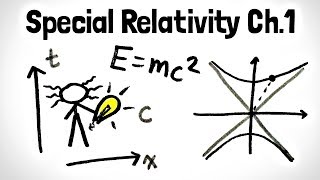
Why is Relativity Hard? | Special Relativity Chapter 1
Feb 1, 2018
Thanks to http://www.brilliant.org/minutephysics for supporting this video! Thanks to my friend Mark Rober (https://www.youtube.com/channel/UCY1kMZp36IQSyNx_9h4mpCg) for making the spacetime globe, and to Grant Sanderson (https://www.youtube.com/3blue1brown) for inspiration. Support MinutePhysics on Patreon! http://www.patreon.com/minutephysics Link to Patreon Supporters: http://www.minutephysics.com/supporters/ This is the first in a series of videos about special relativity. This is definitely not an academic course, but it's going to be a more in depth and developed exploration of a single topic than a typical standalone MinutePhysics video. I've been greatly inspired (and heckled) to do this by my friend Grant Sanderson of 3blue1brown who's set the standard for this kind of thing with his excellent series - serieses? - on calculus and linear algebra. So, special relativity. Special relativity is one of the most popularly famous ideas in physics – it's that thing that Einstein figured out about the speed of light and space and time and E=mc^2! It changed our understanding of the universe. And its core ideas are accessible in principle to anyone who understands some basic algebra and geometry - you don't even need to know calculus! And yet in spite of this, special relativity is one of the subjects in physics that confuses the most people, and in many cases turns them away from physics altogether. MinutePhysics is on twitter - @minutephysics And facebook - http://facebook.com/minutephysics And Google+ (does anyone use this any more?) - http://bit.ly/qzEwc6 Minute Physics provides an energetic and entertaining view of old and new problems in physics -- all in a minute! Created by Henry Reich