 Otwórz w Clue
Filmy do nauki angielskiego102
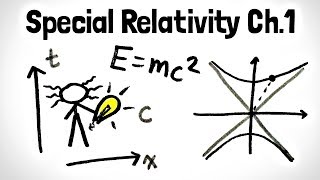
Why is Relativity Hard? | Special Relativity Chapter 1
1 lut 2018
Thanks to http://www.brilliant.org/minutephysics for supporting this video! Thanks to my friend Mark Rober (https://www.youtube.com/channel/UCY1kMZp36IQSyNx_9h4mpCg) for making the spacetime globe, and to Grant Sanderson (https://www.youtube.com/3blue1brown) for inspiration. Support MinutePhysics on Patreon! http://www.patreon.com/minutephysics Link to Patreon Supporters: http://www.minutephysics.com/supporters/ This is the first in a series of videos about special relativity. This is definitely not an academic course, but it's going to be a more in depth and developed exploration of a single topic than a typical standalone MinutePhysics video. I've been greatly inspired (and heckled) to do this by my friend Grant Sanderson of 3blue1brown who's set the standard for this kind of thing with his excellent series - serieses? - on calculus and linear algebra. So, special relativity. Special relativity is one of the most popularly famous ideas in physics – it's that thing that Einstein figured out about the speed of light and space and time and E=mc^2! It changed our understanding of the universe. And its core ideas are accessible in principle to anyone who understands some basic algebra and geometry - you don't even need to know calculus! And yet in spite of this, special relativity is one of the subjects in physics that confuses the most people, and in many cases turns them away from physics altogether. MinutePhysics is on twitter - @minutephysics And facebook - http://facebook.com/minutephysics And Google+ (does anyone use this any more?) - http://bit.ly/qzEwc6 Minute Physics provides an energetic and entertaining view of old and new problems in physics -- all in a minute! Created by Henry Reich
How We Know Black Holes Exist
11 sty 2018
Thanks to the James Webb Space Telescope (JWST) and Space Telescope Science Institute for supporting this video. Support MinutePhysics on Patreon! http://www.patreon.com/minutephysics Link to Patreon Supporters: http://www.minutephysics.com/supporters/ This video is about the astronomical amount of astronomical evidence for black holes, ranging from x-ray binaries with accretion disks, supermassive infrared-radiating galactic nuclei black holes, orbital characteristics of high mass binaries, and direct gravitational wave detection of inspiraling merging black hole binaries with LIGO. Yes, they're real. REFERENCES Interactive: Masses in the Stellar Graveyard https://ligo.northwestern.edu/media/mass-plot/index.html Galactic Center Orbital Models and Inner Stellar Distributions Data provided by Andrea Ghez and Sylvana Yelda, UCLA (obtained with the Keck Telescopes) Visualization by Stuart Levy and Robert Patterson, National Center for Supercomputing Applications, University of Illinois at Urbana-Champaign http://avl.ncsa.illinois.edu/astrophysics/galactic-center-orbital-models-and-inner-stellar-distributions Masses of observed black Holes: https://stellarcollapse.org/bhmasses Downloadable LIGO Data: https://losc.ligo.org/events/GW170817/ LIGO Neutron Star Binary Merger: http://www.astronomy.com/news/2017/10/ligo-detects-a-neutron-star-merger Masses of observed neutron stars: https://stellarcollapse.org/nsmasses Cygnus X-1 X-ray binary Black Hole: https://en.wikipedia.org/wiki/Cygnus_X-1#Star_system Lecture notes on black holes: http://eagle.phys.utk.edu/guidry/astro616/lectures/lecture_ch18.pdf Calvera isolated neutron star X-ray source: https://en.wikipedia.org/wiki/Calvera_(X-ray_source) Scientific American: pulsar that behaves like a black hole https://www.scientificamerican.com/article/black-hole-pretenders-may-be-superfast-spinning-pulsars/ Largest known neutron star: https://en.wikipedia.org/wiki/PSR_J0348%2B0432 http://simbad.u-strasbg.fr/simbad/sim-id?Ident=PSR+J0348%2B0432 Large Neutron Star: https://arxiv.org/abs/0712.0024 Wandering Black Hole: https://www.nasa.gov/mission_pages/chandra/x-ray-telescopes-find-evidence-for-wandering-black-hole.html Sagittarius A* Black Hole Infrared emissions: https://arxiv.org/pdf/0911.4659.pdf MinutePhysics is on twitter - @minutephysics And facebook - http://facebook.com/minutephysics And Google+ (does anyone use this any more?) - http://bit.ly/qzEwc6 Minute Physics provides an energetic and entertaining view of old and new problems in physics -- all in a minute! Created by Henry Reich

The Unreasonable Efficiency of Black Holes
31 gru 2017
Thanks to https://brilliant.org/minutephysics for sponsoring this video! Check out their black hole course at http://brilliant.org/minutephysicsblackhole Support MinutePhysics on Patreon! http://www.patreon.com/minutephysics Link to Patreon Supporters: http://www.minutephysics.com/supporters/ This video is about how efficient various reactions are at converting mass to energy (as we know from the Einstein mass-energy equivalence of E=mc^2). Antimatter is very efficient but it is not naturally-occurring. Chemical reactions like fire or explosions are very inefficient. Nuclear fission and nuclear fusion are better, but not amazing on an absolute scale. Non-rotating black holes (Schwarzschild) and rotating (Kerr) are by far the most efficient, due to their accretion disks and very small radius of their innermost stable circular orbits. REFERENCES: Periodic Videos Hydrogen Explosion in slow motion: https://www.youtube.com/watch?v=qOTgeeTB_kA CIA World Factbook Norway Energy Consumption: https://web.archive.org/web/20120128032332/https://www.cia.gov/library/publications/the-world-factbook/rankorder/2042rank.html Binding Energy: https://en.wikipedia.org/wiki/Binding_energy Hydrogen molecular bonding: https://ocw.mit.edu/courses/chemistry/5-73-introductory-quantum-mechanics-i-fall-2005/lecture-notes/sec13.pdf Gibbs free energy of water formation: https://en.wikipedia.org/wiki/Standard_Gibbs_free_energy_of_formation Party Balloon Size Chart: https://broadwaypartyrental.com/wp-content/uploads/HELIUM-BALOON-CHART.pdf Mass Excess https://en.wikipedia.org/wiki/Mass_excess Table of Mass Excesses: http://www.nndc.bnl.gov/masses/mass.mas12 Deuterium-Tritium Hydrogen Fusion Energy Released: http://www.wolframalpha.com/input/?i=((deuterium+atomic+mass)%2B(tritium+atomic+mass)-(helium-4+atomic+mass)-(neutron+mass))%2F((deuterium+atomic+mass)%2B(tritium+atomic+mass)) Hydrogen to Helium Fusion chain efficiency: http://www.wolframalpha.com/input/?i=(4(proton+mass)-(helium+4+atomic+mass))%2F(4(proton+mass)) Uranium-235 fission efficiency: http://www.wolframalpha.com/input/?i=(neutron+mass%2B(uranium+235+atomic+mass)-(krypton+92+atomic+mass)-(barium+141+atomic+mass)-3(neutron+mass))%2F(neutron+mass%2B(uranium+235+atomic+mass)) Black Hole Accretion rates: http://www-astro.physics.ox.ac.uk/~garret/teaching/lecture7-2012.pdf MinutePhysics is on twitter - @minutephysics And facebook - http://facebook.com/minutephysics And Google+ (does anyone use this any more?) - http://bit.ly/qzEwc6 Minute Physics provides an energetic and entertaining view of old and new problems in physics -- all in a minute! Created by Henry Reich

The Black Hole Tipping Point
30 lis 2017
Thanks to https://brilliant.org/minutephysics/ for sponsoring this video! Check out their black hole course at https://brilliant.org/minutephysicsblackhole Support MinutePhysics on Patreon! http://www.patreon.com/minutephysics Link to Patreon Supporters: http://www.minutephysics.com/supporters/ This video is about the Schwarzschild radius of a black hole, (its "event horizon"), and how much mass and density is required to reach the point of no return where an object like a star, neutron star, red giant, etc will collapse into a black hole singularity. You can calculate it yourself using just the volume equation for a sphere, and the equation for the Schwarzschild radius (and knowing the speed of light and Newton's gravitational constant). REFERENCES Lecture notes on black holes: http://eagle.phys.utk.edu/guidry/astro616/lectures/lecture_ch18.pdf Mass of cat: https://www.google.com/search?q=mass+of+cat&oq=mass+of+cat Schwarzschild radius: https://en.wikipedia.org/wiki/Schwarzschild_radius LIGO Neutron Star Binary Merger: http://www.astronomy.com/news/2017/10/ligo-detects-a-neutron-star-merger Tolman-Oppenheimer-Volkoff Limit: https://en.wikipedia.org/wiki/Tolman%E2%80%93Oppenheimer%E2%80%93Volkoff_limit Neutron Star Equation of State & Density: http://chimera.roma1.infn.it/OMAR/dottorato/papers/annurev-nucl-102711-095018.pdf Neutron Star Radius: http://citeseerx.ist.psu.edu/viewdoc/download?doi=10.1.1.928.903&rep=rep1&type=pdf MinutePhysics is on twitter - @minutephysics And facebook - http://facebook.com/minutephysics And Google+ (does anyone use this any more?) - http://bit.ly/qzEwc6 Minute Physics provides an energetic and entertaining view of old and new problems in physics -- all in a minute! Created by Henry Reich
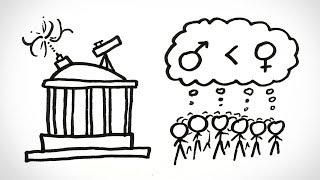
Are University Admissions Biased? | Simpson's Paradox Part 2
31 paź 2017
Simpson's Paradox Part 2. Thanks to Skillshare for supporting this video! Head to http://skl.sh/minutephysics for your first two months free. Comments disabled because the discourse failed to remain civil. This video is about how to tell whether or not university admissions are biased using statistics: aka, it's about Simpson's Paradox again! REFERENCES: Original Berkeley Grad Admissions Paper: https://www.unc.edu/~nielsen/soci708/cdocs/Berkeley_admissions_bias.pdf Interactive Simpson’s Paradox Explainer: http://vudlab.com/simpsons/ No Lawsuit, But Yes, Berkeley Study on Gender Bias https://www.refsmmat.com/posts/2016-05-08-simpsons-paradox-berkeley.html Statistics on college majors by gender: https://nces.ed.gov/programs/digest/2016menu\_tables.asp http://www.npr.org/sections/money/2014/10/28/359419934/who-studies-what-men-women-and-college-majors http://www.randalolson.com/2014/06/14/percentage-of-bachelors-degrees-conferred-to-women-by-major-1970-2012/ Earnings by college major: http://time.com/money/collection-post/3829776/heres-what-the-average-grad-makes-right-out-of-college/ Wall Street Journal Article on Simpson’s Paradox: https://www.wsj.com/news/articles/SB125970744553071829 Support MinutePhysics on Patreon! http://www.patreon.com/minutephysics Link to Patreon Supporters: http://www.minutephysics.com/supporters/ MinutePhysics is on twitter - @minutephysics And facebook - http://facebook.com/minutephysics And Google+ (does anyone use this any more?) - http://bit.ly/qzEwc6 Minute Physics provides an energetic and entertaining view of old and new problems in physics -- all in a minute! Created by Henry Reich

Time Travel in Fiction Rundown
26 paź 2017
Thanks to YouTube RED’s new original series, LIFELINE, for sponsoring this video. Watch the first episode for free: https://www.youtube.com/watch?v=Ru4zkxNuJ_I And thanks to my friends Sam and Niko (and all the rest) at the Corridor Digital channel for making awesome videos. Support MinutePhysics on Patreon! http://www.patreon.com/minutephysics Link to Patreon Supporters: http://www.minutephysics.com/supporters/ For ages I’ve been thinking about doing a video analyzing time travel in fiction and doing a comparison of different fictional time travels – some do use wormholes, some relativistic/faster than light travel with time dilation, some closed timelike curves, some have essentially “magic” or no consistent rules that make any sense, or TARDIS's, or whatever. This video is an explanation of how time travel functions in different popular movies, books, & shows – not how it works “under the hood", but how it causally affects the perspective of characters’ timelines (who has free will? can you change things by going back to the past or forwards into the future?). In particular, I explain Ender's Game, Planet of the Apes, Harry Potter and the Prisoner of Azkaban, Primer, Bill & Ted’s Excellent Adventure, Back to the Future, Groundhog Day, Looper, the video game “Braid”, and Lifeline. MinutePhysics is on twitter - @minutephysics And facebook - http://facebook.com/minutephysics And Google+ (does anyone use this any more?) - http://bit.ly/qzEwc6 Minute Physics provides an energetic and entertaining view of old and new problems in physics -- all in a minute! Created by Henry Reich

Simpson's Paradox
24 paź 2017
Thanks to https://brilliant.org/minutephysics for sponsoring this video! This video is about Simpson's paradox, a statistical paradox and ecological fallacy where seemingly contradictory results are implied by a single set of data depending on how it's grouped. The paradox can arise in medical studies, student test scores, and so on. Support MinutePhysics on Patreon! http://www.patreon.com/minutephysics Link to Patreon Supporters: http://www.minutephysics.com/supporters/ REFERENCES: Interactive Simpson’s Paradox Explainer: http://vudlab.com/simpsons/ Wisconsin vs Texas schools: http://educationnext.org/are-wisconsin-schools-better-than-those-in-texas/ Detailed analysis of Wisconsin vs Texas schools: http://iowahawk.typepad.com/iowahawk/2011/03/longhorns-17-badgers-1.html National US Standardized Test Data: https://nces.ed.gov/nationsreportcard/naepdata/report.aspx?p=2-SCI-3-20153,20113,20093-SRPUV-SDRACE-NP,AL,AK,AZ,AR,CA,CO,CT,DE,DC,FL,GA,HI,ID,IL,IN,IA,KS,KY,LA,ME,MD,MA,MI,MN,MS,MO,MT,NE,NV,NH,NJ,NM,NY,NC,ND,OH,OK,OR,PA,RI,SC,SD,TN,TX,UT,VT,VA,WA,WV,WI,WY,DS-MN_MN-Y_J-0-0-5 MinutePhysics is on twitter - @minutephysics And facebook - http://facebook.com/minutephysics And Google+ (does anyone use this any more?) - http://bit.ly/qzEwc6 Minute Physics provides an energetic and entertaining view of old and new problems in physics -- all in a minute! Created by Henry Reich

How to Build a Teleporter with Aliens
30 wrz 2017
The first 200 people to use http://skl.sh/minutephysics30 get 30% off a premium Skillshare subscription. Support MinutePhysics on Patreon! http://www.patreon.com/minutephysics Link to Patreon Supporters: http://www.minutephysics.com/supporters/ This video is about the international system of units (SI), the international prototype kilogram (the IPK or "le grande k"), and specifically, why we need to redefine our base units in terms of fundamental constants - aka, concepts & ideas - rather than physical objects. The second is already defined in terms of a certain number of oscillations of a photon of the ground state hyperfine splitting energy of Cesium, the meter is then defined as how far light travels in a particular fraction of a second, and hopefully soon, the kilogram will be defined either using the Avogadro approach of counting silicon atoms in a sphere, or using the Watt (Kibble) Balance approach of measuring Planck's constant, h, as used in the formula E=hf for the energy of a photon, which relates to mass via Einstein's famous E=mc^2. REFERENCES: Most Recent Kilogram/Planck Constant Measurement: https://www.nist.gov/news-events/news/2017/06/new-measurement-will-help-redefine-international-unit-mass International Bureau of Weights and Measures page: http://www.bipm.org/en/measurement-units/base-units.html Future Definitions of SI Base Units: http://www.bipm.org/en/measurement-units/rev-si/ Resolution to redefine Kilogram, ampere, kelvin and mole based on fundamental constants: http://www.bipm.org/en/CGPM/db/25/1/ Hyperfine levels of an atom (Cesium, in this case): https://en.wikipedia.org/wiki/Energy_level#Hyperfine_structure https://en.wikipedia.org/wiki/Hyperfine_structure Cesium: https://en.wikipedia.org/wiki/Caesium#Atomic_clocks Atomic Clocks: https://en.wikipedia.org/wiki/Atomic_clock MinutePhysics is on twitter - @minutephysics And facebook - http://facebook.com/minutephysics And Google+ (does anyone use this any more?) - http://bit.ly/qzEwc6 Minute Physics provides an energetic and entertaining view of old and new problems in physics -- all in a minute! Created by Henry Reich

Solar Panels Made With a Particle Accelerator?!
19 wrz 2017
Find more about investing in Rayton solar on http://startengine.com/startup/rayton-solar And on http://www.RaytonSolar.com Support MinutePhysics on Patreon! http://www.patreon.com/minutephysics Link to Patreon Supporters: http://www.minutephysics.com/supporters/ This video is about using particle accelerators as part of the solar panel silicon wafer manufacturing process. The accelerators embed protons into the wafer crystals, allowing them to break and separate from the main crystal in much thinner wafers with no waste silicon. Thus, monocrystalline silicon can be used, which is more efficient. MinutePhysics is on twitter - @minutephysics And facebook - http://facebook.com/minutephysics And Google+ (does anyone use this any more?) - http://bit.ly/qzEwc6 Minute Physics provides an energetic and entertaining view of old and new problems in physics -- all in a minute! Created by Henry Reich

Bell's Theorem: The Quantum Venn Diagram Paradox
13 wrz 2017
Featuring 3Blue1Brown Watch the 2nd video on 3Blue1Brown here: https://www.youtube.com/watch?v=MzRCDLre1b4 Support MinutePhysics on Patreon! http://www.patreon.com/minutephysics Link to Patreon Supporters: http://www.minutephysics.com/supporters/ This video is about Bell's Theorem, one of the most fascinating results in 20th century physics. Even though Albert Einstein (together with collaborators in the EPR Paradox paper) wanted to show that quantum mechanics must be incomplete because it was nonlocal (he didn't like "spooky action at a distance"), John Bell managed to prove that any local real hidden variable theory would have to satisfy certain simple statistical properties that quantum mechanical experiments (and the theory that describes them) violate. Since then, GHZ and others have managed to extend the theoretical work, and Alain Aspect performed the first Bell test experiment in the late 1980s. Thanks to Vince Rubinetti for the music: https://soundcloud.com/vincerubinetti/one-two-zeta And thanks to Evan Miyazono, Aatish Bhatia, and Jasper Palfree for discussions and camaraderie during some of the inception of this video. REFERENCES: John Bell's Original Paper: http://inspirehep.net/record/31657/files/vol1p195-200_001.pdf Quantum Theory and Reality: https://www.scientificamerican.com/media/pdf/197911_0158.pdf "What Bell Did" By Tim Maudlin: https://arxiv.org/pdf/1408.1826 Bell's Theorem on Wikipedia: https://en.wikipedia.org/wiki/Bell%27s_theorem 2015 experimental confirmation that QM violates Bell's theorem: https://arxiv.org/pdf/1508.05949.pdf https://journals.aps.org/prl/abstract/10.1103/PhysRevLett.115.250402 Bell's Theorem without Inequalities (GHZ): http://dx.doi.org/10.1119/1.16243 Kochen-Specker Theorem: https://en.wikipedia.org/wiki/Kochen–Specker_theorem MinutePhysics is on twitter - @minutephysics And facebook - http://facebook.com/minutephysics And Google+ (does anyone use this any more?) - http://bit.ly/qzEwc6 Minute Physics provides an energetic and entertaining view of old and new problems in physics -- all in a minute! Created by Henry Reich

Myths and Facts About Superintelligent AI
29 sie 2017
Join the AI conversation: http://AgeofAI.org This video was based on Max’s book "Life 3.0”, which you can find at: http://amzn.to/2iEwe6w Support MinutePhysics on Patreon! http://www.patreon.com/minutephysics Link to Patreon Supporters: http://www.minutephysics.com/supporters/ We live in an era of self driving cars, autonomous drones, deep learning algorithms, computers that beat humans at chess and go, and so on. So it’s natural to ask, will artificial superintelligence replace humans, take our jobs, and destroy human civilization? Or will AI just become tools like regular computers. AI researcher Max Tegmark helps explain the myths and facts about superintelligence, the impending machine takeover, etc. MinutePhysics is on twitter - @minutephysics And facebook - http://facebook.com/minutephysics And Google+ (does anyone use this any more?) - http://bit.ly/qzEwc6 Minute Physics provides an energetic and entertaining view of old and new problems in physics -- all in a minute! Created by Henry Reich

Misconceptions Footnote †: Randomness and Feedback
17 sie 2017
Footnote to the main video here: https://youtu.be/HUti6vGctQM Feedback loops and spurious correlations! REFERENCES: Spurious correlations: http://www.tylervigen.com/spurious-correlations Loopy by Nicky Case: http://ncase.me/loopy/ CERN/CMS paper on di-photon excess: https://cds.cern.ch/record/2139899 Support MinutePhysics on Patreon! http://www.patreon.com/minutephysics Link to Patreon Supporters: http://www.minutephysics.com/supporters/ MinutePhysics is on twitter - @minutephysics And facebook - http://facebook.com/minutephysics And Google+ (does anyone use this any more?) - http://bit.ly/qzEwc6 Minute Physics provides an energetic and entertaining view of old and new problems in physics -- all in a minute! Created by Henry Reich